Gulls
Where the Crawdads SingGulls are among the most constant living presences in Kya’s life, accompanying her from childhood through the final scenes of the novel. She calls them, feeds them, and seeks their company when people have left or become dangerous. Their significance lies not in any humanlike understanding attributed to them, but in their recurring physical presence: they arrive at the shore, settle beside her, and carry on with the ordinary business of being birds. For Kya, that company becomes part of what makes the marsh feel like family and home.
First Encounters and Childhood
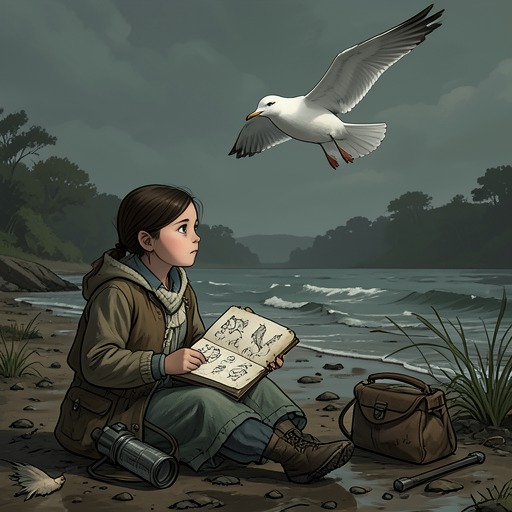
Kya cannot remember her birth date. Because Ma had said the autumn moon appeared for her birthday, Kya eventually decides that the harvest moon means she has turned seven. The next morning, still hoping Ma will return, she puts on her calico dress and watches the lane. When no one comes, she carries grits through the woods to the seashore and calls out to the birds. Silver specks appear from along the beach and over the surf. She throws them food, and as the noisy flock circles, dives, and gathers near her, she tells one large gull that it is her birthday. The birds do not make the day less lonely by changing what has happened; they give her someone to address when no one else has come.
The connection returns after Kya’s first day at school. On the bus ride home, other girls mock her as a marsh hen and swamp rat. She runs from the stop past the shack and through the woods to the beach, where she calls to the birds above the roar of the waves. This time she throws piecrust and yeast rolls onto the sand. Some gulls peck gently between her toes, making her laugh until the laughter gives way to sobbing. She fears that they, too, will leave her, as everyone else has. But they remain nearby, preening their outstretched gray wings. Kya sits among them and imagines bringing them home to sleep together in her bed. The scene joins comfort to vulnerability: their nearness matters precisely because she cannot be certain that anything she loves will stay.
Companionship and the Marsh as Home
As Kya grows older, feeding the Gulls remains part of her life. At fourteen, she still throws them crumbs from the beach and still cannot count them. The detail makes the ritual feel less like a childhood game that has ended than a habit carried forward into a life shaped by work and self-reliance. She may be unable to number the flock, but she knows how to call and feed it; familiarity takes the place of measurement.
The birds also figure in her decision to remain in the marsh. When she considers going to town and turning herself in to the authorities in exchange for food and schooling, she rejects the idea because she cannot leave the Gulls, a heron, and the shack behind. She understands the marsh as the family she has. That attachment is not only an abstract love of landscape: it includes repeated acts of care toward particular living surroundings, among them the birds she has called to the shore since childhood.
At moments of danger, the beach and the birds continue to offer a place where Kya can pause. When she sees Chase Andrews’s ski boat racing toward the channel to her home, she is on the open beach with the Gulls. Big Red lands on the bow of her boat, and Kya laughs before coming ashore to toss crumbs. Chase does not see her as he passes toward the channel. The birds do not knowingly protect her, but her established habit of stopping with them leaves her away from home when he arrives. Later, after hiding from him, she takes her bedding to the beach and lies close to the birds as they preen and settle on the sand. Their presence cannot quiet her fear: she wakes repeatedly at sounds like footsteps and recognizes that isolation is different from living in fear. The episode shows the limit as well as the force of their companionship. The birds are no substitute for safety, but they remain the company she can reach.
Separation, Return, and Continuity
Kya’s imprisonment separates her from the familiar life organized around the marsh and its birds. From her cell, she can look through barred glass toward the sea and the marsh’s edge, but the view is not the same as standing on the shore among the Gulls. Her isolation becomes especially stark when she realizes that the sheriff’s offer of a phone call does not provide her with an easy human connection. The birds, by contrast, remain part of the home to which she longs to return.
When Tate visits, Kya asks him to feed the Gulls if he is near her place. He tells her he has been doing so every other day or so; in fact, he has gone to feed them at dawn and dusk. His care preserves a daily connection between Kya’s confinement and the life outside it, and it takes the form of continuing an act she herself had long performed. The request is modest, but it ties her attachment to the birds to a relationship in which another person can act on her behalf.
After her release, Jodie drives Kya back along the sandy marsh road. She rushes into the shack, touches familiar things, and finds the crumbs Jodie has left for her. Then she runs to the beach, where the Gulls fly toward her from up and down the shore. Big Red lands and walks about as she tosses the crumbs. Kya trembles among the birds and cries. This return answers the earlier scenes of waiting and feared abandonment not by erasing them, but by restoring the familiar exchange: Kya brings food, and the birds gather around her.
The Gulls appear again after Kya’s death. At the beach, Tate holds the shell associated with her and lets it fall among the others; then the birds spiral above him, calling. The moment returns the novel to the sounds and presences that accompanied Kya throughout her life. Their call does not explain her death or disclose her secrets. It places Tate, briefly, within the same living landscape that had been Kya’s refuge.
Natural Life and Narrative Significance
Kya’s attention to animals is grounded in observation rather than sentiment alone. She watches how female Fireflies use distinct flashing patterns to attract males, and how one female changes her signal to draw in and eat a male of another species. She concludes that human ideas of good and evil do not govern such acts in nature. That broader perspective helps clarify how the Gulls function in the novel: they are not presented as moral judges, rescuers, or symbols with a single fixed meaning. Their characteristic actions in Kya’s story are concrete—circling, landing, pecking, preening, settling, and calling.
The contrast between their independent lives and Kya’s need for company gives the recurring scenes their emotional depth. She can tell a gull about her birthday and imagine the flock in her bed, but the narrative does not suggest that the birds comprehend her words or her losses. Instead, their continued presence offers a form of companionship that does not depend on explanation. As a child and as an adult, Kya returns to the shore and feeds them; during her absence, Tate keeps the practice going; after her death, they call above him. Through these repetitions, the Gulls link childhood loneliness, chosen home, separation, and return without turning the birds into human substitutes.