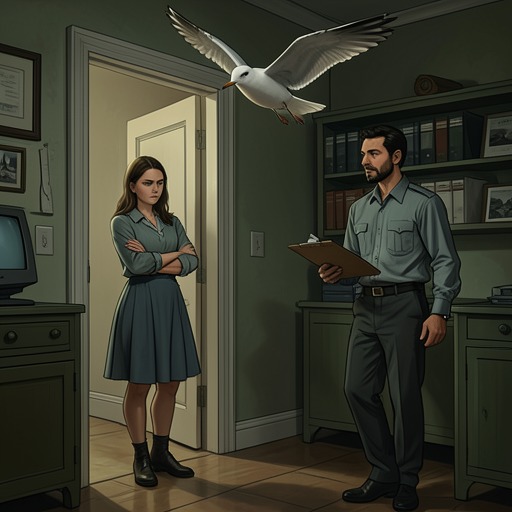
Kya Clark Is Arrested and Held in Custody
Where the Crawdads SingKya Clark’s arrest and pretrial confinement place her in a starkly bounded world: a barred cell at the edge of town, the sea glimpsed through a high window, and the marsh visible only at a distance. Held without bail for two months after a failed attempt to escape the sheriff in her boat, she faces the murder accusation largely alone. The jail does more than remove her from the marsh; it makes visible how deeply abandonment has shaped her expectations of care, trust, and survival.
Arrest and confinement
The account establishes the circumstances of Kya’s custody without narrating the mechanics of her arrest. She had tried to escape the sheriff in her boat, and for the two months before trial she was held without bail in the Barkley County Jail. The charge was murder. In custody, the ordinary passage of time becomes difficult to measure: sitting on her bed, Kya wonders whether it is six o’clock, though only an hour—or perhaps less—has passed since court. The trial has not yet begun, but confinement has already become its own ordeal.
The jail occupies a one-story cement-block building behind the sheriff’s office at the edge of town. Its six cells, each twelve feet square, run along one side of the building, arranged so inmates cannot see one another. In Kya’s cell, three damp cement-block walls meet a barred front and locked door. A wooden bed, bumpy cotton mattress, feather pillow, sheets, gray wool blanket, sink, crate-table, and toilet provide the room’s sparse furnishings. A framed picture of Jesus hangs above the sink; a gray plastic curtain, provided because Kya is the first woman held there for more than a night in years, offers limited privacy. These details define a space built to contain bodies and regulate their basic needs, not to accommodate the life Kya has left behind.
A view of the marsh, out of reach
From a window seven feet above the floor, Kya can just see the sea beyond thick glass and bars. To reach the view, she drags her wooden crate beneath the window and stands on it, craning her neck. She watches whitecaps and pelicans, and can make out the dense edge of the marsh if she stretches far enough to the right. The previous day, an eagle had dived and twisted toward a fish. The view keeps the natural world present while making clear that she cannot enter it: birds move freely where she remains confined.
The cell’s small observations become a measure of her separation. Dust motes cross a shaft of murky light and disappear when they reach the shadows; Kya watches their vanishing movement as daylight, unlike her, is free to pass. She studies strands of her hair, plucking them like feathers, and has red, web-like scratches streaking her arms. Recalling an Amanda Hamilton poem about a broken gull, she connects her own barred existence to an image of damaged flight. The comparison does not erase the material conditions of custody; it gives those conditions a language drawn from the birds and marsh she can no longer reach.
Solitude, fear, and refused help
The men in the two cells at the far end of the row cannot see Kya, but their voices carry. They are serving thirty days after a fight over who could spit farthest at the Dog-Gone Beer Hall. Much of their talk is gossip from visitors about Kya’s case, especially the possibility of the death penalty. It had not been imposed in the county for twenty years, and never on a woman. Kya is not frightened by the prospect of being dead, but the thought of being killed by another person according to a planned schedule is so difficult to imagine that it stops her breath. The distinction reveals what the rumor threatens: not death in the abstract, but an imposed, deliberate ending.
Her isolation is also emotional and practical. The sheriff offers her a phone call, but the only number she knows is Jodie Clark’s. She cannot bring herself to call her brother and say she is in jail accused of murder; shame may also hold her back. Kya understands her solitary position through the history of being left to survive and defend herself. She had begun to glimpse a path back toward Tate Walker before her arrest, with love closer to the surface, yet during his several visits she refuses to see him. Even at her most vulnerable, the jail makes trust feel more dangerous, and she turns instead to self-reliance.
The refusal is not simply proof that she no longer cares for Tate. Kya herself cannot say why confinement has closed her heart more tightly. The account places the possibility of comfort beside her inability to accept it, preserving the difference between having someone willing to visit and feeling able to depend on them. Tate has brought biology texts, but she cannot keep their sentences in place: the words seem to wander and circle back. The shell book given to her by Tom Milton remains her most treasured volume, and its pictures are easier to hold in her attention than the textbooks’ prose.
The meaning of custody
The cell intensifies a pattern already established in Kya’s life. Earlier, while Pa sometimes behaved decently and they fished, ate together, or flew a kite, she still remembered the violence that followed his drinking, including his beating her and Ma. She continued to hope Ma would return and that the family might begin again. Later, after Chase Andrews apologized and approached her, he assaulted her; Kya fought him off and eventually told Jumpin’ that Chase had done it. These histories do not make her arrest a repetition of the same event, but they help explain why vulnerability and reliance carry such weight in the cell: Kya has repeatedly had to survive without assurance that others will protect her.
The jail’s physical boundary sharpens the contrast between the marsh as home and confinement as enforced distance. Kya can see the sea and the marsh’s edge but cannot move through them; she can receive a visitor but refuse the comfort offered; she can possess books but find their words slipping away. Later, Tate Walker remembers Scupper Walker’s belief that a man should be able to feel deeply and do whatever it takes to defend a woman. That recollection supplies a retrospective ethical contrast, but it does not undo Kya’s experience of custody: during the two months before trial, she remains isolated in a cell, facing the case and the threat of execution on her own terms.