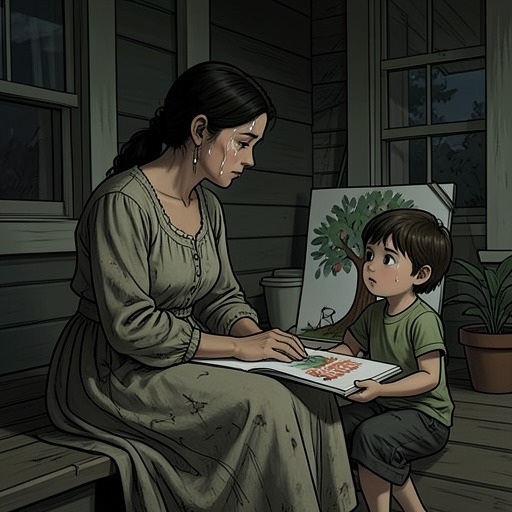
Kya’s abandonment
Where the Crawdads SingKya Clark’s abandonment is not a single departure but a mounting loss of protection: her mother leaves, her siblings follow, and the father who remains becomes both a source of violence and, eventually, another absence. By the time Jake Clark stops coming to the shack, Kya has learned to treat solitude as a practical danger as well as an emotional wound, hiding the truth from others because being discovered could mean being taken away.
A Departure Without Explanation
In 1952, six-year-old Kya is scrubbing grits from a pot when the screen door slaps shut. She knows the sound is wrong: her mother, Ma, does not usually let the door slam. From the porch, Kya sees Ma walking down the sandy lane in her only pair of going-out shoes, fake alligator heels, carrying a blue train case. Ma has previously gone out and returned with food, but the case and the shoes distinguish this departure from those earlier errands.
Kya watches Ma move toward the road through the bog forests and cattail lagoons. Ma has always looked back and waved where the foot lane meets the road; this time she continues on. Kya runs to the place where she expects to see her, but reaches it only in time to glimpse the blue case vanishing among the trees. The conspicuous case disappears into the woods, and Kya returns to the steps to wait. The scene gives her no explanation or assurance, only the changed meaning of familiar signs: the slammed door, the special shoes, and the case indicate that Ma may not return.
Jodie Clark tries to reassure her with the claim that a mother does not leave her children. Kya answers by recalling a fox that left its babies, and Jodie explains that the vixen was injured and had to leave to survive. His comparison makes abandonment legible through the marsh’s logic of survival, but it cannot settle Kya’s fear. He is not certain Ma will come back; he says so for Kya’s sake.
The Family Leaves
Ma does not return that day. Jake Clark says nothing about her absence, asks where supper is, and goes back into the woods after the children shrug. The older girls cook red beans and cornbread, but the family no longer sits together at the table as it did with Ma. Each child takes food elsewhere in the house. The altered meal makes the loss visible in an ordinary household routine: food is prepared, but the gathering that once gave it a shared shape has broken apart.
Over the following weeks, Kya’s oldest brother and two sisters leave as well. They have endured Jake Clark’s rages, which begin in shouting and escalate to punches. Their departure follows Ma’s, and Kya later remembers them by the names Missy, Murph, and Mandy rather than their real names. A small pile of socks left by her sisters remains on her porch mattress, a concrete trace of those who are gone. They are nearly grown, but their leaving also removes potential company and protection from a child who stays behind.
Jodie is the last sibling with Kya. One morning she wakes expecting Ma to be at the stove, but finds Jodie cooking grits and scrambled eggs in lard. He cannot make biscuits, and there is no bacon; still, the two eat alone together, exchanging glances and smiles. The scene briefly establishes care between the siblings, but it cannot restore the family. Later, after Jake Clark has struck Jodie, Jodie tells Kya he has to leave. Kya wants to ask him to stay but cannot get the words out.
Jodie explains that Kya will understand when she is older. She already understands that Jake Clark is why the others have gone; what she cannot understand is why nobody took her with them. She has considered leaving herself, but has nowhere to go and no bus money. Before he departs, Jodie gives her practical instructions: avoid the house if anyone comes, run deep into the marsh, hide in the bushes, and cover her tracks. His warning is a last act of care, yet it also confirms that she will have to manage danger alone. When he walks into the woods, Kya turns to watch him go and tells the waves that the little piggy stayed home.
When Jake Clark Disappears
In the winter of 1956, when Kya is ten, Jake Clark comes to the shack less and less often. Weeks pass without the whiskey bottle, his body sprawled on the bed, or the money he usually brings on Mondays. Kya waits for his limping figure and the poke he carries, then counts one full moon and another since she last saw him. She considers several possibilities: he may have been beaten after a poker-game fight and left in the swamp, or he may have wandered off drunk and fallen in a backwater bog. She does not know what happened; her conclusion is simply that he may be gone for good.
Her response differs from her grief over Ma. Kya struggles to mourn Jake Clark, but recognizes the scale of being completely alone. She expects the authorities to discover that he is gone and take her away, so she decides to pretend, even to Jumpin’, that Jake Clark is still around. Concealment becomes part of her survival: the absence itself is not something she can safely disclose.
The disappearance also removes the Monday money and exposes how little remains. Kya stretches the last few dollars for weeks, eating grits and boiled mussels, with an occasional egg from the rangy hens. By the end, she has only a few matches, a nubbin of soap, and a handful of grits. Matches matter because she needs them to boil the grits she prepares for herself, the gulls, and the chickens. Her fear that she does not know how to live without grits joins an emotional condition to an immediate material fact: family abandonment leaves her dependent on a dwindling supply of food and fuel.
Isolation and Self-Reliance
The successive departures give Kya no single moment in which the family is intact and then suddenly gone. Instead, the losses accumulate: Ma’s case vanishes down the lane; the older siblings leave amid Jake Clark’s violence; Jodie walks away after being struck; and Jake Clark’s visits and money cease. Each departure narrows the help available to her, until even the remaining parent is an absence she must hide.
The marsh is where Jodie teaches Kya to hide, but his instructions cannot replace a home shared with family or the certainty that an adult will return. Kya’s isolation therefore has two connected dimensions: she fears being left alone, and she fears that outside authorities will respond to that condition by removing her. Her decision to conceal Jake Clark’s disappearance is not evidence that she has dependable support; it is a response to the lack of a safe alternative. Abandonment becomes the circumstance in which she must preserve herself, ration what remains, and depend on her own knowledge of the marsh.