Kya’s social exclusion and isolation
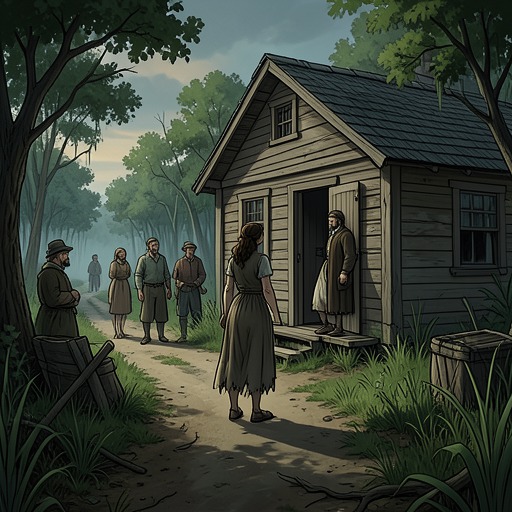
Where the Crawdads SingKya’s social exclusion and isolation take shape across the boundaries between the marsh and Barkley Cove, and between a community’s rumors about an outsider and its willingness to help her. Kya Clark is treated as an object of suspicion and ridicule rather than as a child in need; later, her trial and pretrial confinement make that distance physical. The pattern is not identical for everyone: the town’s racial restrictions explicitly bar Black residents from public spaces, while Kya’s exclusion is tied to her abandonment, poverty, and reputation as the “Marsh Girl.” Together, these forms of exclusion reveal a community that marks some people as outsiders and then treats their marginality as evidence of who they are.
A Town of Boundaries
Barkley Cove’s geography makes it seem cut off from the wider world. Marsh and sea surround it, and a single-lane highway provides its only connection inland. Its businesses are scattered among vacant lots and sea oats rather than joined into a continuous town center. Kya’s first solo trip there to buy groceries means trudging four miles through deep sand or black mud before reaching the village. The distance is practical, but it also gives her arrival the quality of entering a social world in which she has no secure place.
The town’s customs divide that public world further. At Dog-Gone, women and children are not considered welcome inside, though they can order food and Nehi cola from a take-out window. Black residents are denied both the door and the window. That distinction matters: some restrictions are enforced as conventions of propriety, while the racial barrier is more absolute. The storefront offers a concrete measure of who may enter, who must remain outside, and who is refused service altogether.
When Kya encounters boys riding bicycles on the sidewalk, Chase Andrews blames her for getting in their way and calls her “swamp trash.” Miss Pansy rejects his attempt to make Kya the cause of the boys’ wrongdoing and demands that they do a good deed instead. The rebuke momentarily challenges the insult, but it does not create a relationship between Kya and the boys. She knows that Chase’s parents own the Western Auto and has seen him unloading merchandise, yet she has never spoken to him or the others. Her knowledge of their ordinary town lives remains one-sided: she watches from the edge rather than participating in their social world.
Stigma Made Public
The label “Marsh Girl” turns Kya’s separation from the town into a shared story about her. On one night at her shack, after she has watched turkeys and eaten leftover cornbread and beans, boys approach through the woods carrying candles. She realizes there is no back door and that she has waited too long to escape before their lights appear. Their call of “Here we come, Marsh Girl!” makes the nickname an act of intrusion as well as a public identity imposed on her. The scene shows that the stigma travels beyond the village center and reaches her home.
During the murder trial, the courthouse becomes a larger stage for that label. By midmorning the gallery is full, and villagers crowd the remaining spaces to hear evidence and discuss the possibility of the death penalty. The courtroom’s rear balcony seats twenty more; although it is not marked, the understood custom restricts Black people to that space. On this occasion it holds mostly white spectators and only a few Black attendees. The case is treated as a spectacle, with the town’s familiar image of the Marsh Girl shaping the crowd’s interest before the verdict is known.
In his address to the jury, Tom Milton asks the jurors to distinguish the facts of the case from the town’s long history of rumor. He recalls that people called Kya part wolf or a missing link, while describing her instead as an abandoned child who had survived hungry and cold. He also argues that, apart from Jumpin’, no church or community group offered her food or clothes. His speech names a reversal at the heart of her social position: the town treated her as different and excluded her, then used that difference as a reason to continue excluding her. His argument does not erase the allegations in court; it asks the jury not to substitute inherited prejudice for evidence.
Confinement and the Marsh Beyond the Window
Kya’s pretrial isolation gives her social distance a stark physical form. She spends two months without bail in one of six twelve-by-twelve-foot cells in the county jail, after her attempt to escape the sheriff in her boat. The cells stand in a row on one side of the building, arranged so inmates cannot see one another. Damp cement-block walls enclose most of each cell; bars form the fourth wall and the locked door. Kya, the first female inmate other than overnight prisoners in years, is given a gray plastic curtain around the sink and toilet. Even privacy arrives as a limited adjustment within an otherwise controlled space.
The furnishings make the cell’s smallness measurable: a wooden bed, cotton mattress, feather pillow, sheets, gray wool blanket, sink, toilet, and wooden-crate table. The window is seven feet above the floor. Kya pulls the crate beneath it and stands on it to glimpse the sea through thick glass and bars, and to look toward the distant edge of the marsh. Pelicans and whitecaps remain visible, but she can no longer move among the living landscape that has structured her days. The view offers contact without access; the marsh is near enough to see and too far away to reach.
The men held in adjoining cells talk across the space, trading gossip about Kya’s case and the possibility of execution. She hears their words and is not frightened by death as an abstract end; what stops her breath is the prospect of being killed deliberately, by another person’s hand, according to a schedule. In the cell she scratches red marks across her arms and plucks strands of her hair like feathers. Her attention to the birds outside does not dissolve the confinement. Instead, the contrast between their flight and her barred view makes the loss of freedom bodily and immediate.
Isolation, Support, and Belonging
Standing in the cell, Kya thinks that if the people she loved, including Jodie Clark and Tate Walker, had not left her, she would not be there. Her conclusion turns the arrest into a reckoning with older losses: to rely on another person, she feels, is to risk being left on the ground. At the same time, her solitary life has never meant that she felt no loneliness. Before jail she had spent years looking across empty rooms and stretches of sea and grass, with no one beside her to share a found feather or a finished watercolor. She recited poetry to gulls. Those images describe both the richness of her attention and the absence of a human audience for it.
The cell changes the character of that solitude. When the heavy door closes and the jailer disappears down the hall, silence settles around Kya; even the other inmates’ incessant talk had supplied a human presence. Her deeper fear is not simply death but years without the marsh, the gulls, and the sea. The confinement therefore separates her from the place that has taught and sustained her as well as from other people. The novel measures isolation not only by the company Kya lacks, but by the living world from which she is cut off.
After the verdict, the courtroom scene at the back door offers a brief counterimage to that abandonment. Kya thanks Robert Foster for coming from Boston, touches Jumpin’s hand, and is hugged by Mabel. She thanks Tate for what he brought her, and Tom Milton embraces her when she cannot find words. She recognizes Scupper Walker by his eyes, though she has never been introduced to him; he puts a hand on her shoulder and squeezes gently. These gestures do not undo the years of exclusion, but they show people meeting her with care rather than rumor. As Kya leaves, she touches the courthouse cat Sunday Justice’s tail and feels the sea’s breath when the door opens.
Later, Kya understands that years of isolation altered her behavior and made her different from others, but she refuses to treat that difference as a personal failing. Most of what she knows, she learned from the wild; nature nurtured, tutored, and protected her when people did not. Tate’s devotion helps her recognize that human love can exceed the mating contests she observes in marsh life, though she still sees survival instincts persisting in human behavior. Her eventual sense of belonging is therefore not a simple return to society. It is rooted in the marsh and in the natural world that received her when the town did not.