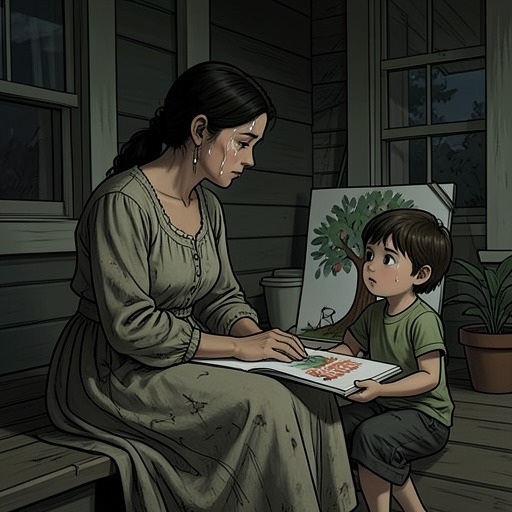
Letter from Ma
Where the Crawdads SingThe Letter from Ma is a blue envelope that gives Kya Clark her first sign in a long time that her absent mother may still be alive, then becomes the object through which Pa prevents her from learning what Ma wrote. Kya never opens it: its contents and postmark are destroyed, leaving her with a handful of ashes and the possibility of an answer she cannot recover.
Arrival and recognition
In early September, during a fishing summer, Kya walks to the mailbox at the end of the lane and finds a blue envelope addressed in Ma’s distinctive hand. The sight stops her among the grocery advertisements. Sycamore leaves are beginning to turn yellow, recalling the season when Ma left; the landscape makes the new arrival feel connected to the old departure, without explaining the years of silence between them.
Kya holds the envelope to the light and runs her fingers over the slanted writing. Her heart pounds. She understands Ma’s handwriting and can make out her own name, but she cannot read enough to know what the letter says. Its arrival nevertheless changes what she thinks she knows: she imagines that Ma is alive somewhere else and wonders why she has not come home. The envelope offers contact, but not an explanation.
Kya does not tear it open. She runs to the shack, where Pa is away in the boat, and props the letter against the saltshaker on the kitchen table so he will see it. While cooking black-eyed peas with onions, she keeps watch over it. She repeatedly goes to the kitchen window to listen for the boat, treating the envelope as something that must remain in view until Pa returns. Her choice to wait for him, rather than open the letter herself, gives him the power to decide whether she will learn its contents.
Pa destroys the message
When Pa comes back, Kya loses her nerve and rushes past him, calling out that she is going to the outhouse and that supper will soon be ready. From the latrine, she watches through a small opening in the door. She does not know exactly what she expects, but she is waiting for his response to the letter without having to face it directly.
The porch door slams. Kya sees Pa walk quickly toward the lagoon with a poke in his hand, then motor away in the boat. When she returns to the kitchen, the letter is gone. She searches his dresser drawers and closet, then looks in the trash and finds the remains: ashes still edged with blue. The act has erased not only Ma’s words but also the envelope that might have shown where it came from.
Kya lifts the ashes out with a spoon and lays them on the table. She picks through the garbage, hoping that some words might have survived, but finds only traces of cinder clinging to thin paper. The peas continue cooking in the pot as she sits beside the small black-and-blue mound. The ordinary supper and the irretrievable message occupy the same kitchen, while the letter’s transformation from readable possibility to refuse makes Pa’s decision materially visible.
The surviving fragment
Kya thinks of the ashes as evidence that Ma touched the letter. That association gives the remains a value the destroyed message can no longer provide: they cannot tell Kya what Ma wrote, but they are a physical trace of her mother’s communication. Kya gathers them into a little bottle and keeps it in her cigar box beside her bed. The box preserves what is left, not the information she wanted.
The missing postmark makes the loss more complete. Because Pa burns the envelope as well as its contents, Kya cannot discover where Ma is by reading its return information. She is left with neither the letter’s words nor a place to which she might direct a reply. What begins as a possible opening into Ma’s life becomes a sealed absence, preserved only in fragments.
Meaning and aftermath
Pa stays away that night and the following day. When he finally returns, he is drunk; Kya gathers the courage to ask about the letter. He tells her it is none of her business and says Ma is not coming back. Kya challenges that assertion, then shouts after him as he walks toward the boat that his grammar is wrong. Her outburst does not restore the letter or obtain an account of its contents. It does show her refusing to accept his statement as the final word on Ma’s absence.
Later, Kya wonders whether she should have opened the envelope herself instead of showing it to Pa. In that imagined alternative, she might have saved Ma’s words and Pa might not have learned of them. The regret turns the unopened letter into a lasting point of uncertainty: Kya cannot know what it said, and the surviving evidence does not establish why Ma sent it or what she intended. The object’s narrative force lies in that gap. It brings the possibility of maternal contact close enough for Kya to touch, then leaves her with a bottle of ashes and no answer.