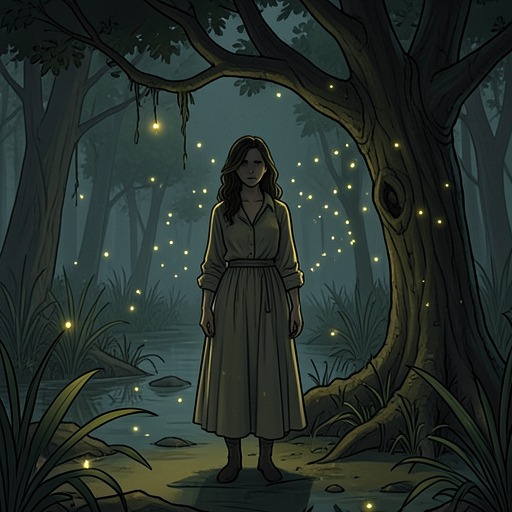
Love is a caged beast
Where the Crawdads Sing“Love is a caged beast” is the central image in a brief poem by Amanda Hamilton that Kya Clark recalls after Tate Walker has left without saying goodbye. Its significance lies in the tension between love as attachment and love as freedom: confined, the beast consumes itself, while the poem imagines love surviving only if it can wander toward its chosen shore and breathe. For Kya, that ideal throws the pain of Tate’s absence into sharp relief, and later resonates with her effort to understand abandonment through the survival patterns she observes in nature.
The Poem and Its Image
Kya remembers Amanda Hamilton’s poem from a recent local newspaper she bought at the Piggly Wiggly. The poem begins, “Trapped inside,” and names its subject directly: “Love is a caged beast, / Eating its own flesh.” It then turns from the image of captivity toward release: “Love must be free to wander, / To land upon its chosen shore / And breathe.” The movement is compact but decisive. Confinement is not presented as protection or stability; it is a condition that makes love feed upon itself. Freedom, by contrast, means movement toward a shore chosen by love, not a place imposed upon it.
The shore and breathing give the poem’s abstraction a physical form. Its image of love is not simply an emotion held in the mind, but something living that needs space and air. The poem’s progression—from being trapped, through self-consumption, to wandering and breath—makes release an apparent condition of life. That image carries particular force in Kya’s memory because its language of chosen movement meets the fact of someone leaving without offering her either an explanation or a goodbye.
Kya’s Memory of Tate
The poem’s words make Kya think of Tate, and her breathing stops. She understands his departure as a choice made in favor of something better: he left for college and did not come back to say goodbye. The poem’s call for love to land upon its “chosen shore” therefore has a double edge. It grants love freedom, but Kya experiences that freedom from the side of the person left waiting. What the poem makes sound like the necessary release of love becomes, in her immediate circumstances, the pain of being abandoned.
That contrast sharpens the distinction between the poem’s ideal and Kya’s experience. Its love is free to choose where it goes; Kya cannot make Tate stay, and the freedom described by the poem offers no assurance that the person left behind will be spared hurt. The image does not resolve the loss. Instead, it gives Kya a language for its bodily effect: at the recollection of Tate, her breathing stops. The poem’s final word, “breathe,” thus stands against the actual response it provokes in her.
The Marsh as a Language of Survival
The image belongs to a larger pattern in Kya’s thinking, in which animals provide ways to observe attraction, signals, and survival without immediately assigning moral judgment. As she watches fireflies at the lagoon, she recalls Jodie Clark’s explanation that females signal readiness to mate through species-specific patterns of light. Kya sees one female attract a male with the proper signal, mate, and then change her flashes to draw a male of another species close enough to eat him. The female gets both a mate and a meal by changing her signals. Kya concludes that judgment has no place in this biological scene: “Biology sees right and wrong as the same color in different light.”
This observation does not make the firefly’s deception identical to Tate’s departure, nor does it establish the poem as a lesson in biology. Rather, the two strands place Kya’s pain beside her habit of looking for patterns in living behavior. The poem describes the damage of love held captive; the fireflies show courtship operating through signals that can attract and deceive. Together, they leave open a difficult distinction between understanding the mechanisms of behavior and deciding what a person owes another. The natural world supplies Kya with comparisons, not a simple verdict on human conduct.
Abandonment, Explanation, and Moral Limits
Kya’s later reflections on Ma extend that search for an explanation. She considers whether extreme stress and danger in Ma’s life with Pa might have activated old survival instincts, recalling the example of a vixen that leaves her kits under severe pressure. Kya reasons that behaviors which seem ruthless may have helped ancestors survive and may persist in human beings. Yet she does not treat this explanation as proof that Ma’s departure was right: she says Ma should have stayed, and remains troubled that Ma did not return or write.
That later reasoning echoes the tension carried by the poem without turning the poem into a defense of abandonment. Kya can imagine why a being might leave under pressure and still distinguish an explanation from forgiveness or justification. Her account of Ma’s departure remains unresolved: understanding possible biological causes does not answer why Ma never came back. In this light, the caged beast is more than a description of heartbreak. It gathers the conflict between attachment and freedom, the need to understand behavior, and the limits of what explanation can repair. The poem offers Kya an image for love’s need to move, but it cannot make the pain of being left disappear.