Natural Laws and Survival
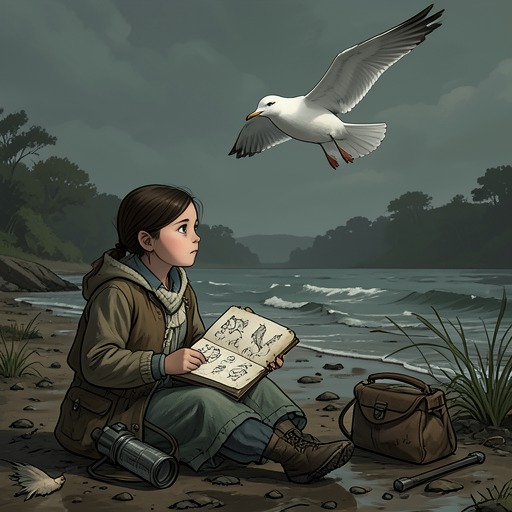
Where the Crawdads SingNatural Laws and Survival names the novel’s recurring idea that life in the marsh follows rules older and less forgiving than written law: when creatures are cornered, isolated, or under pressure, survival can outweigh gentleness. Kya learns these rules by watching animals and by enduring abandonment herself. The idea offers her a language for understanding human behavior, especially her mother’s departure, but it does not turn explanation into absolution: survival may account for a choice without making it right.
The Marsh’s Unwritten Rules
The marsh’s inhabitants are described as keeping their own laws, not written into documents or imposed by formal authority, but embedded in inherited instinct. Under desperation, isolation, or threat, living beings may revert to behaviors that secure survival. In this account, such behavior is not presented as a code of virtue. It is a calculation about which traits and actions are more likely to persist, even when those actions are harsh. The comparison also resists a simple division between peaceful and violent creatures: even doves may fight, while the force of circumstance can make survival more decisive than gentler impulses.
The idea takes on a concrete human cost when Kya is left without dependable care. During one absence of her father, she eats turnip greens from Ma’s garden for three days and discovers that the chicken coop is empty; the flock has escaped into the trees. Later, when she believes her father is gone for good, she fears that authorities will discover her situation and take her away. She decides to pretend, even to Jumpin’, that her father is still present. The last money has run out, and her food and supplies are reduced to grits, boiled mussels, an occasional egg, a few matches, soap, and a handful of grits. Survival here is not an abstract principle: it is food, fire, concealment, and the effort to remain in the only home Kya knows.
Adaptation, Vulnerability, and the Flock
Animal behavior gives the concept its sharpest evidence. Kya remembers a flock of fifteen wild turkeys attacking a hen whose wings have become tangled in briars, leaving her unable to fly. The flock pecks and claws at the injured bird until she dies. Kya has learned from Jodie that a wounded or visibly different bird may attract a predator, putting the others at risk; the flock’s violence is framed as a response to vulnerability that could threaten the group’s survival. Kya runs into the clearing and tries to scatter the birds, but she arrives too late to save the hen. Her intervention establishes an important limit to the survival principle: knowing the logic behind a behavior does not mean being able to stop its consequences.
The fireflies offer a different, more calculated example. As Kya waits for Tate, she observes that female fireflies of different species signal with distinct patterns of flashes. One female first sends the proper signal to attract a male of her own species; after mating, she changes her pattern, draws in a male of another species, and eats him. Kya watches other females use the same kind of deception to secure both a mate and a meal. The scene makes the marsh a source of knowledge in its own right: the animals’ signals, and the consequences of misreading them, become material for Kya’s thinking about attraction and betrayal.
Deception and the Reading of Signals
Kya extends these observations through scientific reading. In a digest article titled “Sneaky Fuckers,” she encounters the contrast between males that win territories through strength or display and weaker males that use posture, concealment, or false signals to obtain mating opportunities. The article’s examples include small bullfrogs hiding near a dominant male’s calls and seizing an opportunity while he is occupied. A related discussion describes female choice and the advantages associated with a mate’s territory, while another offers a limited consolation: males that deceive or move from one female to another often end up alone. Kya connects the argument to Ma’s warning about young men who make noise to advertise themselves. Animal behavior has become a vocabulary through which Kya can assess human courtship, though an analogy is not proof that every human motive follows the same rule.
That distinction matters because the novel uses biological explanation to complicate judgment, not to erase it. Watching the fireflies, Kya recognizes that human categories of good and evil do not map neatly onto behaviors shaped by survival. Yet her reflections on Ma preserve a moral remainder that biology cannot settle. Kya considers whether extreme stress and danger at home drove Ma to leave, just as a starving vixen may abandon her kits and live to breed again. In the account Kya has read, the behavior can increase the mother’s lifetime number of offspring and pass the associated traits onward. She can imagine how pressure might have shaped Ma’s decision; she still believes Ma should have stayed, and cannot understand why she never returned or wrote.
Explanation Without Absolution
Kya’s understanding develops from observation into a way of living with unanswered questions. She recognizes that isolation changes people because she has experienced it herself, and she allows that inherited instincts may persist in humans when circumstances become extreme. This perspective makes forgiveness possible: it lets her imagine Ma’s departure as a response to danger and stress rather than as evidence that Kya was unworthy of love. But it does not supply the missing letter, explain why Ma did not come back, or make the abandonment harmless. Kya can forgive without claiming to understand.
The concept therefore holds two truths together. Nature’s survival strategies can be effective, even when they injure or abandon another creature; human beings may carry impulses shaped by comparable pressures. At the same time, the language of instinct cannot by itself decide what a person ought to have done. The novel’s animal scenes sharpen that tension: Kya cannot rescue the turkey, the firefly’s deception succeeds, and the scientific account offers patterns rather than personal answers. Natural Laws and Survival is ultimately less a declaration that nature is morally right than a framework Kya uses to study the costs of living, to read signals cautiously, and to approach forgiveness without pretending that explanation resolves every wound.