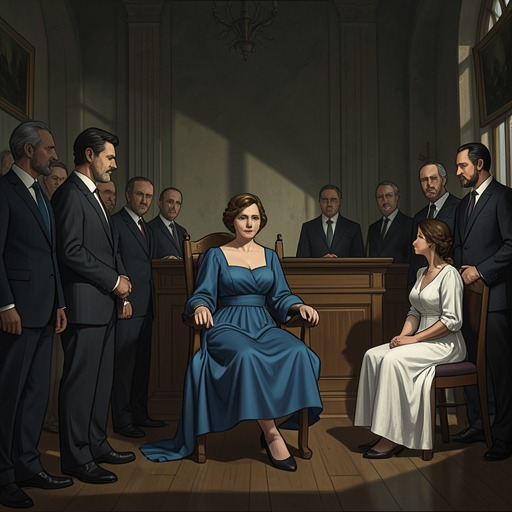
Racial Segregation in the Courtroom Gallery
Where the Crawdads SingRacial Segregation in the Courtroom Gallery is the unwritten custom that reserved the rear balcony of the Barkley Cove courtroom for Black spectators. During the murder trial, the practice becomes visible as a physical division in a packed public room, reflecting a wider pattern of racial exclusion in the town.
The Unwritten Arrangement
The courtroom’s balcony was not marked as segregated, but the seating rule was understood: Black spectators were restricted to the rear, while the main gallery filled with villagers. The custom did not need a posted notice to regulate where people could sit; its force lay in shared expectation and routine.
The balcony held twenty people. At 9:45 a.m. during the trial, the gallery was overflowing, yet the balcony was occupied mostly by white spectators, with only a few Black people present. The division therefore worked not simply by assigning a separate area, but by making racial access to the room unequal even when the public gallery was crowded.
The Practice During the Trial
The seating custom frames the trial as a town spectacle. Villagers filled the pews and gathered along the walls and windows, buzzing about the evidence and the death penalty. Journalists from the Atlanta Constitution and the Raleigh Herald sat in a section near the front. In this audience, the defendant’s case was treated as a white case through and through, while Black spectators remained concentrated in the balcony.
The contrast between a largely white audience and the small number of Black people in the designated rear space makes the segregation legible without a sign or formal announcement. The courtroom is a civic venue where the proceedings are public, but the customary arrangement sorts that public by race.
Wider Pattern and Significance
The courtroom practice has a counterpart in Barkley Cove’s commercial life. On Main Street, Dog-Gone offered a take-out window for women and children who were not considered welcome inside, but Black people could use neither the door nor the window. The different restrictions share a public logic: access is controlled through ordinary customs and arrangements, with racial exclusion imposed more completely than the gendered limits described at the beer hall.
The narrative presents gallery segregation as a settled local convention rather than a rule announced in court. Its quietness is part of its significance: an unmarked balcony can still enforce a clear boundary. Set against the trial’s crowded attention and public claims to justice, the seating arrangement exposes the unequal terms on which Barkley Cove’s residents occupy shared civic space.