Sally Culpepper
Where the Crawdads SingSally Culpepper is Barkley County’s longtime truant officer, a figure whose official connection to Kya Clark reaches from Kya’s years avoiding school attendance into the courtroom where she is tried for murder. Their history is defined less by direct confrontation than by a revealing moment of restraint: Sally once saw Kya hiding from a pursuing officer and did not give her away. At trial, she acknowledges that history openly, then says she can judge the case on its evidence. Her final response to the acquittal quietly recalls the girl she had once seen escape.
Identity and Public Role
Sally tells the judge that she served as Barkley County’s truant officer for nearly twenty-five years and that Kya was one of her cases. The wording makes their connection official but not intimate: Sally had dealings with Kya, or tried to, as part of her work enforcing school attendance. The qualification matters. Kya’s history with authority was not simply a sequence of successful interventions; Sally’s brief account suggests the distance between the office charged with locating her and the child who stayed beyond its reach.
At jury selection, Sally sits in the middle of the second row. Her gray hair is pulled tightly into a small knot, and her hat, suit, and shoes are all a dull brown. The restrained description makes her readily visible as an older, formally dressed community member, but the important fact is her position in the proceedings: when the judge asks whether anyone has a close past relationship with Kya or Chase Andrews that might compromise impartiality, Sally raises her hand and identifies herself rather than letting her connection pass unmentioned.
The Earlier Encounter
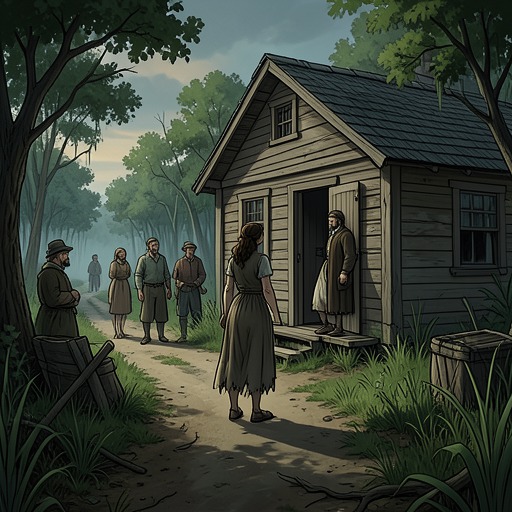
Kya’s recollection supplies the human detail behind Sally’s official description. On an earlier occasion, Sally was sitting in a car while a man in a fedora tried to chase Kya down. Kya did not simply flee without regard for her pursuers: she ran noisily through brambles to give the man a clue, then circled back and hid in bushes beside the car. From there, she shook a holly branch against the door, and Sally looked directly into her eyes through the window.
Kya thought Sally smiled slightly. That impression is explicitly uncertain, but the consequential action is clear: Sally made no attempt to reveal Kya’s hiding place. When the man returned, cursing, and then drove away for good, Kya remained undiscovered. The episode complicates the idea of Sally as only an agent of compulsory attendance. In this encounter she sees the child she is meant to locate and does not turn that sighting into capture. The narrative does not explain her reason, so her restraint remains significant without becoming a claim about her motives.
Disclosure During Jury Selection
During Kya’s murder trial, Sally tells the judge about her former work and admits uncertainty about whether those dealings should disqualify her. The judge’s question is not whether she once knew Kya, but whether she can hear the testimony and decide guilt or innocence from the evidence rather than from past experience or personal feeling. Sally answers that she can, and the judge allows her to remain on the jury.
The exchange gives her brief appearance procedural weight. She neither conceals the connection nor claims that it means nothing; instead, she places the uncertainty before the court and accepts the test of impartiality. The distinction is important in a trial surrounded by public attention and gossip. The courtroom gallery is packed, and Kya is already a figure of intense local scrutiny. Sally’s account connects that public case to an earlier, quieter history in which Kya was a truant she had attempted, without success, to deal with.
Acquittal and Narrative Significance
When the jury finds Kya not guilty, the courtroom reacts unevenly. Among the responses, Sally sheds a lone tear and then wears what the narration describes as a shadow of a smile, thinking of the little truant escaping again. The image reaches back to the encounter by the car: once more, Kya has slipped beyond an authority that might have contained her. But the outcome is different. This time the escape is not from a truant officer’s pursuit; it is from a murder conviction and two months of confinement before trial.
Sally’s response does not erase the formality of her role or establish what she believes about the evidence. It does, however, suggest that the earlier encounter remains part of how she sees Kya. The tear and smile hold together concern and relief without spelling either out as a definitive judgment. Through Sally, the novel gives Kya’s history with local authority a small but telling counterpoint: an officer charged with enforcing attendance once chose not to expose her, later disclosed their connection in court, and watched her leave free.