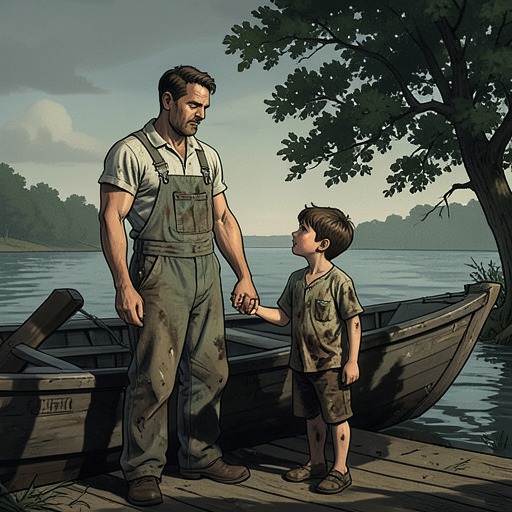
Tate and Scupper’s relationship
Where the Crawdads SingTate Walker and Scupper Walker’s relationship reaches its clearest expression in two courtroom and cemetery scenes: Scupper leaves his boat to stand beside his son during Kya Clark’s murder trial, and Tate later asks his dead father’s forgiveness for the time he failed to give him. Their bond is not presented through a long history of conversation, but through a change in Scupper’s judgment, a shared understanding of Tate’s love, and Tate’s grief at recognizing what he overlooked.
A Father Confronts His Judgment
Scupper had stayed away from the trial, officially because his work kept him occupied, but also because Tate’s enduring attachment to Kya bewildered him. Tate had apparently never cared for another girl in the same way; even as an adult with a professional life, he still loved the mysterious woman now accused of murder. Scupper’s absence therefore reflected more than a scheduling conflict: he could not readily understand the attachment that mattered so much to his son.
That judgment shifts while Scupper is aboard his boat at noon, with nets pooled around his boots. He recognizes that he, like other townspeople, had been prejudiced against Kya because she grew up in the marsh. Remembering Tate proudly showing him Kya’s first book about shells, he recalls being impressed by her scientific and artistic ability. He had bought copies of both her books without telling Tate. His private purchases disclose an appreciation he had not openly expressed, while his recognition of prejudice makes clear that Kya’s work has unsettled the social assumption he once shared.
Scupper’s reassessment brings his son and Kya into the same frame. He is proud that Tate has always known what he wanted and how to pursue it; he sees Kya as having done likewise, despite facing much greater odds. This does not mean Scupper suddenly has a full understanding of her or of Tate’s history with her. Rather, he now recognizes the resolve in both of them and sees that his son’s attachment is bound up with a woman whose ability he has come to respect.
Choosing to Stand Beside Tate
Once Scupper decides that nothing matters more than supporting his son, he acts without ceremony. He drops the net, leaves his boat rocking against the pier, and goes directly to the courthouse. The movement from work to courtroom gives physical form to his change of mind: the man who had kept his distance now accepts the immediate cost of leaving his task unfinished in order to be present for Tate.
At the front row, Jodie Clark, Jumpin’, and Mabel stand so Scupper can squeeze past them and sit beside Tate. Father and son exchange a nod. Tears swell in Tate’s eyes. The moment is small, but it reverses the emotional distance that had kept Scupper away: Tate does not need a speech or an argument, only his father taking a seat beside him while Kya faces a murder charge. Scupper’s arrival also makes his support public, in the courtroom where his earlier absence had been noticeable.
Grief and the Cost of Absence
By the time Tate returns to the cemetery, Scupper has died. The sheriff had found Tate in the marsh to tell him; Tate remembers almost nothing of the burial, only that he moved and acted as other people guided him. He comes back the next day to say goodbye. The sequence makes grief appear both immediate and disorienting: he has been present for the funeral in body, but must return to the grave to make the farewell his own.
Tate measures his loss against the months before it. While pining for Kya and trying to visit her in jail, he spent almost no time with Scupper. He regrets this and wonders whether, had he not been so consumed by his own heart, he might have noticed that his father’s heart was failing. The thought is an expression of grief rather than proof that Tate could have prevented Scupper’s death. Its force lies in the belated recognition that devotion to one person had narrowed his attention to another relationship that also required care.
That regret sharpens because Tate can identify signs that Kya had begun returning to his life before her arrest. She gave him a copy of her first book, came aboard his boat to look through a microscope, and laughed when he tossed his hat. Once the trial began, however, she withdrew even more than before. Tate thinks that jail could do that to a person. His recollection places his hope of renewed closeness with Kya beside his loss of time with Scupper, without suggesting that either relationship cancels the other.
What Scupper Leaves Tate
At Scupper’s grave, beneath the oaks in the Barkley Cove graveyard, Tate finds that his thoughts still turn more to Kya than to his father, and swears at himself for it. Scupper’s grave lies beside his mother’s, with his sister’s on the far side; the small enclosure of rough stone and mortar, embedded with shells, leaves space for Tate. He sets down a battery-operated record player and plays a 78, listening to Miliza Korjus’s voice between his parents’ graves. The freshly turned earth seems, to him, more like a beginning than an end, even as he confronts the absence of his father.
Tate speaks aloud, asking Scupper to forgive him for spending so much time away, and knows that his father would forgive him. He remembers Scupper’s definition of a man: someone able to cry freely, feel poetry and opera deeply, and do whatever is needed to defend a woman. That remembered standard links Scupper’s character to the choice he made at the trial. His support for Tate’s love of Kya had not required him to understand every part of it; it required him to stand beside his son. Tate’s thought that Scupper would have understood tracking love through mud carries that recognition into the marsh, where his devotion had taken him and where his father had once found him.
After touching the grave for the last time, Tate goes back to his boat and tries to return to work among its living specimens. As he steps onto the aft deck, he notices a pale brown feather on the seat and recognizes it as belonging to a female member of the Night herons, a secretive bird that lives alone deep in the marsh. The feather is far from that habitat, near the sea. It does not undo Tate’s grief or his regret, but closes his farewell on an image of solitary marsh life—one that recalls both the world Scupper learned to respect through Kya and the love Tate had tried to follow through it.