The Firefly Lure and Trap
Where the Crawdads SingThe Firefly Lure and Trap develops from a precise observation of animal behavior into one of the novel’s most unsettling images of desire, deception, and survival. For Kya, the firefly’s signal is not simply an invitation to mate: it can be altered into a trap. The image returns in her reflections on biology and human behavior, then becomes a key to Tate’s discovery of what happened to Chase Andrews. Its force lies in the way it joins attraction to danger without making either one morally simple.
A signal that becomes a trap
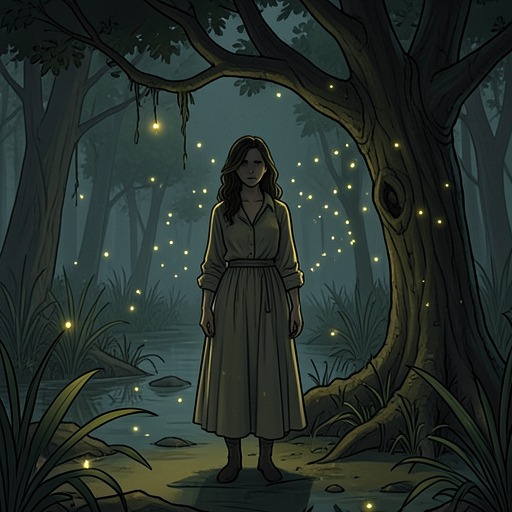
One night, after waiting for Tate and hearing no boat arrive, Kya watches fireflies above the lagoon. She knows from Jodie that female fireflies use species-specific patterns of flashes to signal readiness to mate; males recognize their own species’ signals and approach accordingly. The language of the flashes seems orderly, a code by which the insects find one another. Then Kya sees a female change that apparent order into a weapon.
The female first gives the correct signal, attracting a male of her own species and mating with him. She then changes her pattern. A male from another species reads the new signal as an invitation from one of his own kind and hovers over her. Instead of mating, she grabs and eats him, consuming his legs and wings. Kya watches other females repeat the strategy: by changing their signals, they secure both a mate and a meal. The scene makes deception visible as a behavior with an immediate material reward, not merely as a human judgment about character.
Kya’s response is not to call the firefly evil. She understands the act as life continuing through the loss of some of its participants, and concludes that biology does not divide right and wrong in the same way human judgment does. The insight does not erase the violence: the second male is lured by a signal he mistakes for his own kind’s. Rather, it places that violence inside a natural system where attraction, reproduction, and consumption can overlap. The image is especially charged because Kya has been waiting for Tate; his absence frames the observation, though the firefly’s behavior offers no simple explanation or comfort for human disappointment.
Biology as a language for betrayal and survival
Later, reading a scientific digest outside the old cabin, Kya encounters an article titled Sneaky Fuckers. It describes weaker male animals that use posture, noise, or opportunistic timing to mate when stronger males have drawn females to a territory. The article’s examples make courtship a contest in which signals can advertise strength truthfully or counterfeit it. Kya remembers Ma warning her older sisters that boys who made conspicuous noise were unworthy. The recollection connects the scientific account to inherited family advice without making the two identical: one describes reproductive strategies, the other offers a mother’s warning about young men.
The digest also supplies a counterweight to the firefly’s apparent success. Kya reads that males who send dishonest signals or move from one female to another almost always end up alone. That assurance gives the natural world a kind of consequence for deception, though not a human court’s moral verdict. The book’s recurring animal comparisons thus resist a tidy rule: deception can be an effective tactic, but its immediate advantage does not guarantee lasting connection or safety.
Kya also uses evolutionary reasoning to consider Ma’s departure. Speaking with Tate, she recalls the example of a vixen that abandons her kits under extreme stress, and argues that such behavior can increase a mother’s chances of surviving to reproduce later. She applies this framework to Ma’s life with Jake Clark, suggesting that ancient survival instincts might help explain why Ma left. But Kya explicitly distinguishes explanation from justification: biology may help her forgive her mother, yet it cannot answer why Ma never returned or wrote. The firefly image belongs to this same tension. Natural behavior can make apparently ruthless actions intelligible without turning them into choices beyond question or grief.
The firefly poem and Tate’s recognition
The image acquires its darkest meaning when Tate discovers that Amanda Hamilton, the poet whose work he has found, is Kya. Among the poems is The Firefly, whose speaker describes luring a male with a flash that resembles a valentine, then reveals that the call concealed death. The poem moves from attraction to an unfinished final touch, a fall, and the passing of love back to whatever preceded it. Its sequence compresses courtship and killing into one design: the signal that draws the victim close also begins the trap.
Tate reads the poem again and finds a small box containing the shell necklace Chase wore until the night he died. The necklace turns the poem’s predatory figure into a concrete clue. Tate imagines Kya traveling by night bus, negotiating a riptide, planning around the moon, calling Chase in the darkness, pushing him backward, and recovering the necklace from the mud while covering her footprints. These are Tate’s imagined reconstruction of the killing, not an account of him witnessing it. But poem and object together make the firefly’s false invitation legible as a concealed confession: a lure, a fall, and the removal of what could connect the killer to the dead man.
Tate responds by burning the poems, then removing the shell from its rawhide and burning the rawhide as well. He returns the boards to the floor where the box had been hidden. His actions make the image’s secrecy consequential: the poem does not merely echo Kya’s earlier observations but leads Tate to evidence he chooses to conceal. The shell, once worn by Chase, survives the burning; the poems that might have given the secret a public voice do not.
Meaning and limits of the image
Across these appearances, the firefly’s lure changes scale. It begins as a species-specific signal observed over the lagoon, becomes a model for deceptive courtship in Kya’s reading, and ends as a pattern through which Tate interprets a death. The repeated movement from flash to approach to capture gives the motif its narrative clarity. Yet the human case cannot be reduced to insect behavior: Kya’s reflections on Ma insist that biological explanation may illuminate conduct while leaving responsibility, loss, and unanswered questions intact.
The image therefore holds attraction and danger in the same frame. A signal can make contact possible, but it can also exploit the trust that makes contact possible; survival may explain a tactic without making its consequences disappear. In the poem and the hidden necklace, the firefly’s flash becomes both artistic figure and evidence, illuminating the lethal secret while showing how carefully that secret has been kept.