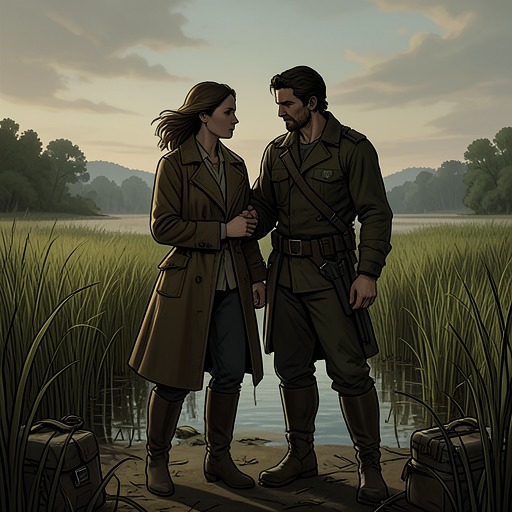
The Rips
Where the Crawdads SingThe Rips are the dangerous coastal currents beyond the familiar marsh waters, a place where Kya’s hard-won knowledge of the sea meets forces she has spent her life avoiding. In 1967, after rejection by Chase Andrews, she steers into them in anger. The passage tests her command of the boat, but its decisive force is emotional: the current carries her toward the loneliness she has tried to outrun, until she recognizes that her grief reaches beyond one failed relationship.
Setting and Natural Forces
Kya knows how to read ordinary currents and riptides. She has learned to ride them out or escape by steering perpendicular to their course, practical knowledge accumulated in the waters she calls home. The Rips are different: deeper, more powerful currents mingle with coastal riptides, generating backcurrents, eddies, and reverse circulations. The Gulf Stream lies beyond North Carolina’s coast, and its enormous flow helps explain the force of the waters in the scene. Yet Kya has not ventured into the Gulf Stream itself; the passage makes that distinction clear, describing her route as a training ground beside the more dangerous open sea.
That difference matters because the location is neither wholly unknown nor safely mastered. Kya can recognize the hazards, but she has never deliberately aimed into the deeper currents. Beneath the surface, sandbars shift and make a close approach dangerous: a glancing touch could overturn the boat. What she knows about the marsh offers some guidance, not control. The Rips expose the limit of knowledge when water, weather, and exhaustion combine.
Kya Enters the Current
From the beach, Kya runs to her small boat and accelerates toward the Rips. She is reacting to Chase’s betrayal, and her first movement is an act of anger: she shouts at him as the confused waves jerk the bow sideways against the tiller. The ocean seems more hostile than the marsh, and she deliberately heads into the deeper water rather than taking the safer course she already knows. She wants to outrun pain and anger, and to prove that she can withstand what she has chosen to face.
The sea soon makes the choice less abstract. A strong rip carries the boat faster while waves push it off course. When the water shifts, the boat spins to starboard and rears on its side, slamming Kya onto the bottom. She is stunned, then pulls herself back into the seat and grips the tiller. The land appears only intermittently beyond the whitecaps; each spin or tilt takes it from view again. Clouds obscure the sun and the signs of turbulence, while cold water accumulates across the floor. Kya has brought no foul-weather gear, food, or water, and her strength drains as steering grows harder.
Survival and Landing
Fear arrives not only as a response to the immediate danger but as a recognition of what the danger seems to confirm: that she will be alone again, perhaps always. As the boat rolls broadside, she makes gasping noises; six inches of foamy water cover the floor and burn her bare feet with cold. She folds one arm across her chest for warmth and steers weakly with the other. Rather than continue fighting every movement of the sea, she begins moving with it.
When the water finally calms, the current still carries her onward, but it no longer thrashes around the boat. Kya spots a narrow sandbar, about a hundred feet long, glistening with water and wet shells. Timing her movement against the underflow, she turns out of the current, steers to the bar’s sheltered side, and beaches the boat. She sinks onto the sand and lies against solid ground. The landing ends the immediate struggle, but it does not erase the emotional reckoning that brought her there.
Emotional and Narrative Significance
On the sandbar, Kya understands that she is not mourning Chase alone. His rejection has reopened a longer history of being left, and she says aloud, “I have to do life alone. But I knew this. I’ve known a long time that people don’t stay.” The Rips give physical form to that crisis: a current can take the boat beyond sight of land, just as the prospect of renewed rejection threatens to carry her beyond the security she has built in the marsh.
Her reflections also connect Chase’s courtship to the behavior she has observed in nature. She interprets his talk of marriage followed by sex and abandonment as a deceptive signal, comparing his conspicuous ski boat to the display of a buck deer in rut. She recognizes an uncomfortable parallel with Ma’s experience and remembers Pa’s courtship before his money ran out and he returned her to life in the shack. The comparison does not make the hurt disappear; it gives Kya a way to name the pattern she feels she has repeated. The Rips thus mark both a physical limit and a point of recognition: nature can teach her how to survive dangerous water, but it cannot promise that human attachments will last.