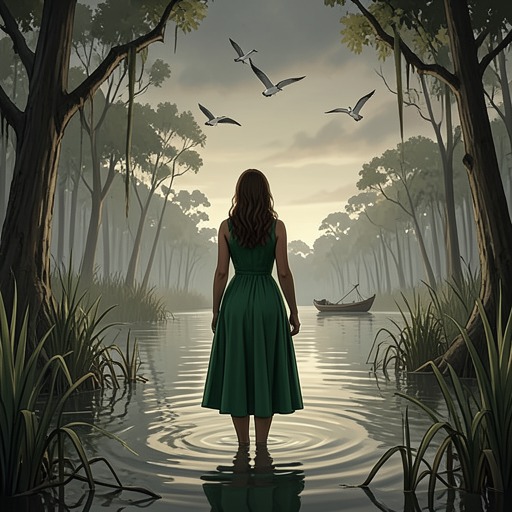
The marsh became her mother
Where the Crawdads Sing“The marsh became her mother” describes more than Kya’s attachment to a landscape: it marks how the wetland fills the practical and emotional space left by her mother’s departure. The marsh catches her when she stumbles, sustains her with its abundance, and supplies a way of knowing the world. It is home and teacher, but also an independent living system whose value is threatened when outsiders treat it as wasteland.
The Phrase Takes Root in Loss
Kya’s understanding of the marsh as maternal grows out of an absence. Each morning she wakes still listening for the sounds of Ma cooking breakfast: eggs from her hens, sliced tomatoes, and cornmeal fritters crackling in hot grease. Instead, the kitchen is cold and silent, and Kya slips away to the lagoon. The memory makes the missing care specific and domestic; what has vanished is not an abstraction but the repeated work and sounds of a parent tending a household.
As months pass and winter settles in, the land becomes the presence that answers that loss. Kya sometimes hears unfamiliar night sounds or jumps at nearby lightning, yet when she stumbles, the marsh catches her. Her heart-pain does not disappear so much as seep deep, and she lays her hand on the breathing, wet earth. The phrase “the marsh became her mother” follows that gesture: a bodily act of contact gives language to a bond built through shelter, endurance, and time.
A Living Provider and Teacher
The maternal figure is not merely imagined as comfort. The marsh is mean country, but it is not lean: sand crabs, crayfish, waterfowl, fish, shrimp, oysters, deer, and geese make its land and water abundant. Its resources support survival for those willing to gather and work. The landscape’s care is therefore material as well as emotional, grounded in food and the conditions of daily life.
It also teaches. During reading lessons at the Tumbledown Old Cabin, Tate reads A Sand County Almanac with Kya. She learns that floodplains are living extensions of rivers, that wetlands sustain life beyond their visible boundaries, and that draining them can dry surrounding land and kill plants and animals. The knowledge gives scientific terms to what her experience of the marsh has already made intimate: this is not inert scenery but a living system with its own processes and consequences.
Home, Ownership, and Environmental Threat
The phrase takes on a sharper public meaning when developers arrive with plans to drain the area and build hotels. Kya has already seen machines cut stands of oak and dig channels, leaving dry, hardened tracks behind them. Calling the marsh a “murky swamp” reduces a complex habitat to land awaiting improvement; the consequences of that judgment fall on the living wetland and the people whose lives are bound to it.
Kya’s uncertainty about whether her family owns its land or merely occupies it reflects a longer history of informal tenure among marsh dwellers. At the Barkley Cove Courthouse, she uses the family Bible and records to establish that her grandfather bought the property in 1897. After calculating roughly eight hundred dollars in back taxes, the clerk enables her to secure a deed in her own name. She leaves with title to 310 acres of lagoons, marsh, oak forest, and private beach. The official category still calls it wasteland, but the place Kya knows as home is neither empty nor valueless. Her remark to a heron that its spot is safe extends belonging beyond private ownership: the deed protects the land she inhabits and the creatures who share it.
Nature as Kinship and Explanation
The marsh’s maternal role also shapes how Kya interprets behavior. Watching fireflies, she sees females use species-specific flashes to attract males; one changes her signal, mates, then lures and eats a male of another species. Kya understands the act through biology rather than human moral judgment, concluding that right and wrong appear differently under another light. The observation makes the marsh a source not only of sustenance but of an interpretive framework for survival.
Later, speaking with Tate about Ma’s departure, Kya applies that framework to maternal abandonment. She considers how a mother fox under extreme stress might leave offspring, and how behaviors that seem ruthless can, in evolutionary terms, increase a mother’s later reproductive success. She allows that such instincts may help explain Ma’s decision in the danger and stress of life with Pa, but insists that explanation does not make it right. Nor does it answer why Ma never returned or wrote. The phrase therefore does not erase the human wound or turn the marsh into a simple substitute parent. It names the relationship that helped Kya endure the loss, while preserving the difficult difference between nature’s impersonal survival processes and the unanswered claims of human love.