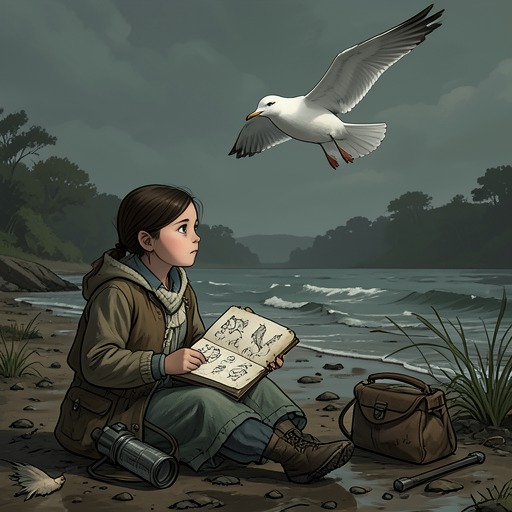
Wild turkeys
Where the Crawdads SingWild turkeys recur in Kya Clark’s life as familiar marshland animals, beloved birds, and witnesses to a brutal instance of survival within a flock. Her attention to their ordinary family life makes the killing of an injured hen especially stark; years later, a single tail feather brings the birds back to her as part of a continuing, intimate exchange.
Familiarity and Natural History
Turkeys had long been among Kya’s favorites. She had watched hens move with their chicks tucked beneath their wings, sometimes as many as twelve young in a brood. A few would tumble from the mother’s back as she walked, then scramble to catch up. These observations give the birds a place in Kya’s close knowledge of the marsh: she notices not only the flock as a group, but the physical work of keeping vulnerable young together.
That familiarity sharpens the contrast in another encounter. About a year before she finds the feather on the stump, Kya hears a high-pitched shriek in a stand of pines and sees fifteen turkeys—mostly hens, with a few toms and jakes—crowding around what first looks like an oily rag. Dust rises from their feet and hangs among the branches. As she comes closer, she recognizes the ragged shape on the ground as a hen from the flock.
The Injured Hen
The hen has become entangled in briars. Her feathers stick out at odd angles, and she can no longer fly. The birds around her peck and claw at her neck and head. A large female pins her with her horny feet while another jabs at her exposed skin; the injured bird looks wildly toward the flock attacking her. The scene is not a simple contest between predator and prey. It is violence among members of the same flock, directed at a bird whose injury has made her different and vulnerable.
Jodie Clark had told Kya that a wounded or disfigured bird is more likely to attract a predator, so its flock may kill it rather than risk drawing an eagle that could take another bird as well. That explanation gives the attack a survival logic without making it gentle. Kya runs into the clearing, waves her arms, and shouts at the turkeys to stop. They scatter, stirring more dust; two fly hard into an oak. But she arrives too late. The hen lies limp in the dirt, her neck bent, blood running from it.
Kya drives off the last of the birds, then kneels beside the dead hen and covers its eye with a sycamore leaf. Her intervention cannot undo the flock’s attack, but the small, deliberate gesture marks a difference between understanding the group’s behavior and accepting the dead bird as merely one more outcome of it. The episode holds both facts together: the flock’s response has an ecological explanation, and the hen’s death remains a particular loss that Kya witnesses and mourns.
The Feather and Its Recurrence
For more than a week, no feather appears on the stump. Kya checks it several times a day, peering through the ferns, and spends an unusual amount of time inside the cabin. Even supper becomes a small distraction: she realizes too late that she has not soaked beans, rummages through the cupboard, and drums her fingers on the table. When she finally sees a long, striped wild turkey tail feather from a distance, it catches her attention at once.
The feather recalls the birds she has loved as well as the injured hen she could not save. The two memories remain joined: whenever Kya sees wild turkeys, she thinks of that killing. Yet finding the feather delights her. It tells her that the exchange associated with the stump is still alive, even after the pause. The feather therefore belongs to two registers at once: it is a recognizable part of a favorite marsh animal and a sign within a human relationship. The account does not identify who left it, but Kya reads its appearance as reassurance that the game continues.
Survival and Meaning
The turkey episode makes visible a form of natural selection at the scale of an individual body. The hen’s entanglement in briars prevents flight; her difference draws the flock’s attention; and the behavior Jodie described is framed as a way to reduce danger to the remaining birds. Kya does not need to mistake that explanation for kindness. Her attempt to interrupt the attack and her care for the hen afterward show that an account of survival does not erase the creature’s suffering.
Elsewhere, Kya watches female fireflies use mating signals and recognizes that nature’s behaviors do not fit neatly into human categories of good and evil. Her later reading also examines deceptive signals and reproductive strategies. These are distinct observations, not explanations of the turkeys’ actions, but together they establish how closely she studies animal behavior: she attends to what animals do, the conditions around it, and the costs borne by particular individuals. Wild turkeys give that attention an especially memorable form. The flock’s violence stays in her mind, while the feather on the stump restores wonder and connection without making the earlier loss disappear.