Audrey Griffin's Dossier
Where'd You Go BernadetteAudrey Griffin's Dossier is a packet Audrey Griffin gives Bernadette Fox during the family intervention and sends on to Bee Branch. Its decisive role is to turn Audrey's judgment of Bernadette's conduct into information Bee can receive and weigh for herself. In a story told partly through institutional records, the dossier also belongs to a wider paper trail in which private actions become legible to schools, investigators, clinicians, and officials.
The Packet and Its Recipients
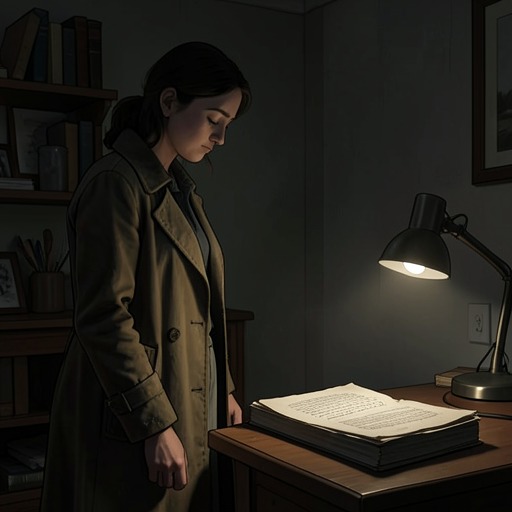
Bernadette describes Audrey as presenting her with a “dossier of my truly terrible behavior” in Audrey's kitchen. She adds that Bee has by then received it through the mail. The sequence gives the packet two audiences: Bernadette encounters it face to face, at a moment when she has just escaped the intervention, while Bee receives it at a distance, as part of the unfolding account of her mother's crisis.
The available account does not itemize the dossier's contents. It establishes its purpose more clearly than its inventory: Audrey has assembled a record she considers relevant to Bernadette's behavior and ensures that Bee gets it. The packet is therefore not simply a private exchange between neighbors; it becomes a means of communication between mother and daughter at a moment when Bernadette's whereabouts and intentions are uncertain.
The Documentary Record Around It
Other documents in the narrative show the kinds of official knowledge that accumulate around the crisis, though the evidence does not establish that these records are physically included in Audrey's packet. A note from Gwen Goodyear, sent home to parents after a pickup incident, uses the event as an occasion to revisit the school handbook's rules. It turns a disruptive episode into a matter of school procedure and parent communication.
An Internet Crime Complaint Center letter to Elgin Branch describes a separate, more extensive breach. Investigators report that Bernadette supplied the supposed assistant “Manjula” with credit-card details, bank wiring instructions, Social Security and driver's-license numbers, addresses, passport numbers, and family photographs. The letter also says Bernadette had suggested that Elgin forbade her from using the service. These details reveal the scale of the family's exposure and show how correspondence, financial records, and identity documents can recast seemingly private dealings as evidence of a crime.
Dr. Janelle Kurtz's report offers another institutional perspective. At the Branch residence, she finds Elgin, Soo-Lin Lee-Segal, and FBI Agent Marcus Strang responding to the discovery that “Manjula” had stolen Elgin's airline miles. The miles had been used for a one-way ticket from Moscow to Seattle, while emails to Bernadette had sought confirmation that she would be alone at home. The report records Elgin's shock and Dr. Kurtz's refusal to promise Bernadette's safety at Madrona Hill without first evaluating her. In contrast to Audrey's personal dossier, the clinical report documents a professional assessment and the limits on what that assessment can guarantee.
Records, Knowledge, and Consequence
A captain's report later records Bernadette's verified presence aboard the H&H Allegra on December 26, including her boarding, cabin assignment, muster drill, and a gift-shop charge. It is a passenger record rather than an identified component of Audrey's dossier, but its precise entries extend the book's documentary pattern: even after Bernadette disappears from the expected family course of events, institutions leave traces of where she has been.
Together, these records clarify the dossier's narrative significance without fixing its contents beyond what Bernadette says. Audrey's packet is a deliberately delivered account of behavior; the other documents independently show how rules, investigative findings, clinical decisions, and travel records make different parts of the crisis visible. The contrast matters: a dossier can convey a judgment to a family member, while official reports preserve narrower facts, procedures, and uncertainties. Bee's receipt of Audrey's packet places her in a position to encounter her mother's conduct through documentation rather than through a direct explanation from Bernadette.