Bernadette Escapes During the Intervention
Where'd You Go BernadetteBernadette Escapes During the Intervention turns a planned effort to assess Bernadette Fox and secure treatment into a sudden escape. The scene brings together family conflict, clinical judgment, police protection, and Audrey Griffin’s intervention: while others prepare to present Bernadette with their account of her condition, Audrey helps her leave, then gives her information that changes how she understands the people around her. Bernadette disappears, and the attempt to find her fails.
Plans, Threats, and Conflicting Records
The intervention had been arranged for 10 a.m. at Dr. Neergaard’s office, with Dr. Janelle Kurtz and Elgin Branch intending to meet Bernadette at her dentist’s appointment. Van Branch was to take Bee Branch to the zoo so she would be elsewhere during the confrontation. But the plan was overtaken by a second crisis. When Dr. Kurtz arrived at the Branch residence, Soo-Lin Lee-Segal and Elgin were there with Federal Bureau of Investigation Agent Marcus Strang, who was informing them that the online assistant using the name Manjula had taken Elgin’s American Airlines miles. Those miles had bought a one-way ticket from Moscow to Seattle, due to arrive the following day. Messages also showed the impostor asking Bernadette to confirm she would be alone while Elgin and Bee were in Antarctica.
The threat altered the meaning of the intervention before it began. Elgin was shocked that the authorities had not told him sooner; Agent Strang explained that online thieves were not generally expected to travel in person. Dr. Kurtz would not promise Bernadette’s safety at Madrona Hill, saying she first had to evaluate her before she could place her on an involuntary hold. Elgin’s fear and helplessness turned into anger at Dr. Kurtz, while Soo-Lin tried to reassure him. The group nevertheless set out for the dentist’s office, believing police protection was in place.
The paperwork surrounding the event supplies competing accounts rather than a single neutral explanation. Dr. Kurtz’s report describes the Branch home, the former Straight Gate School for Girls, as badly deteriorated, and reads the family’s decision to live there as evidence of poor reality testing. Her later list of concerns presents Bernadette’s conduct as a pattern requiring intervention: the conflict with her neighbor, the damage to the neighbor’s home and possible effects on thirty children, Bernadette’s plan to have four wisdom teeth removed to avoid Antarctica, the personal information she had given the criminal, her reliance on an online assistant for household tasks, and the condition of the house. These are Dr. Kurtz’s clinical framing of the case, not an uncontested account of Bernadette’s motives or state of mind.
The Confrontation Begins
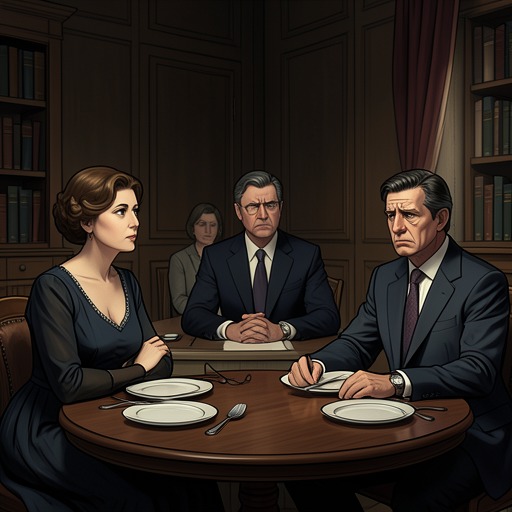
Before the group could reach the office, Bernadette entered the house through the kitchen and found them gathered there. She asked Elgin who the people were. Dr. Kurtz said they had come because they cared about her and wanted her to get help; Bernadette immediately questioned the police outside and Dr. Kurtz’s use of the word “gnat.” When Dr. Kurtz asked her to sit so they could present the reality of her situation, Bernadette said she did not like what was happening and was leaving.
The exchange makes the intervention’s central conflict explicit. Dr. Kurtz understands the meeting as a presentation of reality and an attempt to help; Bernadette experiences the assembled group, police presence, and prospect of being held as an invasion. Later, when Dr. Kurtz enumerates the reasons for concern, Bernadette asks whether she is still being presented with reality or can now speak. Her objection is not simply a denial of the accusations: she asks for room to address them, while the intervention’s structure places her first in the role of patient being assessed.
Bernadette turns to Elgin with a plea that joins her own predicament to the family she fears losing. She says she is “in the weeds,” believes she can get herself out, and asks whether they can get through it together for themselves and Bee. But she refuses to work with the people she calls invaders. Her practical need to leave the room gives her a moment to move away from the group; the sequence then breaks into confusion as the escape becomes apparent.
Audrey’s Intervention
Audrey’s decision to help Bernadette follows her discovery of the intervention plan. While staying with the Griffins, she had looked at Elgin’s computer, found correspondence about the next morning’s meeting, and copied the documents so she could add them to her dossier. She did not want to obstruct the Federal Bureau of Investigation’s case, but she also could not accept Bernadette being taken to a mental hospital because of her own lies. On the way to the dentist’s office, Audrey drove past the Straight Gate residence and saw a police car and Soo-Lin’s Subaru. Then she recognized Bernadette’s car passing by and decided she had to get the file to her.
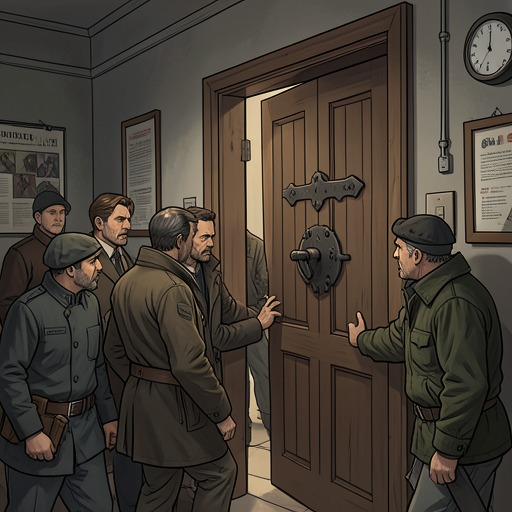
Audrey entered the property through a hole in the fence and reached the house while the intervention was underway. She saw Bernadette cross the living room, found a ladder lying in the side yard, and used it to tap on a window. Bernadette appeared at the window; Audrey called her to come. Bernadette hesitated, but Audrey insisted, and she climbed down after Audrey, closing the window behind her. The ladder and the route out of the house make Audrey’s choice concrete: she does not merely oppose the intervention in principle; she creates a way for Bernadette to leave it.
The two crossed the lawn and went to Audrey’s house, where Audrey sent the floor workers home. She gave Bernadette the completed dossier, which included a newly published online article about Bernadette’s architecture career. Audrey had not known that Bernadette had won a MacArthur grant and recognized that this knowledge might have changed her earlier judgment of her. She left Bernadette to read, brought her tea, and received only one comment: “I would have done it.” Its meaning is not explained in the scene, and the exchange leaves the discovery of the dossier’s contents deliberately unresolved.
Flight and Aftermath
At the Branch residence, Elgin noticed that Bernadette’s bag was now packed, unlike the bags he and Bee had packed earlier. The discovery suggested that she had prepared to leave, but it came too late to prevent her departure. When Elgin tried to follow, he fell in the basement brambles and was taken by ambulance to an eye clinic. A K9 search found no sign of Bernadette. The planned intervention therefore ends not with a decision about treatment but with an absent patient, an injured husband, and a search that cannot establish where she has gone.
Audrey’s account closes the encounter on a smaller, more personal uncertainty. She asked Bernadette whether Elgin and Soo-Lin were involved, but could not say for certain. That was the last Audrey saw of Bernadette. She later learned Bee was at Choate Rosemary Hall and sent the dossier there without a return address. The intervention’s immediate aftermath thus extends beyond the escape: information withheld from Bernadette is placed in her daughter’s hands, while Audrey’s brief act of assistance becomes the final point of contact between the two women before Bernadette’s disappearance.
Documentary Form and Significance
The event is assembled from Dr. Kurtz’s formal report and Audrey’s personal account, and the difference between those records shapes its meaning. The report organizes the meeting around symptoms, risk, and the possibility of involuntary treatment; Audrey’s narrative follows the movement of documents, the police presence, the window, and the ladder. Neither account erases the danger posed by the identity-theft scheme, but the records also expose how institutions and family members act on partial information. The same intervention meant to confront Bernadette with a shared reality becomes, for her, a threat from which she must escape.
Audrey’s role reverses the neighborhood conflict that had made her part of the case against Bernadette. She now carries the file that can alter Bernadette’s understanding, crosses the police-guarded property, and opens a route out. Yet her help cannot settle the deeper questions raised by the dossier or restore the family to a common account of events. The escape is both a physical break from the intervention and a narrative hinge: after Bernadette leaves, the people seeking her must work from reports, messages, and traces rather than from her presence.