Bernadette's insomnia
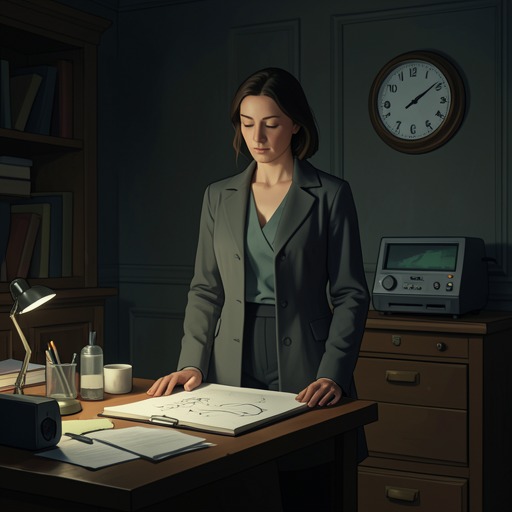
Where'd You Go BernadetteBernadette’s insomnia is a persistent condition that unsettles domestic routines, complicates attempts to manage her distress, and becomes one of the clearest signs that her family cannot tell how much danger she is in. The book presents sleeplessness not as a diagnosis that explains everything, but as a daily strain threaded through medication, exhaustion, and the growing difficulty of reaching her.
A recurring condition in ordinary life
At home, the problem surfaces in small disruptions. Bernadette comes in from the pantry carrying spaghetti pots, drops them with a clang, apologizes, and says she is really tired; Bee Branch notes that her mother sometimes does not sleep. The scene sets exhaustion beside household bustle rather than apart from it. Bernadette remains responsible for practical preparations, including selecting waterproof boots for the family trip, even as sleep eludes her.
The condition is also explicit in Bernadette’s account of her medical history. Doctors treating Bee Branch had repeatedly sent Bernadette home with Xanax or a sleeping pill, and she says she does not sleep. Yet she had not taken those medicines: when she tried them once, they made her nauseated and unlike herself. Her familiarity with sleeplessness had become so established that she describes herself as accustomed to it, even while the accumulating prescriptions show that the problem had not simply passed.
That habituation has an unsettling counterpart in a public pharmacy. After a glass sculpture has held her attention, Bernadette falls asleep there, an involuntary lapse she recognizes as characteristic of never sleeping: when she does finally sleep, it happens at the worst time, in public. Elgin Branch finds her with drool on her cheek. Her explanation is that the pharmacy would not give her Haldol, so she has to wait for Xanax. The episode makes the difference between being unable to sleep and being safely treated for it impossible to ignore: she is exhausted, but her medication situation is confusing even to her.
Prescriptions, hoarding, and risk
Bernadette’s access to medication is not a straightforward treatment history. When a doctor prescribes Xanax for anxiety and a scopolamine patch for motion sickness, she reveals that old prescriptions have accumulated together in a Ziploc bag. At one point, while thinking about overdosing, she emptied the contents of every prescription bottle into her hands to judge whether she could swallow them all. She then abandoned the idea and put the pills in the bag, but cannot remember why she had wanted to die. Her account connects insomnia to suicidal thinking without making sleeplessness a sufficient explanation for it.
At the pharmacy, she asks whether there is a laminated chart identifying pills by appearance, hoping she might pick the Xanax out of the mixed collection and return it to its proper container. The pharmacist is baffled. Bernadette eventually accepts the Xanax and the motion-sickness patch, but the exchange offers no neat resolution: medicines prescribed at different times have become a disordered stockpile, and the person seeking help cannot reliably identify what she already has.
Elgin later finds a cabinet filled with prescription bottles from several doctors, including Xanax, Klonopin, Ambien, Halcion, and trazodone. All are empty. The range of sedatives and sleep-related drugs gives him evidence of prolonged medical intervention, but not a clear account of what is wrong. In his appeal to Dr. Janelle Kurtz, he lists insomnia alongside Bernadette’s hoarding of prescription medicine, extreme anxiety, grandiosity, and suicidal thoughts. The list makes sleeplessness one element in a broader crisis, not a diagnosis that resolves it.
Family concern and medical uncertainty
Elgin’s concern grows through observation and inference. He asks Bernadette whether she has been sleeping; she answers by treating sleep as an unfamiliar concept. Elsewhere, after seeing the empty bottles, he admits that he cannot decide whether she is depressed, manic, dependent on pills, or paranoid, and says she needs serious attention. His uncertainty matters: the family sees the consequences of sleeplessness and medication use, but those signs do not tell them which condition or treatment is appropriate.
The distinction becomes consequential when Elgin seeks help from Dr. Kurtz. He believes the FBI file contains enough evidence to qualify Bernadette for inpatient treatment, while Dr. Kurtz gives him a list of psychiatrists and expresses concern about his determination to pursue an involuntary hold. She explains that the Washington Involuntary Treatment Act requires an assessment of whether a person presents an imminent danger to herself, others, or property because of psychiatric illness; detention is not simply a family’s way to secure supervised rest. Insomnia contributes to the picture of distress, but the legal standard requires more than sleeplessness alone.
Treatment, interpretation, and limits
When Dr. Kurtz proposes that she and Bernadette work together over the coming weeks, Bernadette mistakes the offer for participation in the Antarctic trip and calls it exotic. Dr. Kurtz clarifies that Bernadette needs to concentrate on getting better. The exchange does not identify insomnia as the sole focus of care, but it shows how far Bernadette’s understanding of the conversation has drifted from the clinician’s purpose. Treatment is offered as a process of collaboration, while Elgin’s fear has already drawn him toward a coercive solution.
Across these episodes, insomnia is both a concrete deprivation and an imperfect piece of evidence. It appears in Bernadette’s fatigue, her sudden sleep in public, her reliance on prescriptions she distrusts, and her family’s attempts to interpret her condition. The emptied bottles and mixed pills suggest sustained efforts to manage distress, yet they also expose the danger of treatment without clarity. The narrative leaves the underlying diagnosis unsettled; what it makes unmistakable is that sleeplessness has become part of a crisis whose care cannot be reduced to forcing sleep or placing Bernadette under a hold.