Choate Rosemary Hall
Where'd You Go BernadetteChoate Rosemary Hall is both a coveted educational destination and the setting of Bee Branch’s brief, unsettled boarding-school experience. Its ivy-covered buildings and rigorous admissions process embody the promise of a wider world; for Bee, however, that promise gives way to social alienation, painful revelations about her family, and a decision to leave before the academic year ends.
A coveted school and a remembered stage
In the novel’s landscape of school choice, Choate Rosemary Hall carries the prestige of an elite boarding education. An adviser working with Galer Street School describes affluent parents’ choices as shaped by fear of missing the best education and by aspiration toward a select circle of schools. In that account, Lakeside School is the ultimate destination, while Choate Rosemary Hall is one of the institutions whose recognition helps define Bee’s educational prospects. Its status is therefore more than a campus detail: admission signals that Bee has succeeded in a competitive system her parents and their community take seriously.
Before Bee enrolls, Choate Rosemary Hall also appears through her mother’s memories. Bee asks Bernadette Fox whether the Mellon Arts Center was already there when Bernadette attended. Bernadette recalls that it was, and that the only time she ever performed onstage was as a Hot Box Girl in Guys and Dolls. The recollection gives the school a personal history within the family, distinct from its later role in Bee’s life. Bee has also heard that students perform in an orchestra and that people from Wallingford pay to attend the Friday concerts, an image of the school as a cultural institution connected to its surrounding town.
Admission and the promise of advancement
Choate Rosemary Hall accepts Bee through its Early Decision process after reviewing a highly competitive applicant pool. Its letter congratulates her on her academic achievements and varied interests, while a separate letter from director of studies Hillary Loundes recommends that she skip third form, or ninth grade, and enter fourth form, or tenth grade. The recommendation rests on the school’s judgment that Bee is unusually capable and should not be left bored by work below her level.
The admissions letter explains the selectivity behind that decision: the school expects to accept one in ten applicants, most of whom already have excellent standardized-test scores and near-perfect grades. To distinguish among candidates with similar conventional records, the admissions department says it has worked with Yale’s PACE Center since the late 1990s to develop the Choate Self-Assessment. Bee stands out on this measure, receiving exceptionally strong results for “grit” and “poise.” The school thus presents her admission not simply as a reward for grades but as recognition of qualities it believes will help her meet boarding school’s academic and social demands.
The recommendation initially proposes that Bee begin in the fall as a fourth-former. Elgin Branch, after reconsidering the advice, writes to the admissions dean to ask whether Bee can instead start in January, in a month, as a third-former. He argues that she is already working beyond that level and should enter the school’s academic environment sooner. When the acceptance letter arrives, Bernadette arranges an early dinner and the family drives to celebrate with Elgin. Bee imagines the campus as immense, clean, and picturesque: red-brick buildings with ivy, flowering branches, ducklings on ponds, and a beauty like that of a jigsaw puzzle. Bernadette tells her she is allowed to be happy about going away, acknowledging the mixture of excitement and separation in the occasion.
Campus life and social distance
Bee’s arrival confirms some of the grandeur she had imagined. She describes broad snowy lawns crossed by boot paths, ivy-covered buildings, and modern architecture scattered across the grounds. The campus itself is not what she objects to; the difficulty is the people and the social codes she encounters there. She is assigned a room in Homestead with Sarah Wyatt, a New York student whose father owns buildings. Bee finds that classmates talk about their fathers and display the consumer markers of their social world: nearly everyone has an iPhone, many have iPads, and the computers she sees are Macs.
Bee’s own family background does not translate easily into acceptance. When she says her father works at Microsoft, some students mock her PC and Zune. When she says that Bernadette is a celebrated architect who received a MacArthur award, Sarah disputes the claim and does not look it up when Bee challenges her to check online. These exchanges make the school’s prestige feel double-edged: Bee has been admitted for her exceptional abilities, yet her peers judge her through status signals and treat her accounts of her family with skepticism. She contrasts the campus’s social atmosphere with Galer Street School, which she remembers as smelling of salmon but whose people seemed more normal to her.
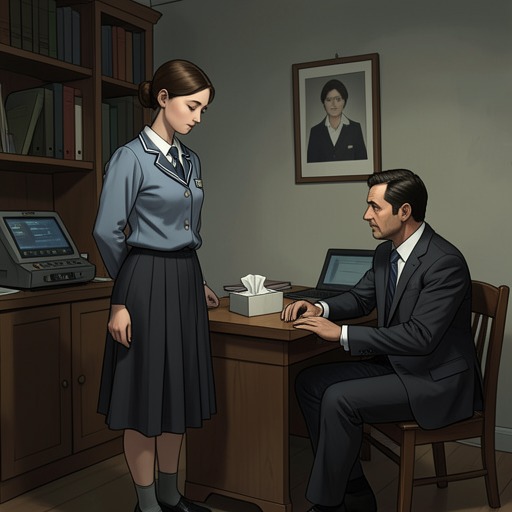
The school’s concern about Bee’s adjustment becomes visible to its leadership. Bruce Jessup, the admissions dean, reports that teachers have seen her sitting at the back of class without taking notes and that she brings food back to her room rather than eating in the dining hall. Sarah asks to change rooms. Bee spends study hours watching Josh Groban perform “O Holy Night” on YouTube, and a chaplain sent to speak with her finds her unreceptive to spiritual discussion. These observations are not isolated complaints: together they lead the school to conclude that Bee is failing to thrive in the boarding-school environment.
Documents, withdrawal, and the school’s limit
A sudden change in Bee’s mood briefly gives the school hope. Jessup notices a bounce in her step, but Sarah soon explains why: a thick manila envelope, postmarked Seattle and bearing no return address, has arrived in Bee’s campus mailbox. Bee says she does not recognize the handwriting. Inside are documents that she reads with excitement and begins turning into a book. Sarah glimpses the writing and is alarmed by confidential FBI materials among the papers, then brings the matter to Jessup.
The packet connects Choate Rosemary Hall to the larger family story unfolding beyond campus. According to Jessup’s description, it includes FBI surveillance documents concerning Bernadette, emails between Elgin and his administrator, handwritten notes between a woman and her gardener, an emergency-room bill, correspondence about a disastrous Galer Street School fundraiser, material about Bernadette’s architecture career, and correspondence between Elgin and a psychiatrist. The school is not the source of these revelations, but its dormitory and mail system bring the packet into Bee’s hands. The documents redirect her attention: she stops watching videos and begins writing the book that will lead her to confront what she believes her father has withheld.
After conferring with Bee’s adviser and dorm mistress, Choate Rosemary Hall recommends that she withdraw immediately, before completing the academic year. Jessup frames the recommendation as an act of care, invoking the school’s duty to recognize when a gifted student needs to be home with family rather than at boarding school. He asks Elgin to come to Wallingford and take her home. At the meeting, Elgin and Jessup describe the decision as being for Bee’s good; they agree that she will leave and that her credits will transfer so she can attend Lakeside School the following year.
In the hallway, beside a bronze bust of Judge Choate, Elgin asks Bee to show him her book. She refuses, though she does show him the envelope. She says her mother sent it so she could know the truth; Elgin points out that the handwriting is not Bernadette’s and says Bee is not old enough to understand what she has read. Bee takes his refusal as confirmation that he would not have told her, and decides she hates him. Choate Rosemary Hall consequently becomes more than the school she wins admission to and then leaves: it is the place where academic distinction fails to protect her from loneliness, and where a prestigious opportunity is overtaken by the need to reckon with her family’s secrets.