Gwen Goodyear
Where'd You Go BernadetteGwen Goodyear is the head of Galer Street School, where she tries to balance parent involvement with student safety and school responsibilities. The reader encounters her less through private scenes than through notices, emails, and brief observations by other characters. That documentary framing makes her a steady institutional presence: she clarifies rules, follows up on concerns, and keeps school business moving amid neighborhood conflict, family crisis, and a disastrous school event.
Role and School Culture
Galer Street School encourages parents to participate in committees and school life. Bernadette Fox, who generally declines committee work, recalls that Gwen’s school fosters an unusually engaged parent community; that expectation shapes the setting for her first recorded interaction with Audrey Griffin. Gwen’s institutional role is therefore not limited to enforcing policy. She operates within a culture that treats conversation and participation among parents as part of school life, even as those same interactions can spill into disputes.
The school’s pickup rules make that tension concrete. After an incident at dismissal, Gwen sends parents a notice saying that nobody was hurt and uses the event to revisit the handbook. Drivers are directed to the school entrance and reminded not to block the loading dock for Sound Seafood International; parents arriving on foot are told to park in the north lot and meet their children on the canal path, rather than approach the drive-up area. Gwen describes student safety as the priority and asks parents to save their conversations for coffee rather than the driveway. Her message translates a socially charged episode into clear procedures, while acknowledging that the school’s community life had contributed to the conditions around pickup.
The Pickup Incident and Bernadette Fox
Gwen’s first notice refers to what happened to Audrey Griffin without initially identifying the driver. In a follow-up sent the next Monday, she clarifies that Bernadette Fox, Bee Branch’s mother, was driving the vehicle that ran over another parent’s foot. The correction is brief and factual, but its timing matters: the school’s written account first invokes the incident as a general safety lesson, then names Bernadette directly. The notices establish Gwen as the person responsible for communicating the school’s version of events, even as the episode belongs to a much wider conflict between Bernadette and Audrey.
Gwen’s handling of the incident also shows the limits of what the notices reveal. They establish that no one was hurt, that a parent’s foot was run over, and that Gwen wanted the pickup rules observed. They do not offer her private judgment of either woman or explain how she understood the neighborhood history behind the event. Her role in the narrative is consequently defined by the public language of school administration: identify the safety issue, clarify the facts, and restate the rules.
Concerns About Kyle Griffin
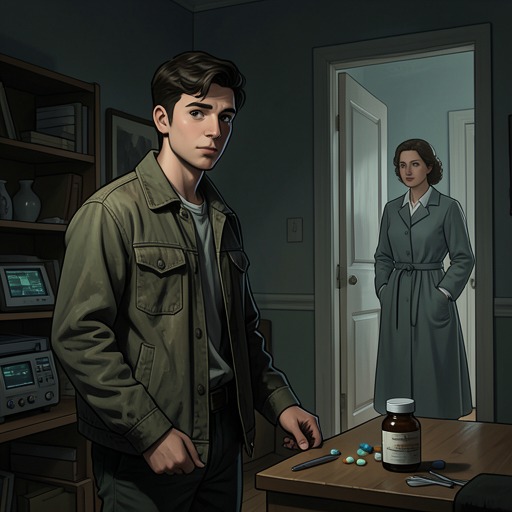
Gwen also becomes involved in a more serious school matter concerning Audrey’s son, Kyle Griffin. She asks Audrey to speak privately in her office, where Kyle is already seated. Gwen opens a desk drawer and presents an orange prescription bottle found in Kyle’s locker the previous day. The bottle bears Audrey’s name and contains Vicodin prescribed after an earlier incident in which Bernadette’s car struck her. The object links the school’s concern about Kyle to the already fraught conflict between his mother and Bernadette.
A later communication supplies more context. A month before writing to Audrey and Warren Griffin, Gwen had received a parent’s accusation that Kyle was selling drugs to students in the hallways. She says she initially refused to believe the allegation, both for Kyle’s sake and for his parents’. By the time of her letter, however, the allegation has become a matter she considers serious enough to raise directly. In a separate email to Audrey, Gwen says that Mr. Levy regards a meeting about Kyle as imperative and that she can work around Audrey’s schedule. These communications establish escalation and follow-up, not a final finding: the evidence records an accusation, a prescription bottle in Kyle’s locker, and the school’s attempt to arrange a conversation, but does not state what conclusion the school reaches.
Administrative Records and the School’s Wider Crisis
Gwen’s work also includes checking the school’s records. After consulting Kate Webb, she confirms that Bernadette and Elgin Branch had requested to be removed from all Galer Street School emails when Bee first enrolled. Gwen verifies that neither parent appears on the school’s current mailing lists. This seemingly minor administrative detail helps explain why the Branch family may have remained outside the school’s routine communications, while showing Gwen responding to a question by checking the record rather than relying on assumption.
During the aftermath of the mudslide at the Griffin home, Gwen appears amid the wreckage in the foyer, handing out Galer Street School gear while trying to keep a brave face. Guests are fleeing, mud-covered staff are milling about, Mr. Kangana is scooping up marimbas, and Ollie Ordway is stuck repeating phrases about an epic failure. Audrey runs down the street, and Bernadette is left caring for thirty traumatized kindergarteners. Against this chaotic scene, Gwen’s small, practical action suggests an effort to preserve some form of school community and care. The novel does not pause to give her an explanation of her feelings; her composure and the gear she distributes make her response visible through what she does.
Narrative Significance
Gwen’s characterization is assembled from institutional traces: a pickup notice, a clarification, a private meeting described by Audrey, follow-up emails, and a brief appearance after the mudslide. These forms suit her function in the story. She repeatedly turns personal upheaval into matters a school must address—safe pickup, a student’s alleged drug sales, parent communication, and the welfare of children caught in a crisis. Her notices also contrast with the partial and emotionally charged accounts circulating among the parents. They do not resolve those conflicts, but they give them an official channel and record what the school is prepared to say.
The evidence presents Gwen as attentive and procedural rather than as a fully explored private personality. She acknowledges a community of involved parents, insists on student safety, investigates a serious allegation without initially accepting it, and pursues contact when a meeting is considered necessary. In the mudslide’s aftermath, her attempt to maintain a brave face and distribute school gear places her among the adults trying to keep children and school life in view while the neighborhood’s familiar order collapses.