Microsoft
Where'd You Go BernadetteMicrosoft is the corporate setting in which Elgin Branch’s robotics work becomes a celebrated public achievement and, later, a project vulnerable to budget cuts and product strategy. The company supports experiments with assistive technology, but its priorities also determine whether those experiments can continue: Samantha gives way to Samantha 2, and Samantha 2 is eventually canceled and folded into games. Elgin’s eventual departure makes the tension personal, turning Microsoft from the source of his professional identity into an institution he leaves behind.
Identity and Setting
Microsoft is also known internally as MS and, in one employee’s wry shorthand, Mister Softy. It enters the story not simply as a place of employment but as part of the Branch family’s daily life: Elgin is hired by the company, and Bee Branch has been there since day care. Her childhood memory of visits to her parents’ workplace centers on a red-wagon ride and a treasure machine built by her father. Children inserted a coin and received a toy selected to match their interests; the machine is later displayed in the Visitor Center as an early example of facial-recognition technology. The family anecdote links Elgin’s technical ingenuity to the company’s institutional history, while showing how work and home have overlapped in Bee’s experience from the beginning.
Elgin’s move to Microsoft brings the family from Los Angeles to Seattle. Bernadette Fox describes the move as something she had intended to be temporary: she expected to recover from her professional humiliation in Los Angeles and eventually begin a second act in architecture. Instead, Elgin comes to love his new life, including the bicycle-riding, Subaru-driving identity he develops around his work. Bernadette’s shifting descriptions of Microsoft—as first marvelous and utopian, then sinister and evil—register her ambivalence about the company and the changes it brings to the household.
Elgin’s Career and the Samantha Projects
Before joining Microsoft, Elgin worked on a research team at Duke attempting to merge mind and computer. The project used rhesus monkeys who moved an animated ball with joysticks to earn treats. Years later, at Microsoft, he worked in robotics and helped develop Samantha, a voice-activated personal robot. In his TED presentation, he demonstrates its domestic promise with a request for popcorn: Samantha goes to a microwave, retrieves a pre-popped bag, and brings it to him. When David Pogue asks for popcorn, Elgin insists that he say please, explaining that the feature came from his daughter’s objection that he was bullying the robot. The moment makes a design decision legible as both a technical function and a lesson in manners.
The demonstration also exposes the distance between a working prototype and a viable product. Samantha had five hundred commands, and Elgin says the team could have added five hundred more; the obstacle was the robot’s thousands of moving parts, its cost, and its lack of marketplace agility. Microsoft canceled the project. When Elgin recalls that cancellation at TED, the audience’s disappointment becomes part of the account: the machine has made a vivid impression, but its complexity and expense have stopped it from becoming a scalable product.
Elgin’s next project, Samantha 2, gives him a new kind of visibility inside Microsoft. When Soo-Lin Lee-Segal learns she will become an administrator on the team, she describes Samantha 2 as a company star project and Elgin as its celebrated leader. He has received Microsoft’s Technical Recognition Award, which she identifies as the company’s highest honor. Samantha 2 has also drawn enormous attention after Elgin’s TED appearance, placing the project and its leader in a prominent position within the company.
That public enthusiasm has a practical purpose. At TED, Elgin introduces Samantha 2 as a system intended to help wounded veterans live independently and productively. He says the project will ship to Walter Reed in March, and describes videos of paralyzed veterans using it in a smart kitchen to cook, watch television, use a computer, and care for a pet. The presentation transforms the earlier robot demonstration: instead of a machine bringing popcorn onstage, the system is presented through everyday activities that can support users’ independence. The project’s promise is concrete, but its continuation still depends on Microsoft’s institutional decisions.
Workplace Culture and Corporate Priorities
The records and employee accounts show a workplace defined by both ambition and instability. One employee worries that a town hall scheduled for the Monday after Thanksgiving signals another round of layoffs. A team leader’s angry reply-all message, declaring Microsoft a dinosaur and predicting its stock would fall to zero, raises fears that the entire organization might be punished. The episode offers a counterpoint to the company’s high-profile technology demonstrations: even an ambitious research environment is also a workplace where employees worry about layoffs, canceled projects, and whether they will land safely after a reorganization.
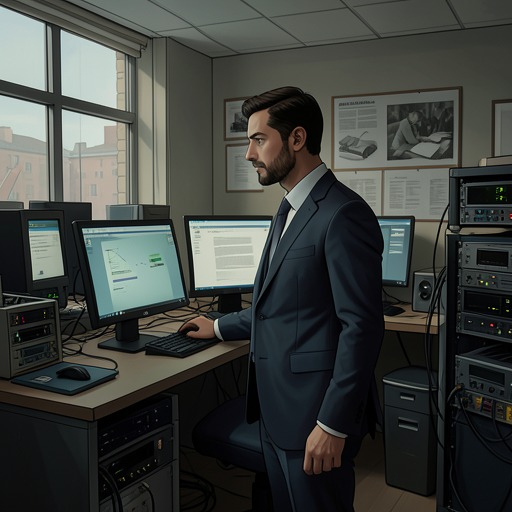
Elgin’s international trip to Antarctica coincides with a pressing deadline: Samantha 2 is due to ship in three months. Soo-Lin, responsible for keeping things running while he is away, describes managing his demands and intervening after he berates marketing employees. Her account reveals the administrative labor around a celebrated technical project, as well as the strain created by Elgin’s mercurial management. Later, when Elgin seeks her out for lunch, he leaves a note on her office door and they bicycle to a spot off campus. The company is thus represented through ordinary details—laptop requests, furniture exchanges, batteries, a missing foosball ball, and an office window—as much as through awards and product launches.
Microsoft’s influence also extends beyond the office. Bee tells her father that she is working long hours for her parents and because the work has the potential to help millions of people; she connects that effort to her hope of taking him to Antarctica. Her account presents the project as a shared family purpose, even as it reflects the way Elgin’s work absorbs time and attention. Elsewhere, the investigation into the fraudulent online assistant posing as Manjula reveals a charge to Elgin’s card billed to a nonexistent company. That incident is not a Microsoft project, but it places the company’s technologically mediated working life alongside the family’s exposure to online deception and stolen personal information.
Cancellation and Elgin’s Departure
Samantha 2’s apparent momentum does not protect it from reversal. While Bee and Elgin are in Antarctica, Elgin tells her that, as of the tenth, the project has been canceled. Walter Reed has withdrawn because of budget cuts, and Microsoft is folding the team into games. He explains the company’s calculation: if Samantha 2 becomes part of games, it might ship in the millions. The exchange makes the conflict between the project’s assistive purpose and the company’s product strategy explicit. A system presented as a means of supporting wounded veterans’ independence is redirected toward a division organized around large-scale release.
Elgin is trying to continue the work elsewhere, in talks with the University of Washington, but Microsoft owns the patents. He corrects Bee’s assumption that he owns them: he owns commemorative cubes, while the company controls the intellectual property. The distinction gives the cancellation a material consequence beyond the end of a team assignment; leaving does not automatically give Elgin freedom to continue using the technology he helped develop.
He has already left Microsoft and turned in his badge the previous week. Bee has never known him without it, and the loss unsettles her: her father’s departure is strange not only as a career change but as the disappearance of a familiar feature of their shared life. Microsoft’s arc in the story therefore closes without a simple verdict. It has provided Elgin a setting for consequential research, recognition, and collaboration, yet its control of budgets, product categories, and patents also restricts what that research can become. The company’s changing place in the family’s life—from Bee’s childhood day care and treasure machine to her father’s surrendered badge—gives its institutional decisions an intimate scale.