Samantha
Where'd You Go BernadetteSamantha, Elgin Branch’s voice-activated personal robot, is both a small domestic helper and a demonstration of the limits of building a useful assistant as a machine with a body. At TED, she makes those limits visible: she can respond to spoken requests and carry popcorn, but her moving parts, cost, and awkward failures ultimately help explain why the project was canceled. The demonstration’s final turn is conceptual rather than mechanical. Branch concludes that the robot itself may be the obstacle, opening a path toward assistance without a robot body.
Design and Demonstration
Branch introduces Samantha as a personal robot developed after he found work at Microsoft in robotics. He explains that the machine is voice-activated and that she was named after the character on Bewitched. The staged example is deliberately domestic: Branch asks for popcorn, and Samantha glides to the microwave, opens its door, removes a bag, and brings it to him. The bag has been pre-popped, an admitted theatrical accommodation that lets the demonstration show the robot fetching and delivering rather than preparing food.
The exchange presents Samantha as functional but basic. She understands a request addressed to her, travels across the stage, and hands over the popcorn; when Branch thanks her, she replies. The sequence gives the audience a compact picture of the promised convenience: ordinary speech directs a machine to act in a household setting. Its charm depends on the contrast between that familiar task and the visible machinery required to perform it.
Courtesy, Error, and the Human Element
David Pogue asks for popcorn from the front row. Samantha does not move when he first asks, and Branch tells him to say please. Branch explains that his daughter, who was eight while he was working on Samantha, had accused him of being a bully; he therefore programmed politeness into the robot. The command is not merely a technical instruction. It carries a lesson from a family interaction into the machine’s rules, making manners part of the interface and giving a practical demonstration a personal detail.
After Pogue repeats the request with please, Samantha rolls to the edge of the stage and reaches out, but drops the bag before he can take it. The popcorn spills in front of the audience. Branch jokes that Microsoft had some bugs, prompting a burst of laughter, then objects that the failure was not that funny. The mishap punctures the polished promise of effortless assistance: Samantha can recognize a social cue and attempt the task, yet the handoff itself remains unreliable. Her physical presence is simultaneously the source of the spectacle and the source of the problem.
Limits and Cancellation
Branch describes the project’s capabilities and constraints in concrete terms. The team taught Samantha five hundred commands and could have added five hundred more, but thousands of moving parts kept holding them back. The difficulty was not simply a shortage of possible commands. A capable, embodied machine also had to be made agile enough for the marketplace and inexpensive enough to scale. On those measures, Samantha was too cumbersome and too costly, and the project was canceled.
The audience responds with disappointment, which Branch meets with a joking question about whether the listeners are a bunch of geeks. The reaction gives the cancellation a public, emotional weight, but it does not alter the practical outcome: the robot’s appealing performance has not made it viable as a product. The contrast between the five hundred commands and the thousands of parts crystallizes the project’s imbalance. More kinds of interaction could be added, but each remained attached to a complicated physical platform.
From Robot to Successor Idea
After repeating that Samantha was canceled, Branch recalls monkeys at Duke and reframes the design problem. If the robot itself is the complicating factor in creating a personal robot, perhaps the robot can be removed. This is the decisive consequence of Samantha’s failure: the goal of a personal assistant is separated from the assumption that it must take the form of a mobile machine.
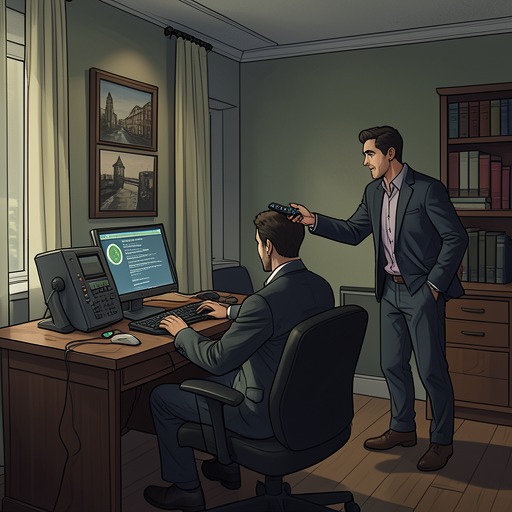
The presentation makes that shift visible through a slideshow. Its first image shows monkeys with wires coming out of their heads; the audience gasps, and Branch apologizes and turns the slide off. He then invokes Moore’s law, explaining that the number of transistors on an integrated surface doubles every two years, and asks the audience to imagine the change over twenty years. The next image replaces the disturbing earlier picture with a shaved head bearing what looks like a computer chip under the skin. The sequence moves from Samantha’s cumbersome moving parts toward a future in which the interface might be closer to the human body. The evidence does not show that this later image solves the difficulties that ended Samantha’s project, but it does establish the conceptual turn the robot’s cancellation prompts: personal assistance can be pursued by changing what counts as the machine, rather than by making the robot more elaborate.