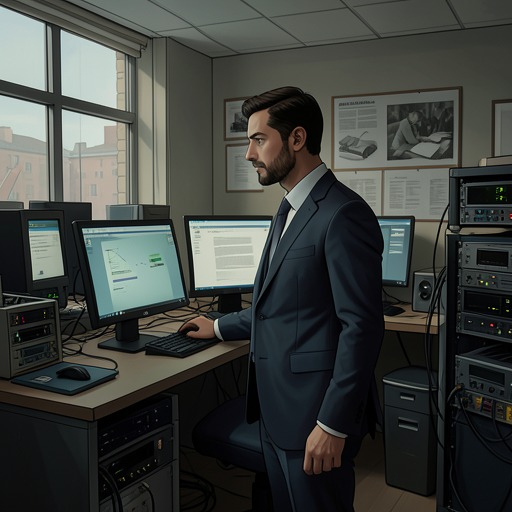
Samantha 2
Where'd You Go BernadetteSamantha 2 is Elgin Branch’s wearable brain–computer interface project: a small forehead patch presented as a way to control household technology through thought. Its public demonstration turns an abstract research ambition into a striking sequence of actions, while its eventual cancellation reveals how a device designed around independence remains vulnerable to institutional budgets, corporate ownership, and the demands of shipping a product.
From Samantha to Samantha 2
The project follows an earlier effort, Samantha, which Elgin says had been taught five hundred commands but was held back by its thousands of moving parts. He describes that complexity as an obstacle to marketplace agility and scale; the project was canceled. For its successor, he reconsiders the basic premise: perhaps a personal robot need not take the form of a robot at all. Samantha 2 shifts the focus from building a machine with a body to making existing devices answer to a person’s intent.
At the TED presentation, Elgin lays out this change through a progression of images and objects. An opening slide shows monkeys with wires emerging from their heads, startling the audience. He then invokes Moore’s law to bridge that disturbing image and a later one of a person with what appears to be a computer chip beneath the skin. A football helmet bearing a Seahawks sticker follows: its interior holds electrodes and wires, but Elgin says it could be worn without wiring anything into the brain. The final step is a Band-Aid-sized patch, which he introduces as Samantha 2. The sequence makes miniaturization visible: what first appears invasive and cumbersome is recast as something light enough to wear.
The TED Demonstration
Elgin sticks the patch to his forehead, sits in a La-Z-Boy, and reclines. A vacuum starts, moves across the floor, and picks up popcorn while he lies still with his eyes open and concentrates. The vacuum stops. The television then turns on, changes channels, and settles on a Lakers game. In the next part of the demonstration, a large screen opens Outlook and a blank email. Its cursor moves without anyone typing: the recipient is Bernadette, and the message reports that the talk went well, the clicker did not, and the Lakers are leading by three at halftime.
The force of the demonstration comes from its ordinary targets. Vacuuming, turning on a television, and composing an email are not spectacular tasks in themselves; what changes is who must perform the physical work. The patch is small, but the actions it appears to set in motion occupy the room: appliances move, screens change, and text appears as Elgin remains seated. The audience rises in an ovation. Elgin removes the patch and announces that Samantha 2 is scheduled to ship in March to Walter Reed.
He presents the intended beneficiaries as wounded veterans with paralysis. A video on Microsoft’s website, he says, shows veterans using Samantha 2 in a smart kitchen to cook, watch television, work on a computer, and care for a pet. The stated aim is to help them live independent and productive lives. This account gives the device a purpose beyond the theatrical proof of concept: domestic tasks are framed as means of agency, not merely as conveniences. The presentation promises practical applications, but the evidence shown onstage is Elgin’s demonstration; the additional examples are described as a video available online.
Promise, Labor, and Conflict
Samantha 2 also becomes part of a conflict over what counts as living independently. During a confrontation with her father, Bee Branch argues that Elgin spent ten years and billions of dollars developing a technology that lets people have a robot do things for them, while Bernadette used an assistant in India to run errands for seventy-five cents an hour. Bee connects Elgin’s attempt to have Bernadette committed to his work, turning Samantha 2 from a celebrated innovation into an accusation about whose dependence is condemned and whose is funded. Her words are an angry interpretation, not a neutral account of the project, but they expose the tension between a device marketed as enabling independence and the labor or infrastructure that makes assistance possible.
The presentation’s language of possibility also contrasts with the project’s material and institutional limits. Samantha’s many moving parts had already made it too expensive to scale, and Samantha 2’s compact patch seems to answer that problem by removing the robot itself. Yet a wearable interface does not free the project from organizations that control money, deployment, and intellectual property. Its promised usefulness depends on more than the patch’s apparent ability to operate devices during a demonstration.
Cancellation and Corporate Ownership
By the time Elgin discusses the project with Bee, Samantha 2 has been canceled as of the tenth. Walter Reed withdrew because of budget cuts, and Microsoft is folding the work into games. Elgin explains that Microsoft values projects that ship; under the games division, the technology might still reach millions of users. That prospect does not preserve the original plan: the hospital partnership has ended, and the project’s direction has shifted from assisting wounded veterans toward a possible mass-market product.
Elgin is in talks with the University of Washington about continuing the work, but Microsoft owns the patents. When Bee assumes that he owns them, he distinguishes the commemorative cubes he owns from the patents held by the company. He has already left Microsoft and turned in his badge the previous week. The distinction makes the end of the project’s first institutional phase concrete: Elgin can leave his employer, but departure does not transfer control of the technology. Samantha 2 therefore ends this part of the story neither as a simple triumph nor as a device shown to be technically impossible. Its public promise remains vivid, while its future is uncertain and subject to corporate ownership, a lost hospital partner, and the unresolved possibility of continuing the work elsewhere.