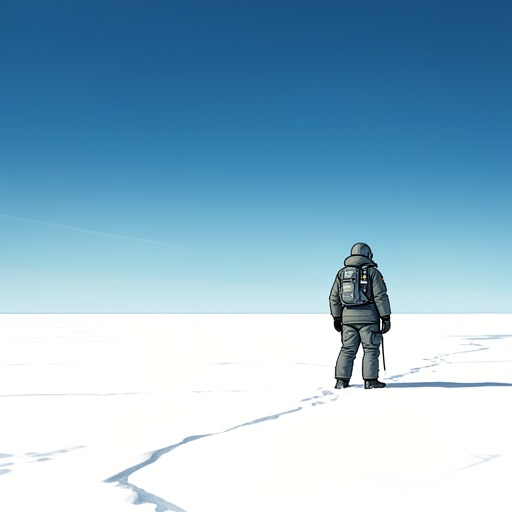
Antarctica expedition destination
Where'd You Go BernadetteAntarctica expedition destination begins as Bee Branch’s reward for earning straight A’s, but it becomes more than a family holiday: a forbidding landscape that tests the family’s attachments and, eventually, reopens Bernadette Fox’s relationship with creative work. The voyage is framed by contrasts between what the family expects to find there and what the place actually offers: not a convenient escape or a picturesque backdrop, but a remote environment with its own scale, conditions, and demands.
The destination and the decision to go
Bee asks for a family trip to Antarctica expedition destination after completing middle school with straight A’s at Galer Street School. She produces a cruise brochure at the dinner table and insists that the trip take place over Christmas. Bernadette immediately objects to the timing and to the prospect of leaving home; the cruise would put her among 149 other passengers, exposed to the social demands she dreads. Yet she also recognizes Bee’s achievement and character, and knows Bee will soon be applying to boarding school. Denying the request would therefore carry a different cost from enduring the trip.
The calendar makes the journey possible as well as urgent. Elgin Branch notices that Christmas falls during the southern summer, the only season in which the trip can be made. Antarctica expedition destination is thus not an interchangeable holiday setting: reaching it depends on a narrow window of access, and the family’s plans are set against the continent’s seasons rather than their own convenience. The expedition’s remoteness is also tangible before departure. Bernadette learns that the route crosses the Drake Passage, which she understands to be exceptionally turbulent, and fears the two-day crossing will leave her severely seasick. Her anxiety is not only social; the physical journey itself seems nearly unendurable.
Arrival and the landscape
The crossing and arrival change the voyage from an idea into a confrontation with place. After taking pills to sleep through the rough sea, Bernadette wakes to the ship’s announcement that land has been sighted at 6:23 and that the vessel is entering Deception Bay. The first landfall is Snow Hill Island. Looking out, she sees a black rocky island capped with snow, surrounded by black water beneath a broad gray sky. Her immediate response is a knot of unease: the scene seems to tell her that she does not belong there.
The ship’s routine sets human activity beside the continent’s severity. Passengers are invited to board Zodiacs for shore excursions, guided walks, and kayaking; the temperature is minus thirteen degrees Celsius, or eight degrees Fahrenheit. On later mornings, Elgin dresses in layers, applies sunscreen and other protective products, and heads out, while Bee stays aboard. From a glass-sided library, Bee reduces the view to three horizontal bands: water, land, and sky, each in shades of black, gray, white, or blue. The image is playful, but it also registers how little the landscape yields to ordinary distinctions or decoration. Its spare composition is not simply scenery for the family story; it sets the measure against which the travelers’ habits and expectations appear small.
That visual restraint gives way to astonishment when Bee finally wakes in the continent after two days of seasickness. An iceberg rises to three times the ship’s height and stretches to twice its width. She rushes to be first in line for kayaking, wanting to encounter the Ice at close range. Ice, unlike snow, appears blue; an iceberg can be tens of millions of years old and calve from a glacier. Bee describes formations at the scale of cathedrals, shipwrecks, concert halls, airplane hangars, and thirty-story buildings. The comparison turns geological mass into an imaginative vocabulary, while the immense blue forms remain independent of human measure. Her response reverses the first arrival’s sense of exclusion: the place that seemed to deny her presence becomes an object of intense attention and wonder.
Conditions, knowledge, and imagined construction
The book also presents Antarctica expedition destination as a place that resists easy or casual human occupation. The distinction Bee learns is that Antarctica is a continent with land, whereas the Arctic is ice; there are no polar bears there, and penguins belong to the southern rather than northern pole. The voyage requires crossing the Drake Passage, and the family’s experience makes that passage’s turbulence more than a fact on a map. These details correct mistaken expectations while emphasizing that the destination cannot be reached without enduring its conditions.
The South Pole sharpens that sense of environmental constraint. Bee learns that it is the planet’s highest, driest, coldest, and windiest place: the average temperature is sixty degrees below zero, winds can reach hurricane strength, and the elevation is ten thousand feet. The Pole sits on a shifting ice sheet, so its official marker must be relocated each year; it can move one hundred feet. The shifting surface unsettles the idea of a fixed point and makes any proposal to build there a problem of adaptation rather than simple placement. Bee wonders whether a structure would have to be a wind-powered, crab-walking igloo, but treats the prospect as a challenge to ingenuity rather than a reason to withdraw.
The logistics make that challenge concrete. Construction would have to be coordinated from the United States, and every material, down to the nails, would need to be flown in. Because transport is so costly, nothing could be wasted. This requirement brings the remote environment into contact with Bernadette’s earlier architectural practice: twenty years before, she built the Twenty Mile House with no waste and using materials sourced from within twenty miles. A South Pole project would reverse that principle, requiring materials from no closer than nine thousand miles. The juxtaposition does not establish that such a building is completed; it reveals how the location gives Bernadette a new problem whose demands resonate with the work she once knew how to do.
Family strain and creative renewal
The destination’s importance is entangled with tensions that began long before the ship arrived. Bernadette’s resistance to the family trip intensifies amid a wider psychological and marital crisis. In the family intervention, Elgin accuses her of arranging wisdom-teeth removal to avoid the voyage and of lying to him and Bee; he also connects her distress to the loss of the Twenty Mile House and her long-standing sense of architectural failure. His attack turns the trip into evidence in a dispute about the marriage, Bernadette’s past, and whether she can still act as wife and mother. Meanwhile, Bee’s anger at the adults’ fixation on proving Bernadette dead shows how the family’s search and fear have made the journey inseparable from the question of whether Bernadette will return.
For Bernadette, however, the continent gradually alters the meaning of being there. She first imagines the voyage as confinement: a crowded ship, a hostile crossing, and forced small talk. At the South Pole, the practical impossibility of building without careful coordination and waste-free use of scarce supplies becomes an invitation rather than merely an ordeal. The resulting surge of energy is explicitly different from the panic she associates with bodily danger. Antarctica expedition destination therefore holds together two opposed experiences: a landscape that exposes vulnerability and a place whose physical limits provoke invention. Its cold, shifting ice, long distances, and monumental forms do not resolve the family’s conflicts by themselves, but they give Bernadette a setting in which attention can turn outward again—to materials, structures, and the possibility of making something.