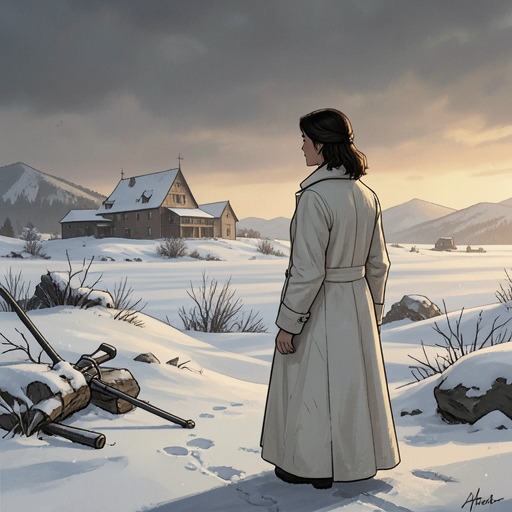
Bernadette Fox
Where'd You Go BernadetteBernadette Fox is a gifted architect whose retreat from creative work reshapes her marriage, her relationship with her daughter, and her place in Seattle. Her story emerges through competing accounts: her own funny, self-justifying correspondence, her husband’s worried recollections, and the records assembled by people trying to assess her condition. Beneath her hostility to neighbors and everyday obligations lies a more consequential loss: she has stopped making things, and neither she nor her family knows how to reverse it.
Identity and Background
Before she became an increasingly isolated presence in Seattle, Bernadette was a rising architect in Los Angeles. She met Elgin Branch when her firm redesigned the animation house where he worked. Both had East Coast backgrounds and attended prep school; Elgin remembers being drawn to her beauty, sociability, and effortless charm. They married while he pursued an idea in computer animation, and his company was eventually bought by Microsoft. Bernadette’s own career took a sharp turn after trouble with a house she was building. She abruptly declared herself finished with the Los Angeles architecture scene, then became the driving force behind the couple’s move north.
In Seattle, she chose the former Straight Gate School for Girls on Queen Anne Hill as a home. Its dilapidated condition did not diminish her enthusiasm: she saw a project where others might have seen only a crumbling building. During her pregnancy, repeated miscarriages and medical restrictions changed the pace of the renovation. The house remained unfinished, with leaks, drafts, and weeds pushing through floorboards. Elgin recalls that they wore parkas indoors, moved spaghetti pots around to catch rain, and kept pruning shears in a living-room vase. He saw the improvised domesticity as romantic, but the house also marks the point where Bernadette’s creative plans became entangled with family crisis and delay.
Bernadette is Bee Branch’s mother and is intensely protective of her daughter, even when that care takes the form of avoidance or concealment. After Bee earns straight S’s at Galer Street School, she asks for a family trip to Antarctica. Bernadette does not want to leave home, and imagines the cruise’s 149 other passengers as an ordeal of noise, demands, and unwanted conversation. Still, she recognizes Bee’s character and the significance of her approaching move to boarding school; she feels she cannot fairly deny the request. Her resistance to the trip is therefore not indifference to Bee but part of a wider difficulty with leaving the house and facing other people.
Creative Work and Withdrawal
The destruction of the Twenty Mile House becomes the defining public wound of Bernadette’s architectural career. The house took three years to complete and was demolished in a single day. Its surviving record is meager: photographs taken by realtor Judy Toll and comically incomplete plans Bernadette submitted to the building department. Architect Paul Jellinek rejects the idea that the loss was simply something done to Bernadette, assigning responsibility to her. The response in architecture circles nevertheless included an outpouring of grief, a measure of how much the house and its destruction mattered beyond her private life.
In Seattle, Bernadette describes herself as having become feral. She traces the image to Sailor, a rabbit she received as a child after finding a golden egg at an Easter hunt. Left in the family’s apartment while Bernadette went away to camp, Sailor was neglected until he was malnourished, overgrown, and frightened; when she opened the cage to comfort him, he scratched her face and neck, leaving scars. Bernadette turns that memory into an account of her own behavior: after years without proper care or connection, even affection can provoke her to lash out. The story is self-mocking, but it also supplies a vivid contrast between the sociable young architect Elgin remembers and the defensive adult she believes she has become.
Her withdrawal does not mean that she has stopped acting. When a machine with spikes and telescoping arms tears through her hillside, she welcomes the prospect of getting out to go to the pharmacy. She also receives fishing vests and fills one with her glasses, car keys, and cell phone, a small, practical detail amid her correspondence with the online assistant she relies on. That dependence becomes one of the most serious parts of the identity-theft investigation: Bernadette has sent a correspondent using the name Manjula extensive family information, including credit-card and bank details, Social Security and driver’s-license numbers, addresses, passport numbers, and photographs. The company billing Elgin’s card is identified as a nonexistent shell company linked to a Russian criminal syndicate. The correspondence that Bernadette treats as help has exposed the family to potential financial ruin.
Conflict and Family Intervention
Bernadette’s conflict with Audrey Griffin begins in the school community, where parents are expected to take part in committees. Bernadette refuses, and Audrey approaches her about the omission. Years later, Bernadette describes a dispute with a neighbor in which she put up a sign in retaliation and inadvertently destroyed Audrey’s home. The incident brings together the consequences of her hostility, her poor judgment, and the physical instability of the setting. During the family intervention, Dr. Janelle Kurtz presents the destruction of the neighbor’s house and the possible trauma to thirty children as part of a larger pattern, alongside Bernadette’s isolation, the identity fraud, and the condemned condition of her own home.
At first Bernadette tries to regain control of the intervention by asking Elgin to send the visitors away and insisting that the matter be discussed privately. When Elgin says that he knows the truth, she reaches for the Antarctic trip as a defense: she claims to have canceled an appointment with Dr. Neergaard and says she is going. Dr. Janelle Kurtz challenges that account, describing Bernadette’s plan to have all four wisdom teeth removed as a way to avoid the journey. The intervention’s catalogue of her conduct is blunt and confrontational, but it also makes visible the gap between her assurances and the evidence her family has gathered.
Bernadette later recounts that she fled the intervention and found unexpected help in Audrey. Audrey pulls her from the balcony, shelters her in the kitchen, and gives her a dossier documenting her behavior. The reversal matters: the neighbor Bernadette has treated as an enemy becomes the person who helps her escape the immediate crisis and confront what has happened. Bernadette then goes to the airport intending to speak with Elgin and Bee in person. Because she cannot learn whether they have checked in, she checks in and boards a plane herself. Her explanation stresses the need for face-to-face contact, a stark departure from the electronic correspondence on which she had come to depend.
Antarctica and the Return of Making
A captain’s report records Bernadette boarding the H&H Allegra at Ushuaia on December 26, assigned to cabin 322 and present for the muster drill. She buys clothes and toiletries aboard, receives treatment for motion sickness the following morning, and refuses housekeeping service for the rest of the journey. These impersonal details give her departure a documentary shape: the woman who feared being trapped among strangers is now moving through the voyage while keeping the cabin and its services at a distance.
In Antarctica, Bernadette’s attention turns back toward architecture. She asks Ellen to get a real letter to Bee in Seattle before the ship returns to Ushuaia, insisting that it must arrive by the seventeenth. She also wants the chance to design the South Pole station and says she needs to visit it to understand the place. The practical barriers are formidable: access to McMurdo requires travel across 2,100 nautical miles from Palmer, and flights to the Pole are reserved for essential personnel. Even so, the ambition itself marks a change. Her future is no longer defined only by the promise never to build again; she is imagining a project and seeking the experience needed to make it.
Bernadette and Bee reunite at Palmer Station. Bernadette appears in Carhartt pants and a fleece, drops to her knees, and holds Bee as Bee runs to her. The embrace follows Bee’s search across Antarctica and transforms Bernadette’s disappearance into a meeting rather than a final separation. The story does not resolve the damage to the family or the uncertainty around Bernadette’s work. Instead, it ends this part of her trajectory with contact restored and creative desire reawakened.
Relationships and Narrative Significance
Elgin’s account presents both affection and regret. He remembers Bernadette’s early energy and the confidence with which she chose their Seattle home; later, he admits that he failed to understand how to help an artist who had stopped creating. He had forgotten that they used her MacArthur money to buy Straight Gate, a fact that makes the deteriorating house seem like the physical collapse of hopes they once shared. His recognition of Paul Jellinek’s insight—that Bernadette needed to create—reframes her crisis as more than an inability to manage domestic life.
Bee’s relationship with her mother gives the Antarctic journey its emotional stakes. After reading documents never intended for a fifteen-year-old, Bee learns about the pregnancies her mother had lost and wonders whether her mother would have preferred those other children, while also feeling broken because of her heart. Elgin acknowledges that the documents were painful and says Paul understood Bernadette’s need to make things. Bee’s reunion with Bernadette does not erase those fears, but it restores the physical closeness that the paper record cannot supply.
The novel’s shifting forms keep Bernadette from being reduced either to her own comic explanations or to the intervention’s list of symptoms. Her emails reveal an abrasive wit and a tendency to defend herself; Elgin’s letter supplies a longer history; official reports record movements and transactions; and Bee’s perspective registers the cost of the adults’ secrets. Across those accounts, Bernadette is both responsible for real harm and someone whose gifts have been stranded. Her return to Bee and renewed interest in designing do not undo the losses, but they open a way beyond retreat: connection and creative work become possible again.