Samantha 2 TED demonstration
Where'd You Go BernadetteElgin Branch’s TED presentation of Samantha 2 turns a faltering technical talk into a live demonstration of a brain-computer interface that controls ordinary devices and composes a message addressed to Bernadette Fox. The event is recounted through a time-stamped account of the presentation, whose small failures—the dead clicker, the delayed slides—make the eventual demonstration feel less like a polished promise than something unfolding in front of the audience.
A public appearance at odds with Elgin’s school presence
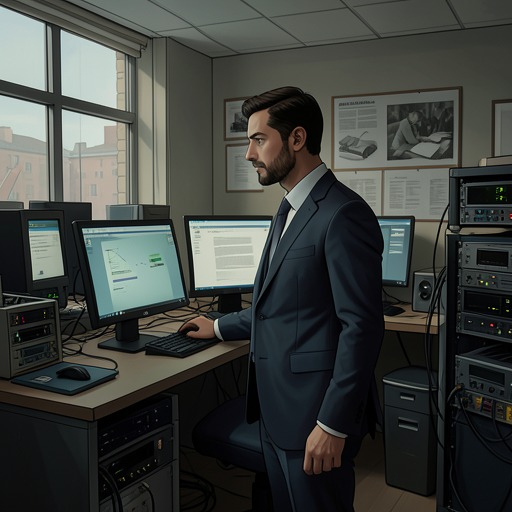
The account begins at 5 PM, when Elgin Branch puts on a headset and appears on the large screen. His place onstage contrasts with the relative absence that Soo-Lin Lee-Segal had noticed in the school community: when she shared a shuttle ride with him, she was initially unsure who he was, and he seemed unfamiliar with her until she identified herself as Lincoln’s mother from Galer Street. He then put on sound-canceling headphones and returned to his laptop. At work, by contrast, Elgin is known as the team leader of Samantha 2 at Microsoft, and TED gives him a stage on which to explain the work behind that project.
The presentation is constrained by the event’s short format. At 5:01, Elgin begins by describing his first job, testing code for a research team at Duke twenty-five years earlier. A clicker fails, and repeated attempts do not advance the presentation. At 5:03 he continues without the slides, describing an experiment in which two rhesus monkeys sat before a screen with joysticks. The joysticks moved an animated ball; when a monkey moved it into a basket, it received a treat. The account records the technical setback alongside Elgin’s persistence: he carries on while the equipment fails and no one immediately comes to help.
By 5:10, Elgin tells the audience that he has one minute left. A person named Chris eventually comes onstage to apologize for the clicker, which has frustrated the audience as well as the speaker. Elgin has not yet explained the robot, and the interruption leaves the presentation’s central subject waiting behind the failed equipment. Two minutes later, he says that the Duke job ended and that he eventually found his way to Microsoft, in robotics. The audience cheers; Elgin, apparently unaware of the reason for its enthusiasm, asks what has happened. He then introduces his work on a voice-activated personal robot.
From Samantha to Samantha 2
Elgin explains that the original Samantha could respond to five hundred commands, but its thousands of moving parts made it too expensive to scale and insufficiently adaptable for the marketplace. The project was canceled. The audience responds with disappointment, while Elgin treats the reaction with humor. The cancellation, however, does not end the idea behind the project. Remembering the Duke monkeys, he reasons that the robot itself may be the complicating factor in building a personal assistant, and that the solution might be to remove the robot.
When the clicker finally works, the slides make that shift visible. The first image shows monkeys with wires emerging from their heads, prompting gasps and shouts; Elgin quickly turns it off. He then traces a sequence from that disturbing image to a person with a computer-chip-like device beneath the skin, and from there to a football helmet bearing a Seahawks sticker, fitted with electrodes and wires inside. The helmet suggests a less invasive arrangement: it can be put on without wiring anything into the brain. At 5:27, Elgin sets it down and produces a small, bandage-shaped device. He introduces it as Samantha 2 and places it on his forehead, just below his hairline.
The demonstration links a practical engineering decision to the project’s earlier history. The original Samantha’s moving parts had made the robot costly and difficult to scale; Samantha 2 instead depends on a wearable interface that translates Elgin’s concentration into commands for devices around him. The presentation does not rest on slides alone: Elgin sits in a La-Z-Boy and begins the live test, letting the audience watch the proposed system operate in real time.
The live demonstration and its message
At 5:29, a vacuum starts, moves on its own, and picks up popcorn while Elgin lies back in the recliner with his eyes open and concentrates. The vacuum then switches off. At 5:31, the television turns on by itself and changes channels before stopping at a Lakers game. The sequence gives the audience a set of recognizable household actions—cleaning up popcorn and turning on a television—rather than an abstract account of what the interface might someday do.
The large screen then changes to Outlook. A blank email opens, the cursor moves to the recipient field, and the name Bernadette appears. The cursor enters a message reporting that the TED talk went well, the clicker did not work, nobody present knows PowerPoint, David Pogue is somewhat uncoordinated, and the Lakers are leading by three at halftime. The message makes the demonstration newly intimate: the system is not only controlling appliances but composing a specific communication addressed to Bernadette. The audience rises and roars as Elgin removes the device from his forehead and holds it up.
At 5:32, Elgin explains that Samantha 2 is scheduled to ship in March to Walter Reed. He directs the audience to a Microsoft video showing paralyzed veterans using the system in a smart kitchen to cook, watch television, work on a computer, and care for a pet. He identifies the project’s goal as helping wounded veterans live independently and productively. The promised applications are thus grounded in particular activities of daily life, not simply in the spectacle of the TED demonstration. The audience responds with an uproar, and Chris returns to the stage to embrace Elgin.
The account’s framing and significance
The event reaches the reader through a time-stamped account rather than an unmediated transcript: its writer says the talk will not appear on the TED website for a month and credits a blogging friend, TEDGRRRL, for allowing her to transcribe a phone video. That form preserves the uneven pace of the talk—the broken clicker, Elgin’s unscripted continuation, the successive visual demonstrations—and makes the audience’s changing response part of the event. Elgin’s muted, low-key manner is set against the crowd’s growing excitement, culminating in its standing roar.
The final email is the presentation’s most consequential reversal. What begins as a product demonstration arrives at Bernadette’s name, bringing Elgin’s public work into contact with his private life without explaining the full meaning of that message. The account records what the screen displays and how the audience reacts, leaving the implications of the address open. At the same time, the transition from a canceled robot to a wearable interface reframes failure as a design problem: rather than making a more elaborate machine, Elgin’s team has made the machine unnecessary. The applause follows both the apparent technical achievement and the possibility that such a system could support independence in everyday life.