South Pole
Where'd You Go BernadetteThe South Pole becomes more than a remote destination in Bernadette’s account: its hostile conditions and demanding construction logistics revive her identity as an architect and give her a problem large enough to command her attention. The marker itself can drift with the ice, while the station depends on costly, carefully coordinated supplies. For Bernadette, those constraints make the place not impossible but irresistible: she wants to reach it in person and pursue the design of its new station.
Geographic and environmental setting
Bernadette describes the South Pole as the planet’s highest, driest, coldest, and windiest place. The average temperature is sixty degrees below zero, hurricane-strength winds are possible, and the elevation is about ten thousand feet. The original explorers had to do more than travel to the Pole: they also faced the challenge of climbing at altitude. These details make the location an environment that imposes physical demands even before the work of living or building there begins.
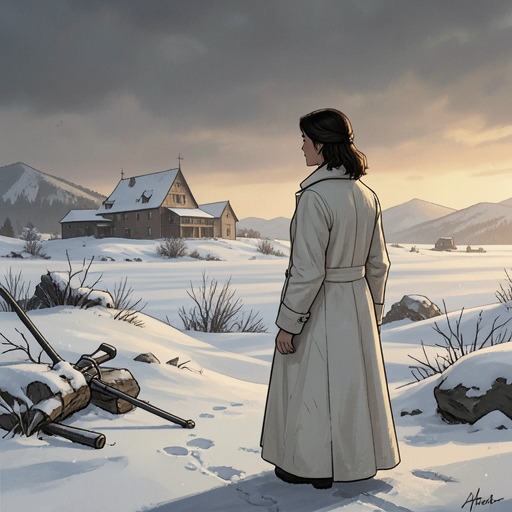
The Pole’s position is not fixed in the ordinary sense. It sits on a moving ice sheet, and the official marker must be relocated each year because the ice can carry it as much as one hundred feet. Bernadette responds to that instability by imagining whether a building might have to move with the landscape, even as she treats the question as an invitation to ingenuity rather than a reason to abandon the project. The shifting marker gives the site a distinctive tension: the place is named as a point, but its surface is in motion.
The location also carries a history of exploration that Bernadette makes personal through comparison. She notes that Roald Amundsen was first to reach the Pole, while Ernest Shackleton became a celebrated figure despite never getting there. She favors Captain Scott, whose failure and difficulty with people complicate his later heroic reputation. Her jokingly partisan judgments show her converting polar history into a set of competing human temperaments, while the Pole remains the severe physical destination against which those reputations were tested.
Construction under extreme constraints
A South Pole station would have to be coordinated from the United States, and every building material, down to each nail, would need to be flown in. The expense of transporting supplies makes waste especially consequential: nothing can simply be treated as disposable or easily replaced. Bernadette measures the scale of this challenge against an earlier project, the house she built twenty years before using no materials sourced from farther than twenty miles away. The proposed station reverses that principle. Its materials would have to come from no closer than nine thousand miles.
That contrast helps explain why the station captures her imagination. The South Pole does not offer the familiar freedom of choosing materials locally; distance, cost, and the conditions of transport define the design problem before construction begins. Bernadette imagines the possibility of a wind-powered, crab-walking structure, but the account establishes the underlying constraint rather than a completed design. No station design is shown as approved or built. What matters here is the challenge the place presents: a building must be conceived around a remote supply chain and a landscape that itself shifts.
Bernadette’s pursuit of the station project
Learning about the station turns Bernadette’s family trip into a professional quest. She becomes absorbed in the prospect of taking over the design of the new South Pole station, staying awake for two days and devoting every hour to planning. She does not describe herself as a great architect; instead, she understands her strength as creative problem-solving, taste, and an attraction to logistical nightmares. The Pole seems to offer a project suited to that self-conception, as well as the chance to stand at the marker and feel the literal center of the world beneath her hand.
The opportunity depends on access as much as design. The South Pole, McMurdo, and Palmer stations are operated by the same military contracting company based in Denver, and the coordinator of Antarctic operations is temporarily at Palmer. Bernadette’s closest connection to this system is Becky. When she raises the possibility of accompanying Becky to Palmer Station, she encounters strong objections: civilians are not permitted, access is limited to essential personnel, and the wait is described as five years. The restrictions establish that scientific and operational priorities govern entry; enthusiasm alone cannot secure a place.
Bernadette nevertheless asks Ellen Idelson for help reaching the Pole in person, believing that she needs to experience the site before designing for it. Ellen explains that flights to the Pole depart only from McMurdo, 2,100 nautical miles from Palmer, and are reserved for essential personnel. After an exchange in which Ellen lays out the obstacles and Bernadette withdraws her request, Ellen returns with a route: a place on a Hercules flight from McMurdo to Ninety South, leaving in six weeks. Bernadette would leave Palmer in five weeks and stand for the three-hour flight among weather balloons, powdered milk, and jet fuel. The arrangement gives her a chance to travel, not a confirmed commission to design the station.
Isolation, access, and the imagined future
The South Pole’s human environment is presented as another part of its physical difficulty. Ellen warns that it is considered the world’s most stressful living environment: a small group of twenty people is confined together, with isolation intensifying the strain. The screening profile for people suited to overwintering favors blasé, antisocial tendencies, comfort with solitude in small rooms, little need for exercise outdoors, and an ability to go long periods without showering. Bernadette recognizes an uncomfortable resemblance between this profile and her own habits, joking that she has spent twenty years training for the conditions. The screening makes clear that survival there involves a particular social and psychological fit, not simply endurance of cold.
Bernadette makes her participation conditional on receiving her daughter’s blessing and arranges for a real letter to reach her in Seattle before the ship returns to Ushuaia. In the letter, she asks her daughter to say yes to an additional month away. She imagines returning to work on plans for the new South Pole station while her daughter graduates from Galer Street School and goes to Lakeside School, and Elgin continues his work at Microsoft. These are plans she offers for a possible future, not outcomes the account confirms. The South Pole thus becomes a place where Bernadette tries to join architectural ambition to family life: its distance and restrictions threaten separation, while the letter frames that separation as temporary and asks her daughter to make the journey possible.