The Brain’s Discounting Mechanism
Where'd You Go BernadetteThe Brain’s Discounting Mechanism is Elgin Branch’s account of how the mind reduces its response to conditions that persist, whether they are pleasurable or harmful. In a conversation with Bee Branch about Straight Gate, the idea explains how a family can become accustomed to holes in ceilings, wet floors, and sealed-off rooms until damage stops registering as damage. Its force lies in the difference between adapting in order to survive and mistaking adaptation for proof that everything is fine.
Definition and Examples
Elgin introduces the concept by asking Bee whether she has heard that the brain is a discounting mechanism. He explains that a fabulous diamond necklace might initially provoke intense happiness, but that the same necklace brings less excitement the next day and may eventually seem unremarkable. The object has not changed; the mind’s response to it has diminished through familiarity.
He gives the reverse example through a cracked windshield. At first, the damage seems like a serious problem, especially when it obstructs the driver’s view. If there is not enough money to repair it, however, the driver continues using the car. A month later, the crack may have become so familiar that its presence is barely noticed. The mechanism thus applies to negative experience as well as pleasure: persistence can reduce the felt urgency of a problem without removing the problem itself.
Bee recognizes the same process in a domestic example. When she first visited Kennedy’s house, she noticed the strong smell of fish from Kennedy’s mother’s cooking and asked what the smell was. Kennedy did not notice it. Elgin treats this as confirmation: the familiar environment had ceased to stand out to the person living in it. The example makes the concept reciprocal. What is conspicuous to an outsider may have become invisible to someone who encounters it every day.
Adaptation and Survival
Elgin explains discounting as a survival mechanism rather than simply a flaw in perception. In his example, someone living among fragrant flowers must stop responding intensely to their constant scent; otherwise, the flowers could mask the smell of a predator. The mind reduces the force of familiar stimulation so that novel experiences, which may signal danger, can command attention.
That explanation gives the concept its ambiguity. Discounting helps a person function in an unchanging environment, but it can also dull awareness of conditions that deserve attention. The cracked windshield remains cracked, and the predator remains the relevant possibility behind Elgin’s jungle illustration. Adaptation changes what people notice, not the material facts around them. The mechanism is protective precisely because it filters experience, yet that filtering can make ongoing harm seem ordinary.
Straight Gate and Family Life
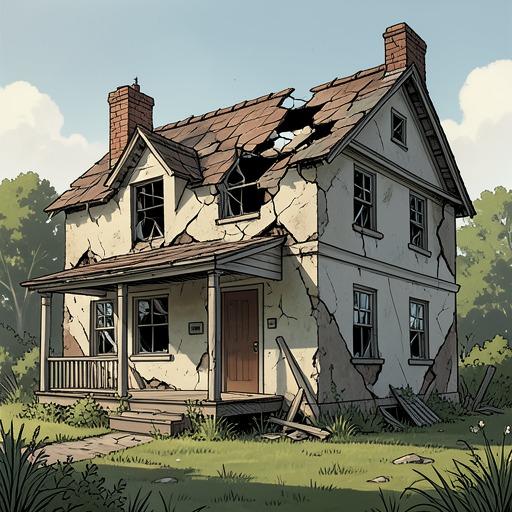
The discussion turns from examples to the house where the family has lived. Elgin says that the family has discounted the holes in Straight Gate’s ceilings, the wet patches on its floors, and the rooms closed off behind barriers. These are concrete signs of deterioration, not merely an atmosphere of discomfort. His judgment is direct: this is not how people live.
Bee answers that it is how they lived. Elgin then repeats her wording in the past tense: it is how they lived. The small grammatical shift marks a change in perspective. The family’s adaptation is acknowledged as real, but it no longer has to define the present. The conversation does not erase the time spent in the house; it makes the neglected conditions newly visible by naming them together.
The idea also meets the history attached to Straight Gate. Earlier in the conversation, Elgin recalls that Bernadette Fox’s MacArthur money had been used to buy the property. After reading an Artforum article, he had remembered it as a place tied to Bernadette’s hopes and dreams, now literally crumbling around them. The house therefore carries both material decay and the weight of an unrealized creative future. Discounting lets its damage fade into the background, but the remembered origin of the purchase makes that damage difficult to treat as merely familiar.
Narrative Significance
The concept provides a vocabulary for the gap between what a household can endure and what it should accept. The damaged house is not described as having become habitable through familiarity; rather, familiarity has altered the family’s response to its condition. The exchange lets Bee and Elgin hold two truths at once: Straight Gate was their home, and its holes, wet floors, and cordoned-off rooms were not normal living conditions.
The scene ends not with a repair plan but with a pause. After Elgin restates that the family used to live that way, time passes; Bee notices a seal and Elgin takes out his ChapStick. Bee then compares them to the Beatles. These modest details keep the conversation grounded in shared life rather than turning the concept into an abstract lesson. The pause also leaves room for the family’s attachment to the house: seeing its damage clearly does not make their past there meaningless. The mechanism explains how the unacceptable can become familiar, while the conversation begins the harder work of seeing it again.