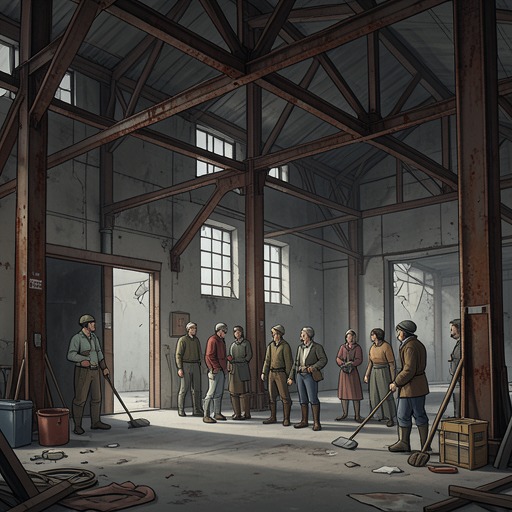
The dilapidated condition of the former Straight Gate building
Where'd You Go BernadetteThe dilapidated condition of the former Straight Gate building turns the Branch family’s home into more than a backdrop: its dark, damp rooms and neglected passages make physical disrepair part of the family’s daily life, while complicating the intervention staged there. Once a school for girls, the building is grand in scale but deteriorated in use, its decay visible in boarded rooms, leaking roofwork, and a basement overgrown with blackberries.
Building and Setting
The Branch residence occupies the former home of Straight Gate School for Girls, a grand brick building on an immense sloping lawn overlooking Elliott Bay. Its scale and position suggest a substantial property, but the interior presents a stark counterimage. Rooms are boarded up, and the building is dark and damp; an investigator describes its musty smell as so overpowering that it seemed almost tangible. The contrast between the imposing exterior setting and the shocking disrepair inside defines the house’s condition: grandeur remains in its scale, while ordinary habitation has not kept the interior in working order.
The deterioration appears not only as general neglect but as an active problem of water entering the home. During the intervention, Bernadette notices that a couch is wet and explains that the orange discoloration comes from rusted roof flashing, through which water drips. She says the stain usually comes out with lemon juice and salt. Her practical account links a visible household mark to a specific failing part of the building, and to an improvised method of cleaning rather than a completed repair. The couch, the orange stain, and the leaking roof bring the building’s condition into the middle of a conversation otherwise focused on Bernadette’s safety and the family’s crisis.
Signs of Neglect in Daily Life
The home’s disrepair coexists with the practical arrangements of family life. As the family prepares for Antarctica, boxes of clothing and equipment arrive at a rapid pace. Parkas, boots, gloves, and snow pants spill from half-open cartons; three packing lists are taped to a wall, one for each family member. Elgin enters the living room, crashes into the boxes and suitcases, and demands to know what they are. The immediate obstruction is travel clutter, not damage to the building, but the scene places the family’s preparations inside a home where ordinary space is already shaped by disorder and unfinished conditions.
The suitcases sharpen the contrast between readiness for travel and the condition of the home. Elgin identifies his own suitcase and Bee’s, then asks where Bernadette’s is. When he picks it up, it hangs limply, still empty. Around it, the expedition’s equipment has accumulated in the living room, while the residence itself remains in disrepair. The episode does not establish that the house’s condition causes Bernadette’s empty suitcase or the family’s tensions; instead, it shows how domestic disorder and travel preparations occupy the same cramped, unsettled scene.
The House During the Intervention
The building’s neglected state becomes especially consequential when Dr. Janelle Kurtz records the plan to confront Bernadette at her dentist’s office. The intended meeting place is not the residence: the family plans to keep Elgin’s car away from the dentist’s office, and Elgin and Dr. Kurtz are to travel there in her car. Yet the intervention’s preparations bring Dr. Kurtz to the Branch home, where she encounters the property directly. She describes a family with significant income living in such deteriorating conditions as suggestive of poor self-regard, ambivalence about financial and social superiority, and poor reality testing. These are the evaluator’s conclusions, not an independently established explanation of why the building has been allowed to decay.
At the residence, the condition of the house is interwoven with the discovery that the online assistant called Manjula has stolen Elgin’s airline miles. Dr. Kurtz arrives as FBI agent Marcus Strang is informing Elgin and Soo-Lin Lee-Segal about the theft and a one-way ticket from Moscow to Seattle. The house’s condition does not cause that fraud, but the episode places the family’s neglected surroundings beside a sudden security crisis. When Bernadette joins the intervention, the wet couch and rust-stained leak interrupt its procedural effort to present reality: the home’s material problems remain immediate even as the adults discuss danger, surveillance, and treatment.
The Sealed Basement and Narrative Significance
The house’s most striking neglected space is its basement. When the investigators ask where a door leads, Elgin identifies the basement and explains that the family never opens it because it is overgrown with blackberries. The door scrapes against the floor as they try to open it; Dr. Kurtz reacts to the smell. The scene offers no account of what lies beyond or how the blackberries came to overtake the space. What it does establish is a part of the home rendered inaccessible through neglect, with vegetation and odor marking the threshold.
Across these scenes, the former schoolhouse is described through concrete failures rather than a single dramatic collapse: boarded rooms, persistent damp, rusted flashing, an orange stain, and a basement door obstructed by blackberries. The details make the building’s deterioration recurrent, from an investigator’s first account of its interior to Bernadette’s matter-of-fact explanation of a leak and the later attempt to enter the basement. Its grandeur and its decay remain in tension. The residence shelters the Branch family, but its leaking roof and unopened, overgrown lower level also make visible the neglected conditions surrounding their efforts to manage a crisis.