Goddess of Fancy
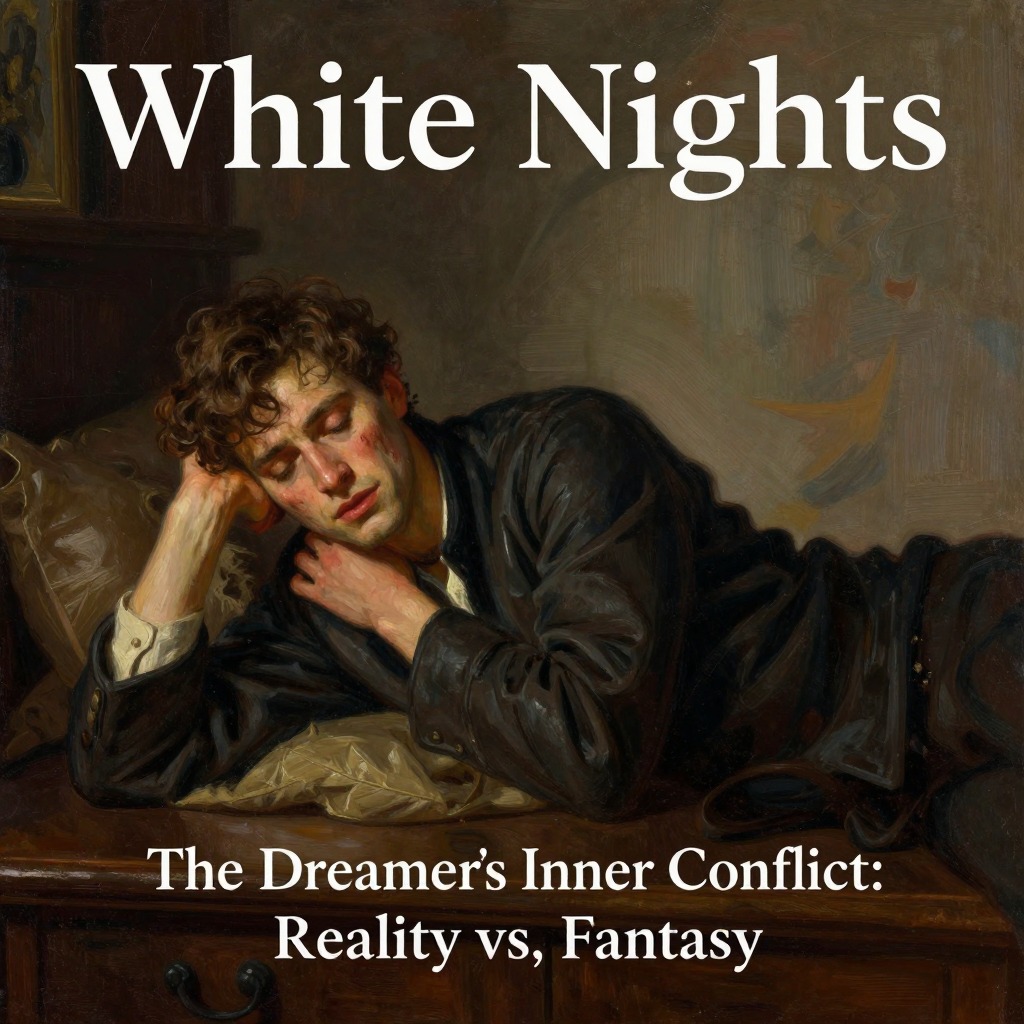
White NightsThe Goddess of Fancy is the presiding deity of the Dreamer's inner world, a personification of the imaginative power that transforms his solitary existence into a realm of endless romantic and heroic adventures. She is the force that allows him to live a life of intense feeling and drama entirely within his own mind, making him, in his own words, "the artist of his own life." This figure is central to understanding the Dreamer's character, as she both sustains him and ultimately alienates him from genuine human connection.
Identity and Role in the Dreamer's Life
The Dreamer introduces the Goddess of Fancy during his long confession to Nastenka on the second night, invoking her by name as a reference to the poetry of Zhukovsky. He describes how, at the hour when his daily work ends, "the Goddess of Fancy" begins to spin her "golden warp" and weave "patterns of marvellous magic life." She is the agent of his most cherished escape: she can transport him from the "excellent granite pavement" of Petersburg to the "seventh crystal heaven." This figure is not a literal character in the story but a metaphor for the dreamer's own creative and self-deceptive faculty. She is the source of the "fresh dreams" and "fresh happiness" that follow each period of imaginative work, providing a "fresh rush of delicate, voluptuous poison." The Dreamer's entire identity as a "type"—an "original" and "absurd person"—is built around his devotion to her.
The Mechanism of Fantasy
The Goddess of Fancy operates through a specific daily ritual. After work, the Dreamer walks the streets of Petersburg, his mind already beginning to drift. He barely notices his surroundings; instead, the Goddess catches up "in its playful flight" every passerby, every detail—the old woman, the curious passers-by, the laughing child, the peasants on their barges—and "capriciously weaves every one and everything into the canvas like a fly in a spider's web." This process of weaving reality into fantasy is the core of his existence. He returns to his room, and after dinner, in the stillness and solitude, his imagination is "fostered by solitude and idleness." It "faintly smoulders, faintly simmers" until it "breaks out spasmodically," and a new world opens before him. The Goddess of Fancy is thus the engine of a continuous, self-generating cycle of illusion.
The Content of the Fantasies
The fantasies the Goddess produces are a rich tapestry drawn from literature, history, and romantic cliché. The Dreamer lists them in a breathless rush: the lot of the unrecognized poet, friendship with Hoffmann, the St. Bartholomew's Night massacre, the heroism of Ivan the Terrible's capture of Kazan, scenes from Walter Scott's novels, the council of Constance with Jan Hus, the opera "Robert the Devil," the Battle of Berezina, Danton, Cleopatra and her lovers, and a little house in Kolomna with a beloved companion listening to him on a winter evening. These are not original creations but a collage of borrowed, highly romanticized narratives. The Goddess of Fancy provides him with a ready-made, idealized life, one in which he is always the central, heroic figure. He even imagines elaborate love stories, complete with a beloved, a jealous old husband, a secret garden, a parting, and a triumphant reunion in a Venetian palazzo.
The Cost of Devotion
While the Goddess of Fancy grants the Dreamer immense private joy, her dominion comes at a terrible price. He admits that his devotion to her has made him incapable of living in "real life." He has lost "all touch, all instinct for the actual, the real." The very richness of his fantasy world makes the real world seem "torpidly, slowly, insipidly" by comparison. He confesses to Nastenka that his life is a "crime and a sin" because it is a flight from reality. The Goddess of Fancy is a "voluptuous poison" that has left him a "voluptuous sluggard." The most painful consequence is the moment of "returning sobriety" after a night of fantasy, when he hears the "whirl and roar of the crowd in the vortex of life" and realizes he is excluded from it. He is forced to celebrate the "anniversary of his own sensations"—memories of things that never happened—because he has nothing real to remember.
The Moment of Crisis and Rejection
The Dreamer's encounter with Nastenka brings his relationship with the Goddess of Fancy to a crisis. For the first time, he experiences real, reciprocal emotion. He tells Nastenka, "Now that I sit beside you and talk to you it is strange for me to think of the future, for in the future—there is loneliness again, again this musty, useless life; and what shall I have to dream of when I have been so happy in reality beside you!" This suggests that real happiness might supplant the need for fantasy. However, when Nastenka ultimately leaves him for the Lodger, the Dreamer does not retreat into his old fantasies. Instead, he accepts his loss with a quiet, selfless blessing. He does not invoke the Goddess of Fancy to console himself. The final line of the story—"My God, a whole moment of happiness! Is that too little for the whole of a man's life?"—implies that he has, for a moment, chosen the real over the fantastic, and found it sufficient. The Goddess of Fancy is thus implicitly rejected, or at least transcended, in the story's final, poignant resolution.