Nastenka's House
White NightsNastenka's House is the small, three-windowed wooden home where Nastenka lives with her blind grandmother, serving as the central domestic space of the story and the site of the grandmother's restrictive pin rule, the lodger's residence, and the emotional anchor for Nastenka's secret romance and eventual reunion.
Identity and Setting
The house belongs to Nastenka's grandmother and is described as a little wooden house with three windows, as old as the grandmother herself, with a little upper storey. It is located in a remote part of Petersburg, near the canal embankment where the Dreamer walks late at night. The house is not merely a dwelling but a prison of sorts: the grandmother, who is blind, pins Nastenka's dress to her own to prevent her from leaving, and this pin rule confines Nastenka to the house for two years. The house's upper storey is rented out to lodgers, and the rent from this, together with the grandmother's pension, constitutes almost all of their income.
The Lodger's Residence and Nastenka's Secret
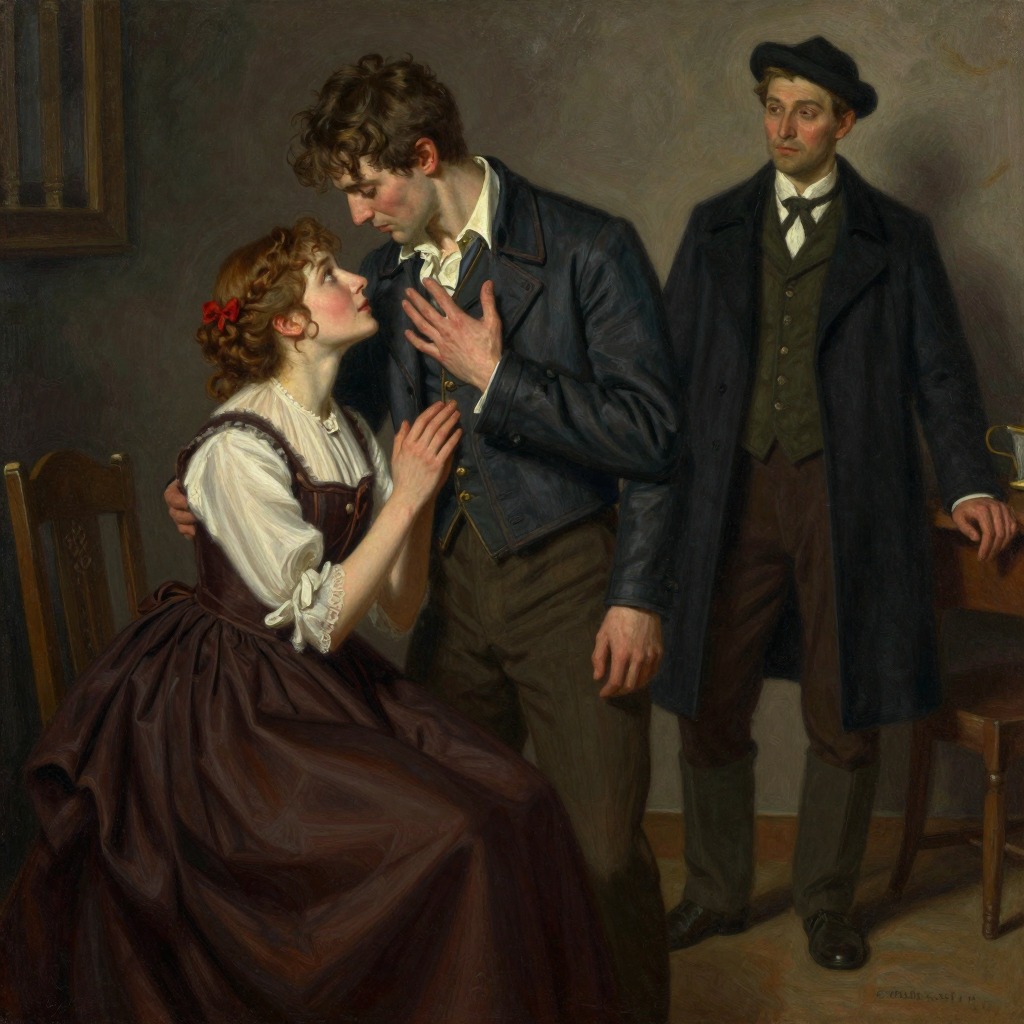
The new lodger, a young man from outside Petersburg, moves into the upper storey. He does not haggle over the rent, and the grandmother accepts him. His presence transforms the house into a site of secret romance. He sends books—Walter Scott's novels and Pushkin—through the charwoman Fyokla, and Nastenka reads them aloud to her grandmother. The lodger eventually invites them to the theatre, and Nastenka falls in love with him. When he must leave for Moscow for a year, Nastenka, unable to bear the thought of remaining pinned to her grandmother, packs her belongings and goes up to his room in the house to offer herself to him. He promises to marry her if he can establish himself, and they agree to keep the promise secret from the grandmother.
The House as a Site of Waiting and Reunion
After the lodger's departure, Nastenka waits for his return for a full year. The house becomes the locus of her anxious waiting: she knows he has arrived in Petersburg but he does not come to the house. She arranges for the Dreamer to deliver a letter to him through mutual acquaintances, and she waits for him at the canal embankment rather than at the house. The house is also the place where the grandmother's rule is most oppressive: Nastenka cannot leave in the morning to meet the lodger, and she must sit beside her grandmother, sewing or reading. The house's upper storey remains empty after the old lady lodger leaves, and Nastenka proposes that the Dreamer move in as a new lodger, imagining a future together. However, the lodger finally appears on the embankment, and Nastenka rushes to him, leaving the Dreamer behind. The house, then, is the space of confinement and secret hope, but the decisive reunion occurs outside it, on the canal embankment.
Narrative Significance
Nastenka's House functions as a chronotope of domestic confinement and secret aspiration. It is the physical manifestation of the grandmother's control and the social limitations placed on Nastenka. At the same time, it is the site of the lodger's residence, which enables the secret romance. The house's upper storey, where the lodger lives, becomes a threshold space where Nastenka's most daring act—offering herself to him—takes place. The house is also the place the Dreamer associates with Nastenka's happiness: he walks past it, ashamed to look at its windows, and imagines her life there. In the end, the house remains as a symbol of the life Nastenka escapes through love, and the Dreamer's own solitary room, with its grimy green walls and spider webs, stands in contrast to the warmth and possibility that Nastenka's House once represented.