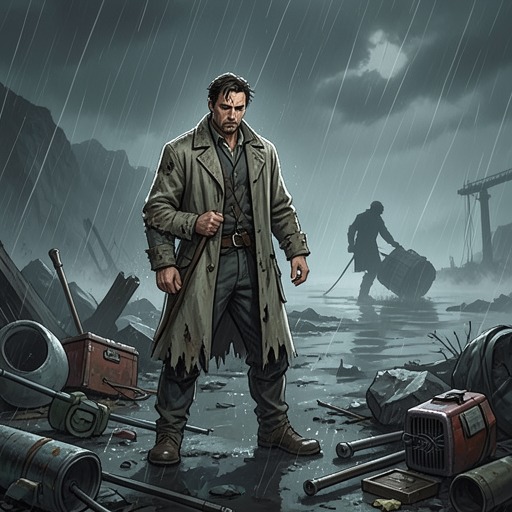
Job
Who's Causing Your TroubleJob is the book’s clearest example of a person overwhelmed by immense trouble, and his catastrophe is used to establish a decisive distinction between visible agents and the real enemy. His losses appear to come from raiders, fire, and wind, but the narrative identifies Satan as the power behind them. Job’s story therefore becomes an argument about spiritual diagnosis: until the source of destruction is correctly recognized, blame falls on the wrong people and even on God.
Identity and Introduction
Job is introduced through the scale of what he possesses and what he loses. His inventory includes seven thousand sheep, three thousand camels, five hundred yoke of oxen, five hundred she-asses, and a very great household. The magnitude of this estate makes his ruin more than a private misfortune; it turns his experience into one of the greatest robberies described in the book. The account measures suffering in concrete objects, animals, servants, and family members, allowing the reader to see how comprehensively his world is stripped away.
The losses arrive with extraordinary speed. Job loses his oxen, donkeys, sheep, and camels, all his children die, and only four of his many servants escape with their lives. Those survivors function as bearers of the disaster, bringing Job report after report of what has happened. The concentration of so many calamities in a single day gives the episode the force of a coordinated assault rather than a series of unrelated accidents.
The Course of Job’s Catastrophe
The first report blames the Sabeans for taking the oxen and donkeys and killing some of the servants. A second report attributes the destruction of the sheep and additional servants to fire and explicitly places blame on God. A third assigns the camels and further deaths to the Chaldeans. Finally, the deaths of Job’s children are attributed to the wind. Each explanation supplies a different immediate cause, dividing the catastrophe among human violence, destructive fire, invading forces, and natural power.
This distribution of blame is precisely what the book asks its readers to question. The Sabeans and Chaldeans may have carried out evil deeds, and the wind and fire appear to be physical forces, but the separate reports obscure the unity of the attack. The narrative’s earlier heavenly exchange reveals that God tells Satan that everything Job has is in Satan’s power, while forbidding Satan to touch Job himself. The permission establishes Satan’s authority over Job’s possessions within the test and identifies him as the mastermind of the losses.
Job consequently becomes the subject of a layered causal structure. The raiders are instruments, the elements are apparent mechanisms, and Satan is the directing power. The text insists that God did not cause the destruction that came upon Job, even though the catastrophe is later described as occurring under authority God allowed. This distinction is central to the book’s theological reasoning: permission and ultimate responsibility are not treated as identical.
Relationships and Conflict
Job’s defining conflict is with Satan, not with the Sabeans, the Chaldeans, the wind, or the fire considered separately. The visible attackers receive the immediate blame because they are the ones named in the reports, but Satan controls the larger pattern. He takes control of everything Job has and motivates the robberies and murders, turning scattered events into one spiritual assault against a single victim.
Job’s relationship to God is therefore framed through a difficult tension. God is the one who grants Satan authority to test him, yet the book argues that God is not the destructive agent. Job’s experience exposes how easily observers can confuse divine permission with divine causation, a confusion represented by the report that blames God for burning the sheep and servants. The episode is designed to correct that interpretation rather than leave the responsibility ambiguous.
The later account of the bent woman provides a deliberate contrast that clarifies Job’s position in the book’s argument. Religious leaders see her condition as merely physical, but Jesus identifies Satan as the source of the eighteen-year bondage and brings immediate healing. In the same way, Job’s material disasters must be read beneath their physical and social surface. In both cases, naming the spiritual adversary changes the meaning of the suffering and opens the way toward deliverance.
Narrative and Thematic Significance
Job’s story supplies the book’s model for recognizing the real troublemaker. Readers are urged to accuse Satan rather than blame God, circumstances, or surrounding people. The practical instruction is presented as an exercise of God-given authority: once the enemy is identified and confronted, his destructive activity must cease, and what he has stolen must be restored.
That restoration language is reinforced by the book’s appeal to biblical theft laws. Exodus 22:7 states that a found thief must pay, while Proverbs 6:31 says that the thief must restore sevenfold and give all the substance of his house. The book applies these legal images to Satan, transforming Job’s losses into the paradigm of a theft for which the real culprit is expected to repay. The promise is expanded rhetorically from property to the things destroyed or stolen from people and their loved ones.
Job thus functions less as a fully developed psychological portrait than as an exemplary case in an argument about attribution, authority, and recovery. His sheep, camels, oxen, donkeys, servants, and children make the cost of the assault unmistakable, while the heavenly permission makes Satan’s hidden agency legible. The story’s lasting force within this framework lies in its reversal of first impressions: what looks like the work of raiders, nature, or even God is declared to be Satan’s organized attack, and correct recognition becomes the first condition of victory and restoration.