Paul
Who's Causing Your TroublePaul is portrayed as a spiritually perceptive apostle whose ministry depends on identifying the true source of opposition. The visible agents of trouble may be false brothers, magistrates, inquisitors, widows who turn aside, or circumstances that prevent a journey, but Paul reads these appearances through a larger conflict. For him, Satan is not an abstract explanation added after the fact; Satan is the enemy who works through human instruments and obstructs the life of the Christian Church. This recognition determines both his interpretation of suffering and his practical response to it.
Identity and Spiritual Discernment
Paul is introduced as a man who was “always aware of his real enemy.” The narrative emphasizes his ability to look beyond the immediate surface of an event and assign responsibility to the spiritual power he believes stands behind it. The devil is said to have sent a satanic messenger to hinder him, and Paul describes his own affliction as “a thorn in the flesh, the messenger of Satan to buffet me.” In this account, the thorn is not treated as an unexplained misfortune or simply as the consequence of bodily weakness. It is interpreted as an instrument of hostile spiritual action.
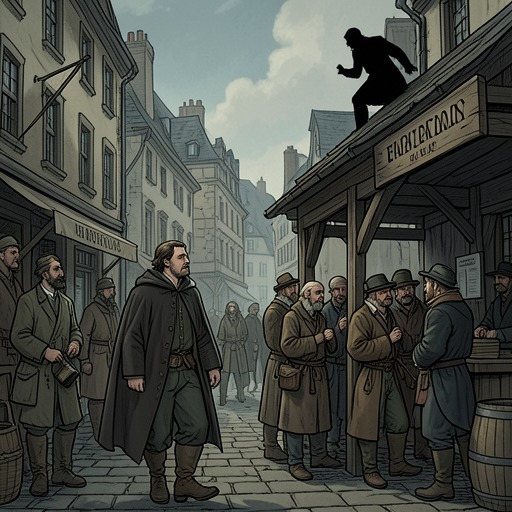
Paul’s discernment also distinguishes between the enemy and the enemy’s instruments. The messenger of Satan appears through “false brothers, evil magistrates as well as various inquisitors,” all of whom confront or hinder him in different forms. Their human agency is not denied, but it is subordinated to the deeper pattern Paul perceives: Satan chooses disguises, while the apostle identifies the power operating through them. His characteristic act is therefore not merely resistance to a person but an effort to reach what the narrative calls “the root of the problem.”
Ministry Under Opposition
The clearest example of Paul’s conflict with Satan concerns his relationship with the saints at Thessalonica. He wanted to visit them and had attempted, or intended, to come more than once, yet his movement was blocked. Paul did not attribute the failure vaguely to travel difficulties or blame the Thessalonian believers. He stated that Satan hindered him. The blocked visit thus becomes evidence of an active adversary interfering with pastoral work and separating an apostle from the community he sought to serve.
Because Paul could not be present personally, he did not allow the separation to become passivity. When he suspected that trouble had arisen among the Thessalonian saints, he sent Timothy to discover where the tempter had attacked them. The decision shows a ministry that combines spiritual interpretation with concrete pastoral action. Paul names Satan as the source of the danger, but he also dispatches a trusted coworker to examine the condition of the threatened community. Diagnosis and response proceed together.
Paul applies the same interpretive framework to problems among widows in the Christian Church. He understands Satan’s interference as the root of trouble in that setting and warns that some have already turned aside after Satan. The language makes moral and communal deviation part of the enemy’s field of action. The adversary can operate not only through public persecution but also through conduct that brings reproach upon the Church and exposes vulnerable members of the community to spiritual danger.
Relations with Human Adversaries
Paul’s principal conflict is with Satan, but the struggle repeatedly takes human form. False brothers, hostile magistrates, and inquisitors confront him as recognizable opponents; nevertheless, he refuses to treat them as the final explanation of his difficulties. They are instruments through which the enemy acts. This produces a distinctive hierarchy of causation: people may perform the visible deed, while Satan is presented as the mastermind of the obstruction.
The same principle appears in the book’s wider interpretation of trouble. Job’s oxen and donkeys were taken by the Sabeans, his camels by the Chaldeans, and the wind was blamed for the deaths of his children; yet the narrative insists that Satan masterminded the losses after receiving authority to test Job. Likewise, the woman who had been bent over for eighteen years was initially viewed by religious leaders as having a merely physical problem, while Jesus identified Satan as the power that had bound her. These episodes supply the interpretive background for Paul: visible people, natural forces, and bodily conditions can conceal the alleged spiritual culprit.
This pattern also explains why the book places Paul’s teaching beside the command that believers wrestle “not against flesh and blood,” but against principalities, powers, rulers of the darkness of this world, and spiritual wickedness in high places. Paul’s understanding of opposition is therefore relational and strategic rather than merely personal. The human opponent is not necessarily the whole enemy, and confronting the visible instrument without recognizing the spiritual power behind it risks attacking the wrong target.
Instruction, Authority, and Response
Paul’s example becomes a model for readers. The book urges them to recognize Satan as the source of every problem, accuse him openly, and take authority over him. The recommended confession is direct: “Satan, you are at the bottom of my trouble!” In this framework, naming the adversary is itself a decisive movement from confusion toward action. The sooner a believer accuses Satan and exercises authority, the sooner the book says that the way to total victory will open.
The promised consequence is restoration. The devil is said to have to restore what he has destroyed or stolen from believers and their loved ones. The argument invokes the rule that when the thief is found, he must pay, even restoring sevenfold and giving all the substance of his house. Paul’s spiritual discernment is thus folded into a broader theology of recovery: identifying the real thief is meant to lead not only to understanding but also to repossession and recompense.
The book turns this teaching into a spoken declaration addressed to the devil. The believer is instructed to stop blaming God, circumstances, or surrounding people and to announce that Satan’s days of stealing are over. The declaration claims that the devil is under the believer’s feet, must return what has been stolen, and must pay “seven hundred percent,” because the biblical text says the thief shall restore sevenfold. Paul’s role in this structure is exemplary: he demonstrates the interpretive act on which the confession depends, moving behind appearances to name the spiritual adversary.
The response is not presented as solitary speech alone. The book closes this line of instruction by inviting agreement in prayer, citing the promise that if two people agree on earth about what they ask, it will be done for them by the Father in heaven. Paul’s ministry therefore becomes part of a chain linking discernment, accusation, authority, restoration, and collective prayer. His inability to visit Thessalonica did not end his responsibility for the believers there; he acted through Timothy, and the reader is likewise encouraged to act through faith-filled speech and agreement.
Narrative Role and Significance
Paul gives the book’s central argument its apostolic and practical form. Job’s losses and the healing of the bent woman establish that apparent causes can conceal Satan’s activity; Paul then shows how a minister should respond when that activity appears in persecution, bodily affliction, blocked travel, temptation, or communal disorder. His importance lies less in a complete biographical portrait than in the consistency of his interpretive posture. Again and again, he looks past the immediate agent and identifies the adversary.
That posture also gives the narrative its characteristic reversal of blame. God is not presented as the author of Job’s destruction, human opponents are not treated as the ultimate source of Paul’s hindrances, and bodily affliction is read as more than a physical irregularity. The book asks believers to redirect accusation away from God, circumstances, and people, and toward Satan. Paul embodies that redirection most clearly because his response is neither resignation nor indiscriminate hostility: he recognizes the enemy, investigates the damage, sends help, and calls believers to use the authority the book says God has given them.
Paul consequently functions as both character and interpretive authority. His statements transform scattered misfortunes into a coherent spiritual conflict and convert recognition into a program of resistance. Within the book’s theology, victory begins when the real troublemaker is named; Paul is the figure who repeatedly performs that naming in the face of ministry failure, personal affliction, and danger among the churches.