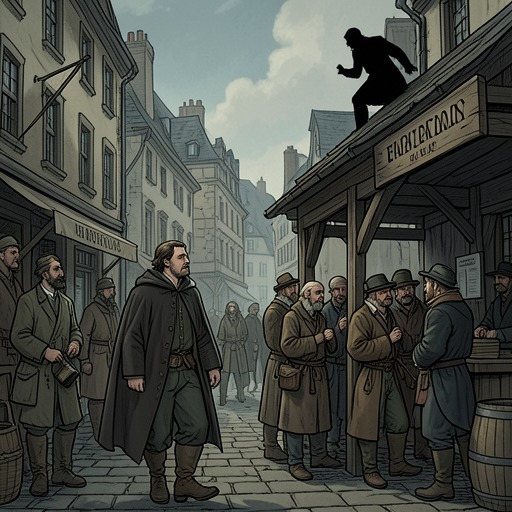
Paul's hindered visit
Who's Causing Your TroublePaul's hindered visit is the episode in which Paul explains that repeated efforts to reach the believers in Thessalonica were blocked by Satan. Its decisive significance lies not only in the failed journey but in the way Paul interprets that failure: he refuses to leave the cause at the level of inconvenience, hostile people, or ordinary circumstance, and instead names Satan as the agent obstructing his pastoral purpose. The episode therefore becomes a model of spiritual diagnosis and response, turning an interrupted visit into an argument about recognizing the real enemy.
The Blocked Journey
Paul says that he and his companions intended to come to the Thessalonian believers “once and again,” but that Satan hindered them. The wording presents the obstruction as repeated rather than accidental. Paul had not abandoned the community or forgotten its needs; the desired visit remained an active intention, yet the route toward it was persistently closed. The obstacle is therefore defined by its effect on a concrete pastoral relationship: it prevented Paul from reaching people for whom his presence mattered.
The account gives no detailed physical description of the barrier and does not identify a single human scene as the cause. That restraint directs attention away from the surface mechanics of the failed journey and toward Paul's interpretation of its source. The visit's interruption is narrated as an act of opposition, with Satan occupying the role of the adversary who interferes with Paul's movement toward the Thessalonian church.
Spiritual Diagnosis
Paul's interpretation belongs to a wider habit of looking beneath visible instruments. The book presents him as someone who encountered false brothers, evil magistrates, and inquisitors, yet recognized that such people could function as instruments of Satan. In this framework, the visible actor and the deeper adversary are not identical: human beings may perform hostile actions, but Satan is identified as the power that motivates or directs the obstruction. Paul's hindered visit is consequently treated as an instance of spiritual conflict rather than merely a dispute among people.
This diagnosis is set against the principle that the struggle is not against flesh and blood but against principalities, powers, rulers of the darkness of this world, and spiritual wickedness in high places. Paul's language gives the failed visit a larger scale. A local absence becomes evidence of an unseen opposition, and the thwarted journey is read as part of the same pattern of interference that the book associates with temptation, accusation, and destructive trouble.
Paul's Pastoral Response
Although Paul could not visit the Thessalonian believers personally, he did not respond with passivity. When he suspected that the tempter had attacked them, he sent Timothy to discover their condition. The substitute mission preserves the pastoral objective even when the original plan cannot be carried out. The obstruction changes the method of care, but it does not cancel the responsibility to care.
Timothy's dispatch also shows that Paul's recognition of Satan's role was not an excuse to ignore practical circumstances. Spiritual interpretation led to concrete investigation. Paul sought information about what was happening among the Thessalonian saints and acted through a trusted representative. The episode thus joins discernment to organized pastoral action: identifying the adversary does not replace attention to the affected community, but determines the urgency and direction of that attention.
The Episode Within the Book's Theology
The book uses Paul's hindered visit to teach readers to accuse Satan as the real troublemaker rather than automatically blaming God, circumstances, or people. The same logic appears in its reading of Job's losses, where Sabeans, Chaldeans, wind, and the language of “acts of God” might appear to explain the disasters, while Satan is presented as the mastermind. It also appears in the account of the bent woman, whose physical condition was interpreted by others as a bodily problem but by Jesus as an affliction rooted in Satan's interference. Across these examples, naming the deeper culprit is presented as the first step toward deliverance.
The intended response is explicitly verbal and authoritative. Readers are urged to say aloud that Satan is at the bottom of their trouble, to put the devil on notice, and to take authority over him. The text treats these declarations not as private descriptions but as actions expected to alter the situation: once the real thief is recognized, the devil must cease destructive activity and restore what has been stolen. The language of Proverbs is then applied as a promise of sevenfold restoration, giving the act of accusation a legal and compensatory shape.
Significance and Aftermath
Paul's blocked journey does not end with a recorded confrontation or a description of Satan's defeat. Its immediate outcome is more indirect: the community is not left without attention because Timothy is sent in Paul's place. The event therefore emphasizes endurance and adaptation within opposition. A thwarted plan remains a real loss, but it does not have the final word over Paul's mission.
The episode also prepares the book's concluding movement toward collective spiritual action. After instructing readers to identify the enemy and exercise authority, the book invites agreement in prayer and cites the promise that when two people agree on earth about what they ask, it will be done by the Father in heaven. Paul's hindered visit thus functions as both testimony and instruction: opposition may obstruct a chosen route, but recognition, delegated care, spoken authority, and prayer are presented as means of continuing the work and pursuing victory over Satan.