Sin
Who's Causing Your TroubleSin is presented as the decisive breach through which evil entered a creation that had been made good. The account does not treat the world’s disorder as an original feature of creation or as an unavoidable physical condition. Instead, it locates the beginning of the sin problem in Satan’s misuse of free will and his interference with God’s perfect work, then traces the consequences through human disobedience, suffering, sickness, temptation, and opposition to believers.
Origin in a Good Creation
The theological sequence begins with a contrast between the goodness of creation and the later presence of evil. God’s completed work is described as very good, while Satan himself is said to have been perfect from the day he was created. The change therefore comes not from a defect in creation but from a will that turned away from its intended order. Through the misuse of free will, Satan brought sin and evil into the world, making sin an intruder rather than a constituent element of the created order.
This origin story assigns sin both a spiritual source and a historical consequence. Satan’s rebellion is not left as an isolated act in the heavenly realm; it becomes active within human life when he tempts Adam and Eve to disobey God. The resulting human fall gives the sin problem its earthly reach. Satan motivates the first disobedience, while humanity becomes the site at which that disobedience takes visible form.
Satan and Human Disobedience
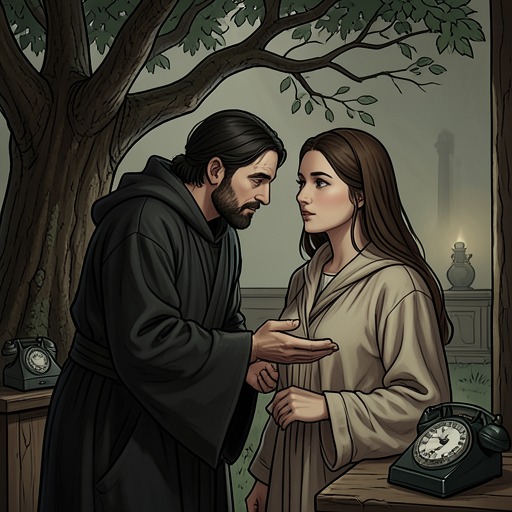
The account of Adam and Eve also establishes how responsibility can become obscured after sin occurs. Adam begins by blaming Eve, explaining that the woman gave him the fruit and that he ate. His response places the immediate act before the reader but does not erase the prior deception that set the trap. The narrative’s emphasis is therefore not only on the act of disobedience but on the struggle to identify who initiated and governed it.
Satan’s role is treated as more fundamental than the visible human action. Adam and Eve disobey, but Satan is identified as the power that motivated them to sin. This distinction becomes the pattern for later examples: a human being, a physical instrument, another nation, or a natural force may appear closest to the harm, while the account searches for the spiritual agent understood to stand behind it.
Sin as the Root of Later Trouble
The same attribution governs the interpretation of Job’s losses. In a single day, Job loses his oxen, donkeys, sheep, and camels, his children die, and only four of his many servants escape alive. The reports assign blame in several directions: the Sabeans are accused of taking the oxen and donkeys and killing servants; God is blamed for the fire that consumes the sheep and more servants; the Chaldeans are blamed for the camels and additional deaths; and the wind is blamed for the deaths of Job’s children.
Yet the narrative places the decisive authority elsewhere. God gives Satan permission to act against everything Job possesses while forbidding him to touch Job himself. Satan consequently becomes the mastermind of the robberies and killings, even though Sabeans and Chaldeans perform some of the human violence and the wind appears as the immediate instrument in the children’s deaths. The account explicitly rejects the conclusion that God caused Job’s destruction. Sin and evil are thus interpreted through a layered model of responsibility: visible agents and circumstances may deliver the harm, but Satan occupies the ultimate position of culpability.
The Job episode also exposes a recurring interpretive danger. Destructive events are easily attributed to God, nature, or human actors because those are the explanations closest to observation. The book insists that such explanations can mistake an instrument for the guilty party. Its broader claim is that identifying the true source of trouble is necessary before resistance or restoration can begin.
Affliction, Temptation, and Spiritual Opposition
The account applies the same logic to the woman who has been bowed over and unable to straighten herself. Religious leaders view her condition as a purely physical problem and judge that it should not be addressed on the Sabbath. Jesus looks beyond the bodily symptom, recognizes a spiritual cause, and identifies Satan as the one who has bound her for eighteen years. Once the true source is named, immediate healing follows, while the crowds rejoice and the adversary is put to shame.
This episode makes sin’s effects visible in the body without reducing the woman to moral blame. The physical condition is treated as the outward expression of Satan’s interference, and Jesus’ action reverses the condition by confronting its spiritual root. The contrast between the synagogue ruler’s judgment and Jesus’ discernment is central: one sees a bodily irregularity and a disputed Sabbath procedure, while the other sees bondage and answers it with release.
The same adversarial role appears in the account of the widows and the Thessalonian believers. Paul understands Satan’s interference as the root of trouble among some widows in the Church and names the devil as the perpetrator. He warns that some have already turned aside after Satan and urges the younger widows to avoid giving the adversary an occasion to speak reproachfully. Elsewhere, Satan is identified as the tempter who seeks to tempt believers. Sin therefore operates not only as a past act inherited from the human fall but as an active pressure that can redirect conduct, damage communal reputation, and obstruct faithful perseverance.
Responsibility, Authority, and Restoration
The book’s summary assertion is uncompromising: the entire sin problem is laid at Satan’s feet, and the statement that the one who commits sin is of the devil is used to connect continuing sin with the devil’s own activity from the beginning. This does not make human behavior irrelevant; Adam’s eating, the widows’ turning aside, and the actions of those involved in Job’s losses remain part of the visible chain. But the interpretive priority is to expose the spiritual enemy rather than leave blame resting on the sufferer, the body, nature, or God.
Recognition is presented as the first practical movement toward overcoming. Readers are instructed to identify Satan as the source of their trouble, accuse him for his part, and take authority over him. The recommended confession is direct: "Satan, you are at the bottom of my trouble!" In this framework, speech is not merely explanatory. Naming the adversary is an act of resistance intended to open the way to victory and to force the devil to cease destructive activity.
Restoration is then linked to the biblical law of restitution. The book cites the rule that when a thief is found, the thief must pay, and it invokes the command in Exodus that the thief pay back what was taken. The principle is applied to Satan as the real thief: once he is identified and confronted, he is said to have to restore what he has destroyed or stolen from believers and their loved ones. Sin thus becomes part of a larger drama in which exposure of the hidden culprit leads not simply to diagnosis but to authority, judgment, and the expectation of recovery.