Demons
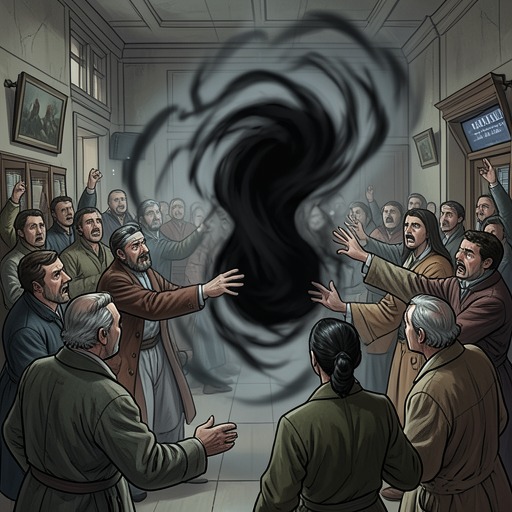
Who's Causing Your TroubleDemons are the spiritual forces associated with Satan’s opposition to God and with the destructive troubles described throughout the book. They are not treated as independent rivals equal to God or Jesus Christ; rather, they belong to the defeated hostile power structure that believers are taught to recognize, confront, and resist.
Identity and Spiritual Position
Demons appear under the related designation “unclean spirits.” When Jesus Christ called His twelve disciples, Judas included, He gave them power against unclean spirits, along with authority to cast them out and to heal every kind of sickness and disease. This places Demons within the book’s account of spiritual opposition while also establishing that their activity can be restrained by authority granted to Jesus Christ’s followers.
Their position is further defined by the book’s use of the language of spiritual conflict. The struggle is not against flesh and blood but against principalities, powers, rulers of the darkness of this world, and spiritual wickedness in high places. Demons therefore belong to an organized, unseen opposition rather than to the visible human circumstances that often appear to be the immediate cause of suffering.
Defeat Through Jesus Christ
The book insists that Demons must be understood in light of Jesus Christ’s resurrection. When Jesus Christ rose from the grave, He stripped the devil and his Demons of their power and made an open display of their defeat. The cited account of this triumph describes the hostile principalities and powers as spoiled and publicly exposed, with Jesus Christ triumphing over them.
This claim changes the practical meaning of spiritual danger. Demons may still be identified as agents of destructive activity, but believers are not instructed to live in fear of what Satan or his Demons might do. Their defeat is treated as an accomplished fact, and the believer’s task is to recognize that defeat and exercise the authority made available through Jesus Christ.
Activity in Human Trouble
The book connects Demons with Satan’s broader work of producing trouble, while assigning Satan the role of the ultimate source and mastermind. In the account of Job, destructive events were carried out through visible agents and circumstances: the Sabeans took oxen and donkeys, the Chaldeans took camels, fire destroyed sheep, and wind brought about the deaths of Job’s children. The book argues that these human and natural means concealed the real spiritual cause. Satan received authority to test Job and took control of everything Job had, motivating the robberies and murders; the visible instruments were not the final explanation.
The same interpretive pattern governs bodily affliction. The woman who was bowed over and unable to straighten herself had been bound for eighteen years. Religious leaders treated her condition as merely physical and judged that Jesus Christ should not address it on the Sabbath, but Jesus Christ looked beyond the visible symptoms and identified Satan as the source of the bondage. Once the real culprit was named, the woman received immediate healing, the multitudes rejoiced, and the adversary was put to shame.
This attribution is presented as a deliberate correction to ordinary habits of blame. People may blame illness, hostile individuals, natural forces, or circumstances, just as Job’s losses were variously attributed to the Sabeans, the Chaldeans, fire, and wind. The book instead directs attention to the spiritual agency behind such manifestations. In its own framework, Demons are part of the unseen realm through which that destructive agency operates, while the visible event is only the instrument or surface expression.
Influence, Temptation, and Opposition
The book also associates Demons with Satan’s influence over human conduct. Judas had been a disciple from the beginning, had witnessed most of Jesus Christ’s miracles, and was included among those given authority against unclean spirits. Nevertheless, Judas allowed the devil to gain control of his mind and turn him against Jesus Christ. The emphasis falls not on a lack of religious proximity or privilege but on the spiritual force that motivated his unfaithfulness.
Paul likewise interpreted opposition within the Christian community and threats to its faithfulness through Satan’s activity. He referred to Satan as the tempter and identified the adversary as the source of trouble involving some young widows, warning that some had already turned aside after Satan. These examples extend the book’s account beyond spectacular demonic manifestations: spiritual opposition can appear through temptation, disloyalty, reproach, and the redirection of human behavior.
Believers’ Authority and Narrative Significance
The book’s central instruction is recognition. Those who want to overcome must identify Satan as the source of their trouble, accuse him for his part, and take authority over him. The recommended confession is direct: “Satan, you are at the bottom of my trouble!” Once the real enemy is recognized, the book says, the doors of victory open and the devil must restore what he has destroyed or stolen from believers and their loved ones.
For a born-again believer, the proper perspective is linked to being seated in heavenly places with Jesus Christ, where spiritual realities can be seen more clearly. The believer must stop blaming people and circumstances for insufficiency and failure, recognize that the struggle is against spiritual powers rather than flesh and blood, and act on the authority God provides. Demons thus function in the book both as agents of a real spiritual threat and as defeated powers whose authority cannot finally withstand the victory of Jesus Christ or the properly exercised authority of believers.