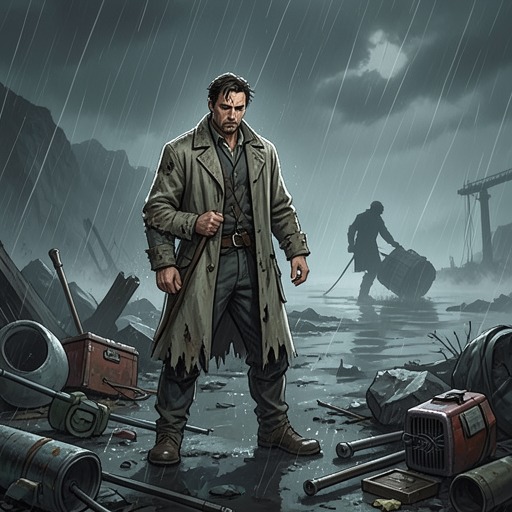
Job's trials
Who's Causing Your TroubleJob's trials function in the book as the clearest large-scale demonstration of its central claim that Satan is the hidden source behind apparent human, natural, and material disasters. Job's losses arrive with the speed of a catastrophe and wear several misleading faces—raiders, fire, and wind—but the narrative directs responsibility behind those visible instruments to Satan, who receives authority to control what Job possesses. The episode therefore becomes more than a record of suffering: it is an interpretive lesson about identifying the true enemy rather than blaming God, circumstances, or the people caught in the event.
The Scale of Job's Losses
Job is introduced through the magnitude of what is taken from him. His inventory includes seven thousand sheep, three thousand camels, five hundred yoke of oxen, five hundred she-asses, and a very great household. The precise enumeration makes the disaster economic as well as personal: the attack destroys the productive base of a vast estate, removes servants who sustain it, and turns abundance into devastation.
The losses are compressed into one day. Job loses the oxen and donkeys, the sheep and additional servants, the camels, and still more servants; then reports announce that all his children have died. Of Job's many servants, only four escape with their lives. Their survival serves a narrative function, since they remain to carry the successive reports of disaster, allowing the catastrophe to arrive in waves while still forming one overwhelming day of ruin.
Visible Agents and Hidden Responsibility
The first reports assign responsibility to different immediate causes. The Sabeans take the oxen and donkeys and kill some servants. A later report blames God for burning up the sheep and more of the servants. The Chaldeans seize the camels and kill additional servants, while the deaths of the children are attributed to the wind. The sequence distributes blame across hostile peoples, divine action, and nature, creating a surface explanation in which no single culprit appears to govern the whole calamity.
The book rejects that fragmented reading. It explicitly contrasts the reports in Job 1:15-19 with the heavenly exchange in which God tells Satan that everything Job has is in Satan's power, while forbidding Satan to touch Job himself. On this account, the Sabeans and Chaldeans perform evil deeds, and the wind remains the immediate means of the children's deaths, but Satan masterminds the entire assault. He takes control of everything Job has and motivates the robberies and murders; God permits the test within the stated limit but is not presented as the destroyer.
This distinction also challenges the language of so-called acts of God. The book observes that people commonly blame God for the loss of goods and that insurance policies allow for liability when destructive incidents are classified in that way. Job's trials are used to separate permission from authorship: the fact that God grants Satan authority to test Job does not, in the book's interpretation, make God the cause of the destruction.
A Lesson in Spiritual Attribution
Job's experience is placed beside the book's broader insistence that trouble must be traced beyond its visible form. A person who sees only raiders, fire, wind, or economic loss may assign blame to the wrong party. The lesson drawn from Job is that Satan can work through human actions and natural forces while remaining the deeper source of the attack. Recognizing that source is treated as the beginning of effective resistance.
The same interpretive pattern appears in the account of the bent woman. Religious leaders regard her condition as merely physical, but Jesus identifies Satan as the one who has bound her for eighteen years. Her immediate healing follows the exposure of the spiritual cause. In this comparison, Job's material catastrophe and the woman's bodily affliction belong to one explanatory system: what looks like an isolated physical, social, or economic problem may be an expression of Satan's activity.
The book extends the principle into its account of spiritual warfare, invoking the claim that the struggle is not against flesh and blood but against principalities, powers, rulers of the darkness of this world, and spiritual wickedness in high places. Job's trials thus model a shift from visible opponents to an unseen adversary. The shift is meant to alter conduct as well as interpretation: readers are told to accuse Satan, take authority over him, and refuse to make God or surrounding people the primary objects of blame.
Loss, Theft, and the Promise of Return
The vocabulary applied to Job's experience is the vocabulary of theft. Satan is described as taking what Job possesses, and the book connects this interpretation with legal language from Exodus and Proverbs: when the thief is found, the thief must pay, and the thief must restore sevenfold, even giving all the substance of the thief's house. These passages are presented as the basis for a restoration claim directed against the identified spiritual thief.
That legal metaphor changes the shape of the episode. Job's losses are not treated only as inexplicable suffering or as evidence of divine hostility; they become stolen goods whose hidden taker can be exposed and compelled to repay. The later confession addressed to the Devil promises not merely the return of what has been taken but sevenfold repayment, described there as seven hundred percent. Job's catastrophe therefore supplies the book with both a warning about misdirected blame and a precedent for demanding recovery.
The promise is tied to spiritual identity. The book says that restoration begins when a person accepts Jesus as personal Savior and stops serving Satan, described as the god of this world, in order to serve the God of the Word. In that framework, salvation is the beginning of restoration, while recognizing Satan's role and exercising authority over him are the actions expected to open the way toward recovered goods and relationships.
Narrative and Theological Significance
Job's trials are powerful in the book because they dramatize a reversal of interpretation. The first explanations point outward in several directions—toward the Sabeans, the Chaldeans, God, and the wind—until the heavenly account reveals a single organizing adversary. The event's force lies not only in the scale of Job's suffering but in the claim that the visible story is incomplete unless Satan's agency is recognized.
The episode also establishes a recurring contrast between accusation and deliverance. When the wrong agent is blamed, the destructive pattern remains obscured; when Satan is named as the real troublemaker, the book associates recognition with authority, victory, and restoration. The command to say aloud that Satan is at the bottom of one's trouble turns Job's narrative into a prescribed verbal act. The sufferer's losses become an example through which readers are instructed to reinterpret their own troubles and announce that the Devil's days of stealing are over.
In this reading, Job is not presented as proof that God causes every disaster. He is presented as evidence that Satan can be the power behind a complex chain of human violence, natural destruction, and personal loss. The trials consequently serve as the book's exemplary case for spiritual attribution: identify the thief, refuse false blame, claim the authority associated with Jesus Christ, and expect the stolen substance to be restored sevenfold.