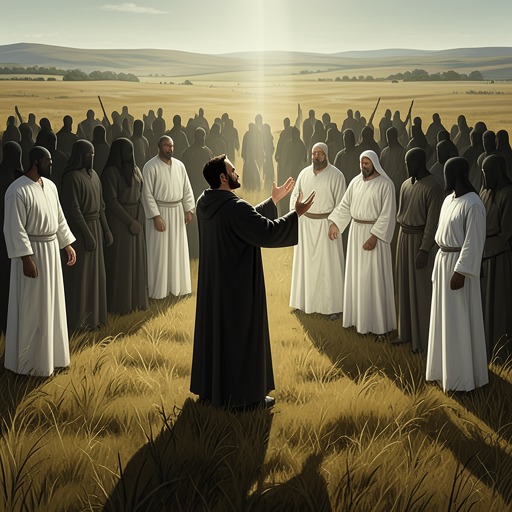
Peter's rebuke
Who's Causing Your TroublePeter's rebuke is the confrontation in which Simon Peter attempts to stop Jesus Christ from going to Jerusalem after Jesus Christ teaches that the Son of man must suffer, be rejected by religious authorities, be killed, and rise again after three days. Although Peter's intervention appears to arise from devotion and a desire to protect his master, Jesus Christ identifies Satan as the force directing Peter's words. The episode therefore becomes a decisive example of spiritual discernment: the visible speaker is Simon Peter, but the deeper opponent is Satan, whose resistance seeks to obstruct the path toward suffering, death, and resurrection.
Context and Immediate Cause
The action occurs before the Crucifixion and Resurrection of Jesus. Jesus Christ has begun teaching his disciples that rejection, death, and resurrection are necessary parts of what lies ahead. His announcement places the disciples before a purpose they do not welcome: the mission will not proceed through avoidance of suffering, but through passing directly into it. Peter responds by taking Jesus Christ aside and rebuking him. To a casual observer, this is the understandable protest of a devoted disciple trying to prevent his master from being killed by enemies.
The narrative's tension arises from the gap between appearance and cause. Peter's words sound like personal loyalty, yet Jesus Christ does not treat them as merely Peter's private judgment. The rebuke threatens to divert him from Jerusalem and from the suffering he has just declared necessary. What looks like protection thus becomes, within the book's interpretation, an attempt to interrupt the divine purpose through an unwitting human instrument.
Jesus Christ Identifies the Hidden Speaker
Jesus Christ's response depends on his ability to see beneath outward behavior. The account emphasizes that he needed no testimony from anyone about human beings because he knew what was in human nature and could read people's hearts. That knowledge allows him to distinguish between the disciple standing before him and the spiritual influence using the disciple's speech.
Jesus Christ therefore turns toward Simon Peter and the disciples and rebukes the real power behind the exchange: "Get thee behind me, Satan...." The command does not simply reprimand Peter for having poor advice. It names Satan as the troublemaker at the root of the conflict. The decisive act in the scene is not Peter's attempt to argue, but Jesus Christ's exposure of the hidden agency directing the argument.
Conflict Between Loyalty and Opposition
Peter's rebuke demonstrates that sincere human feeling can become an instrument of spiritual opposition without the person recognizing what is happening. Peter is not presented here as consciously choosing Satan's cause. Jesus Christ understands that Satan is directing his words, making Peter an unwitting tool of the enemy. The episode consequently separates intention from effect: Peter intends to spare Jesus Christ, while the counsel would obstruct the mission that Jesus Christ has announced.
This distinction also explains why the episode is central to the book's wider teaching. The book repeatedly argues that people, circumstances, disease, and visible agents may be mistaken for the ultimate source of trouble. In the account of Job, losses are attributed in turn to the Sabeans, God, the Chaldeans, and the wind, while the narrative identifies Satan as the mastermind. In the healing of the bent woman, religious leaders see a physical condition, whereas Jesus Christ sees that Satan has bound her for eighteen years. Peter's rebuke follows the same pattern: the surface event is a disciple's protest, but the underlying conflict is between Jesus Christ and Satan.
Consequences for Peter and Spiritual Discernment
The rebuke does not establish that Peter is permanently disqualified. The surrounding teaching explicitly states that failure does not have to be final and recalls that, even after Peter denied the Lord three times, Jesus Christ did not cast him aside. Instead, the Lord restored Peter and gave him the ability to recognize the enemy's work in others. Peter's rebuke is therefore both a moment of failure and part of a larger trajectory of restoration and discernment.
The scene also supplies a model for the reader's response to trouble. The book instructs believers not to treat flesh and blood as the true enemy, but to recognize principalities, powers, rulers of the darkness of this world, and spiritual wickedness in high places. It calls readers to accuse Satan for his part, take authority over him, and refuse to blame God, circumstances, or surrounding people for the trouble in their lives. The confrontation with Peter becomes the narrative demonstration behind that instruction: identify the real troublemaker before judging the visible person through whom the trouble appears.
Narrative and Thematic Significance
Peter's rebuke functions as a revelation scene. Jesus Christ's reply changes the reader's understanding of what has just happened, converting an apparently affectionate disagreement into an instance of spiritual warfare. Its dramatic reversal lies in the discovery that the disciple who seems to defend Jesus Christ is, in that moment, voicing the resistance of Satan. The episode's force comes from this unsettling proximity: opposition does not always arrive wearing an openly hostile face.
The action also makes speech itself consequential. Peter's words are not treated as harmless opinion, because they participate in an attempted redirection of Jesus Christ's course. Jesus Christ's counter-speech, by naming Satan and commanding him to withdraw, restores the proper line between the disciple and the enemy. In the book's broader exhortation, believers are likewise urged to speak directly against Satan and to declare that he is the source of their trouble. The episode thus joins recognition and authority: naming the hidden adversary is presented as the first movement toward overcoming his destructive activity.
Peter's rebuke ultimately concentrates the book's central contrast between misidentification and discernment. A visible human relationship carries the scene, but the decisive relationship is the opposition between Jesus Christ and Satan. The disciple's failure is real, yet it is not final; the enemy's influence is exposed, yet the disciple remains capable of restoration and future service. Through that double movement, the event warns against judging only by appearances while preserving the possibility that a deceived believer can be corrected, restored, and taught to recognize the enemy more clearly.