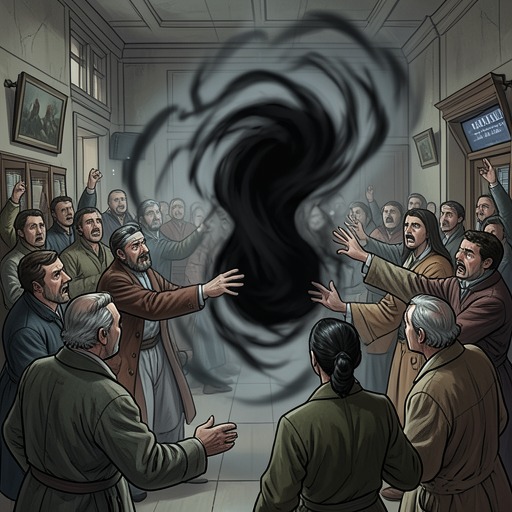
Spiritual wickedness in high places
Who's Causing Your TroubleSpiritual wickedness in high places names the unseen spiritual forces that the book presents as standing behind earthly trouble. Rather than treating human beings, circumstances, bodily symptoms, or natural events as the ultimate enemy, the expression directs attention to a hostile spiritual order that operates beyond ordinary visibility. Its decisive significance is therefore interpretive and practical: identifying the real source of a problem is presented as the first step toward resisting it and receiving release.
Definition and Spiritual Setting
The expression appears within the claim that believers’ struggle is not against flesh and blood. The opposing powers are described as principalities, powers, rulers of the darkness of this world, and spiritual wickedness in high places. “High places” gives the conflict a vertical, spiritual setting, distinguishing it from merely human disputes while placing it among organized powers of darkness.
The book connects this unseen realm with Satan’s activity. Through misuse of his free will, Satan brought sin and evil into the world, and the text treats the resulting evil as an unnatural intrusion rather than part of God’s intended order. Spiritual wickedness in high places is consequently not an abstract force detached from events on Earth; it is the hostile spiritual dimension through which the book explains concrete affliction, deception, destruction, and resistance.
How the Powers Are Recognized
The expression supplies a framework for reinterpreting apparent causes. People may blame other people or the circumstances of life, but the book repeatedly redirects that blame away from flesh and blood. In the account of Job, losses were reported as the work of the Sabeans, the Chaldeans, fire, and wind: oxen and donkeys were stolen, servants were killed, sheep were consumed, camels were taken, and Job’s children died. Yet the narrative identifies Satan as the mastermind behind the devastation, after God allowed him authority to test Job while forbidding him to attack Job himself at first.
This distinction also governs the interpretation of illness. In the healing of the bent woman, the synagogue ruler treated her condition as a purely physical matter and objected to its being addressed on the Sabbath. Jesus Christ looked beyond the visible condition and identified Satan as the power that had bound her for eighteen years. Once the spiritual cause was named, the woman received immediate healing, while the people rejoiced and Jesus Christ’s adversaries were ashamed.
The same interpretive shift affects the book’s treatment of divine responsibility. It rejects the idea that God caused Job’s destruction, even though one report blamed God for the fire that consumed the sheep and servants. The book distinguishes God’s permission from Satan’s destructive agency and warns against explaining harmful events simply as “acts of God.”
Defeat and Hierarchy of Power
Although spiritual wickedness in high places is portrayed as formidable and organized, it is not presented as victorious. The resurrection of Jesus Christ is the central reversal in the book’s account of the spiritual conflict. When Jesus Christ rose from the grave, he stripped Satan and his demons of their power and made an open display of their defeat, triumphing over principalities and powers.
This victory changes the position from which believers confront spiritual evil. A born-again believer is described as being raised and seated with Jesus Christ in heavenly places, a position associated with clearer spiritual perception. From there, the believer is instructed to stop assigning insufficiency and failure to people or circumstances, recognize Satan as the real troublemaker, and take authority over him.
The language of elevation is therefore answered by a language of subjection. The powers are located in high places, but the book says that Satan is under the believer’s feet. The contrast does not erase the existence of spiritual opposition; it establishes the believer’s claimed authority within a conflict whose outcome has already been determined by Jesus Christ’s triumph.
Practical Consequences and Authority
The book turns recognition into a verbal and practical discipline. Readers are told to accuse Satan for his part in their troubles and to say aloud that Satan is at the bottom of the trouble. This spoken accusation is meant to replace the habitual blaming of God, circumstances, or surrounding people. The intended consequence is not merely a changed explanation but a change in conduct: once the true enemy is recognized, the believer can exercise authority and bring the destructive activity to an end.
The framework extends from spiritual diagnosis to restoration. The book presents Satan as a thief who must repay what he has stolen once he is found. Proverbs 6:31 is applied as a promise of sevenfold restoration, and the proposed confession places Satan on notice that the period of stealing is over and that everything taken must be returned, with the text expanding the repayment into seven hundred percent.
Narrative and Theological Significance
Spiritual wickedness in high places is the book’s vocabulary for connecting invisible conflict with visible suffering. It explains why the same adversary can be associated with Job’s economic and familial catastrophe, the bent woman’s bodily bondage, and the general evil that abounds on Earth. It also organizes the book’s recurring contrast between false attribution and spiritual recognition: human agents may appear in the foreground, but Satan is assigned the deeper responsibility.
At the same time, the expression supports a movement from fear to confidence. The spiritual powers are real, active, and capable of producing destruction, but Jesus Christ’s resurrection has publicly defeated them, and believers are urged to see from a heavenly position, name the enemy, and act on the authority given to them. The expression therefore functions not only as a description of evil but as an instruction about perception, speech, resistance, and the expected recovery of what has been lost.