
Roger’s Ascent and Collapse
Why Didn't They Ask EvansRoger builds an identity around charm, inheritance, and calculated deception, then escapes punishment even after his crimes are exposed.
increasing Bearing strength in each event
 decreasing
Bearing strength in each eventdecreasingThe Charming Stranger

The Charming Stranger
A helpful appearance
Roger arrives on the coastal path after the stranger has died and agrees to remain with the body. He tells Bobby that he is a visitor looking for a house.
An identity designed to reassure
His manners and plausible explanation make him seem harmless. He later confirms his house-hunting story to local agents, establishing the respectable surface that protects him from suspicion.
A Family’s Dependent Brother
A Family’s Dependent Brother
A familiar role
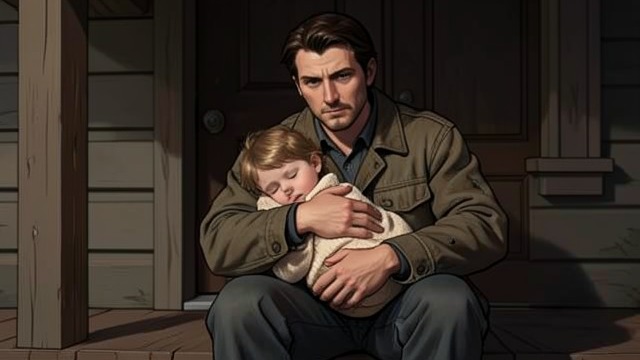
Sylvia describes Roger as a restless family ne’er-do-well who seldom keeps a job. He is affectionate toward Tommy and offers comfort to Sylvia, presenting himself as a valued but irresponsible relative.
Access as an advantage
The household trusts Roger because he belongs within it and appears emotionally generous. His domestic position gives him proximity to Henry, Sylvia, and the family’s vulnerabilities.
A Criminal’s Performance

A Criminal’s Performance
Misdirection by charm
Roger encourages Frankie’s interest while allowing suspicion to settle on Dr Jasper Nicholson. He also makes arguments against the Grange treatment of Henry, appearing more protective than self-interested.
Control through role-playing
His performance is so persuasive that Frankie begins to doubt her original suspicion. Roger’s skill at adopting the role of an innocent family member is central to his ability to continue the plot.
The Captor Unmasked
The Captor Unmasked
A false doctor
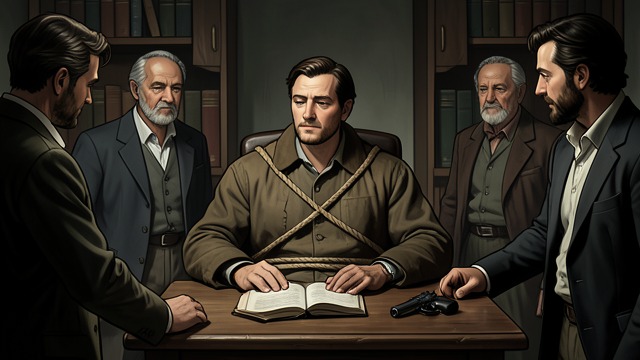
Roger impersonates Dr Jasper Nicholson and threatens to stage a fatal car accident for Bobby and Frankie. Bobby recognizes the imposture from the man’s ears, an identifying detail he noticed while watching the real doctor.
A temporary defeat
Badger helps the captives escape their bonds, and the three overpower Roger. His composure persists even when bound, demonstrating how completely he has made performance part of his identity.
The Fugitive’s Letter
The Fugitive’s Letter
Confession without repentance
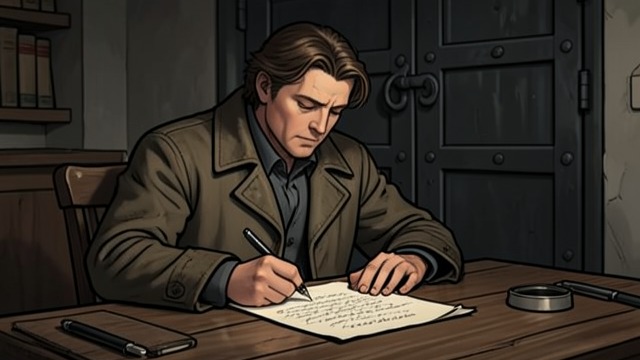
Roger writes from abroad, recounting his crimes and admitting that he wanted money, property, and a larger role for himself. He treats exposure as an obstacle rather than a moral reckoning.
An unresolved ending
He signs the letter as an affectionate enemy and jokes about trying again. The letter supplies the facts needed to understand the case, while Roger’s escape leaves his personal fate unsettlingly open.
On the evening of the cliff death
During Frankie’s stay at Merroway Court
After Frankie’s arrival at Merroway Court
During Bobby and Frankie’s captivity
Several weeks after the final confrontation
