Alan Carstairs
Why Didn't They Ask EvansAlan Carstairs is the man whose death at the cliffs of Marchbolt is first reported as an accident and whose corpse is falsely identified as Alex Pritchard. His effort to investigate John Savage’s suspicious will threatens the people behind the deception; Roger Bassington-ffrench murders him, then manipulates the evidence so that Carstairs’s death initially hides the very identity that could expose the plot.
Identity and the False Identification
Carstairs had recently returned to England after ten years abroad, including time in Siam, and was beginning a walking tour when he fell from the cliffs at Marchbolt. The early newspaper account described the death as a fatal accident in sea mist. It said that a photograph found on the victim had led to his identification as Alex Pritchard, the brother of Mrs Leo Cayman, who travelled to Marchbolt and identified the body. An inquest was due to be held there the following day.
That account gives Carstairs a name only after the mistaken identification has already taken hold. Bobby Jones recalls the haunting face of the photograph, while Frankie Derwent later brings a cutting from her local paper to the Bassington-ffrench household. She describes the dead man as handsome, and the cutting prompts discussion of the accident before she has established his name. At this point, the photograph and public report appear to settle the victim’s identity; in fact, they are the means by which it is concealed.
Frankie’s investigation initially yields little beyond a name: Alan Carstairs. The name matters because it connects the anonymous dead man to people and events beyond Marchbolt, including Moira Nicholson and the will that Carstairs had begun to question. The difference between the reported Alex Pritchard and the real Carstairs turns identification itself into part of the mystery.
Connections and Investigation
Carstairs had known Moira before her marriage. When Bobby asks whether she knew him, she confirms that they had been acquainted and says that Carstairs visited her once, about a month earlier. She had not written to him since marrying, had not told him where she was living, and did not know how he had found her. She also says that her husband did not know of the visit, though she allows that he might have known without telling her.
Their conversation does not establish that Carstairs understood Moira’s later fear for her safety. She says she had not yet begun to suspect danger and had tried to conceal from him that her marriage was unhappy. When Bobby tells her that Carstairs is dead, she pauses, then reflects that this explains why he never returned; she had wondered about his absence. Her restrained response gives Bobby evidence of their past connection without making their relationship, or what Carstairs knew of her circumstances, more certain than her account permits.
Carstairs also consulted Mr Spragge when he was last in England, about a month before the conversation with Frankie. He sought advice concerning Savage’s will. Mr Spragge recalls him as an attractive personality and explains that his legal opinion had been that there was little practical recourse unless Savage’s relatives could afford to contest the matter. He generally preferred settlement outside court rather than litigation without strong prospects of success. This consultation places Carstairs’s interest in the will before his death and shows that he had tried to pursue the question through legal advice.
The basis for his suspicion becomes clear later. Savage had written to Carstairs from aboard ship, mentioning Mrs Templeton and enclosing a snapshot of her. After returning from a shooting trip, Carstairs heard of Savage’s death and the will. He found the story unconvincing: Savage had not seemed preoccupied with dying, Carstairs did not believe he feared cancer, and the will’s wording struck him as unlike a hard-headed businessman. In particular, he doubted that Savage would leave a large sum to a pretty woman and the remainder to charity. The apparently respectable charitable provision, later revealed as Roger Bassington-ffrench’s idea, had helped make the arrangement look less suspicious.
Carstairs came to investigate rather than accept the apparent explanation. He went to Chipping Somerton, failed to locate the former cook Rose Chudleigh, and then tracked down Gladys Evans, learning her married name before setting off for Marchbolt. Roger recognized the danger: if Evans identified Mrs Templeton and Mrs Nicholson as the same person, the scheme could unravel. Carstairs’s inquiries had therefore connected the questionable will to a wider problem of identity and recognition.
Murder and the Switched Evidence
Roger’s later account identifies Carstairs not as the victim of an accidental fall but as the person he deliberately killed. Roger says that he followed him as the mist came up, crept closer, and pushed him over the cliff. The fog that made the death appear accidental also gave the murderer an opportunity to approach unseen.
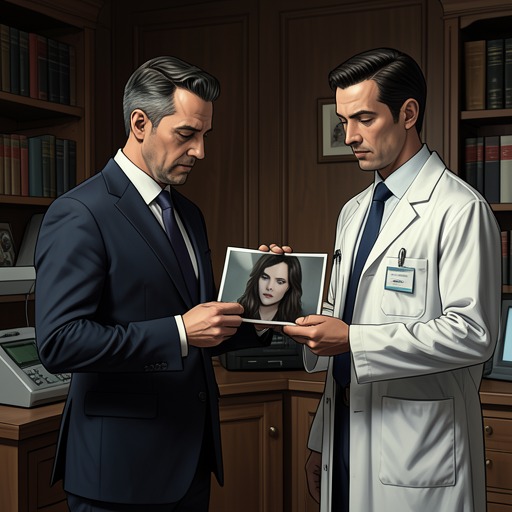
Roger then used the brief interval in which he was alone with the body to remove a photograph of Moira and other letters or identifying material. He says that Carstairs had obtained Moira’s photograph from photographers, presumably so that he could identify her. Roger planted instead a photograph belonging to one of the gang. The photograph publicly associated with the dead man as Mrs Leo Cayman’s likeness was thus not reliable evidence of who he was: the substitution helped make the invented identity of Alex Pritchard seem confirmed.
The false identification appeared to succeed when the supposed sister and brother-in-law came to Marchbolt and identified the body. Roger believed the arrangement had worked, but Bobby Jones unsettled it. Carstairs had regained consciousness before he died and had said something; Roger learned that he had mentioned Evans, who was then in service at Marchbolt Vicarage. The clue survived the attempt to erase Carstairs’s identity and pointed back toward a person whose testimony could threaten the deception.
Narrative Role and Significance
Carstairs’s importance lies both in what he discovers and in how the story initially withholds who he is. The public report supplies a plausible name, a relative, and a photograph, while the person whose investigations could explain the crime remains hidden behind that account. His history emerges in fragments: Frankie finds his name, Moira confirms their earlier acquaintance, Mr Spragge recalls the legal consultation, and Roger’s confession reconstructs the investigation and murder.
His inquiry links Savage’s suspicious will to Mrs Templeton, Moira, and Gladys Evans, while his murder produces the first major crisis of mistaken identity. The photograph is not merely a clue but an instrument manipulated by the criminals: the image that appears to identify the corpse helps divert attention from the dead investigator. Yet Carstairs’s questions and his last mention of Evans leave traces that the plotters cannot fully control. His death removes him as an investigator, but the evidence he leaves behind continues to move the investigation forward.