Henry Bassington-ffrench
Why Didn't They Ask EvansHenry Bassington-ffrench is a country gentleman whose morphia dependence makes him appear volatile and estranged from his family, but his apparent suicide is ultimately revealed as murder. His story moves from a household marked by unease to a treatment plan that Roger Bassington-ffrench exploits, then overturns: Henry agrees to seek help, but Roger kills him and constructs the appearance of suicide.
Identity and First Impressions
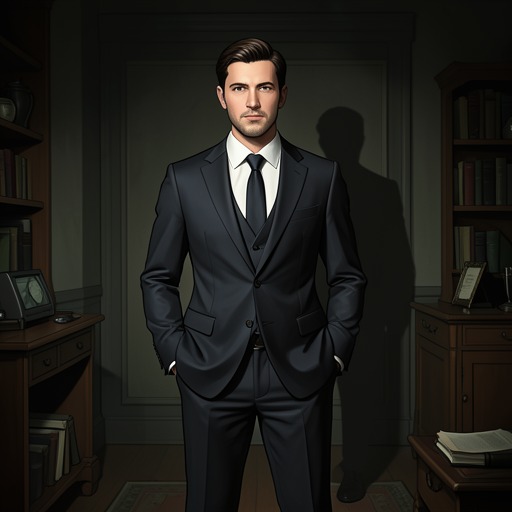
When Frankie Derwent meets Henry, he is described as a large, heavy-jowled man with a kindly yet abstracted air. He spends much of his time shut away in his study. Frankie judges him fond of his wife, Sylvia Bassington-ffrench, while taking little interest in her concerns. This combination of affection and remoteness belongs to the household’s first, outwardly settled picture of him.
That picture grows less reassuring as Frankie observes him more closely. His manner can shift from nervous agitation and abstraction to bitter, sarcastic replies. At dinner, by contrast, he jokes, laughs, and tells stories with a fluency that strikes her as excessive and unlike him. She notices his unsettling eyes, but initially has no reason to identify him as a criminal: it is Roger, not Henry, who has been connected to the fatal events in Marchbolt. The contrast between Henry’s ordinary social performance and his abrupt changes of mood makes him an object of suspicion and concern before the cause is known.
Family Life and Morphia Dependence
Sylvia appears deeply attached to her home and their seven-year-old son, Tommy, whom she adores. Frankie senses that Sylvia is not entirely happy, despite that attachment. Henry’s distance from his wife and his changing conduct give the household an undercurrent of strain, though Sylvia does not at first understand what lies behind them.
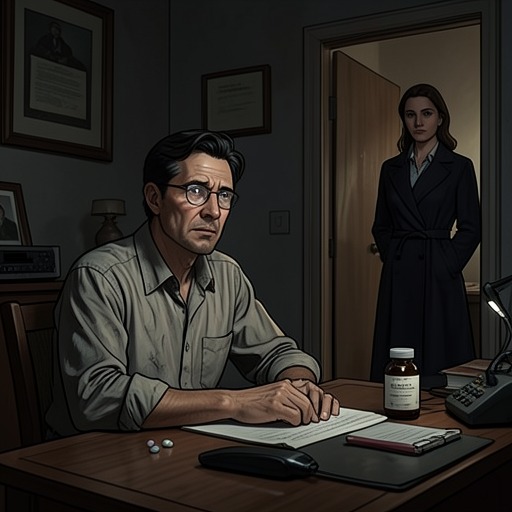
Roger tells Frankie that he is certain Henry is taking drugs. He points to Henry’s appearance and extraordinary shifts in mood, and says his pupils are unusually small. Roger dates the beginning of his suspicions to about six months earlier, when Henry complained repeatedly of sleeplessness. He identifies morphia or another form of opium as the likely cause. Henry’s distress becomes unmistakable when Dr Jasper Nicholson’s treatment of drug dependence is discussed. Although Sylvia speaks of Nicholson’s record of curing patients, Henry reacts with agitation to the prospect of withdrawal and leaves the room. His response suggests personal knowledge of dependence and of the suffering associated with treatment.
Roger presents the question of treatment as a family dilemma. He believes Sylvia does not know about Henry’s drug use and asks Frankie whether she should be told. He argues that a person dependent on drugs may be beyond the influence of even close relatives, while suggesting that Henry might agree to a cure in a moment of remorse. The proposed secrecy is intended to make treatment possible without burdening Sylvia with the truth. Roger first advocates The Grange, a facility run by Dr Nicholson a few miles from the village, partly because Henry likes the doctor. In retrospect, the proposed cure is also connected to Roger’s plans for Henry.
The Treatment Plan and Reversal
Moira Nicholson later tells Bobby Jones that she believes her husband wants to murder her and marry Sylvia. She describes a series of incidents that she regards as deliberate attempts on her life, and fears that Dr Nicholson is arranging for Henry to be admitted to The Grange. She suspects that Henry’s morphia comes through the post and that Nicholson supplies it, though her account at this point is a frightened character’s suspicion rather than the final explanation of Henry’s dependence.
Sylvia eventually learns the truth about Henry’s drug use and goes to speak with him. She tells Frankie and Roger that Henry has agreed to enter The Grange and place himself in Dr Nicholson’s care the following day. Roger and Frankie react with immediate alarm. Roger reverses his earlier recommendation, now saying that The Grange would not be a good choice, even as Sylvia asks whether Henry could overcome his dependence alone. Henry’s agreement is a brief turn toward treatment, but it does not lead to recovery: the plan has brought him within the reach of the people whose intentions are dangerous.
Death and the Staged Suicide
Henry is found dead in his study, and the scene is initially presented as a suicide: he appears to have written a few words before shooting himself. The locked-room circumstances and the written message contribute to that impression. Sylvia is in a near-faint when Roger and Frankie reach the study window; their discovery leaves Frankie expecting to leave that day.
The later account overturns the apparent explanation. Roger admits that Henry did not die by suicide: Roger killed him while Henry was writing in the study. An aeroplane passing overhead gave Roger the opportunity to conceal the sound. He then wrote a false, affecting letter, removed his fingerprints from the revolver, placed Henry’s hand around it, and left the key in Henry’s pocket. Roger locked the study from outside with a dining-room key that fitted the lock, and arranged a timed device in the chimney to go off several minutes later. These details explain how the supposed suicide was manufactured and why the earlier account of a locked room could mislead those investigating the death.
Narrative Role and Significance
Henry’s dependence is both a genuine crisis and a cover that Roger turns to criminal advantage. Roger says that he introduced Henry to morphia after Henry suffered rheumatic pain following an accident in the hunting field; Henry took the drug in good faith and became dependent. Roger’s plan was to have him sent to The Grange, where his death could be made to look like suicide or an overdose, with Moira involved and Roger himself kept at a distance. The eventual killing changes the method but preserves the intended disguise: Henry’s illness and treatment remain central to the appearance of a self-inflicted death.
His character is therefore seen through competing interpretations. To Frankie, his agitation, strange eyes, and sudden brilliance first make him puzzling; to Roger, his dependence becomes a problem to be managed and then an instrument of murder. Sylvia’s late discovery gives Henry a chance to consent to treatment, but that decision cannot undo the plans already set around him. The shift from suspected drug-taking to a staged suicide, and finally to Roger’s confession, makes Henry’s household life one of the story’s clearest examples of how illness can be made to disguise violence.