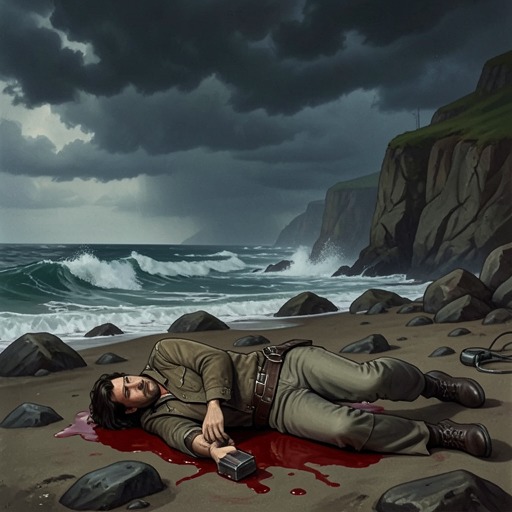
Murder of Alan Carstairs
Why Didn't They Ask EvansThe Murder of Alan Carstairs is the killing that turns an investigation into a concealed-identity case: Alan is pushed from a cliff near Marchbolt, and the criminals manipulate the evidence so that his body is identified under a false identity. The later confession connects the attack to Alan’s pursuit of Evans and reveals how a photograph was used to disguise who had died.
Causes and Background
Alan’s inquiries had brought him close to a threat the criminals could not safely ignore. After failing to trace Rose Chudleigh, he tracked down Evans, learned her married name, and set out for Marchbolt. The speaker who later recounts the murder says that Evans might identify Mrs Templeton and Mrs Nicholson as the same person. Since Evans had been in the household for some time, the criminals also feared she might know more than they could establish.
The confession presents the decision to kill Alan as a response to that danger: he had become, in the speaker’s words, a serious obstacle to the group. The opportunity came when mist rose and the speaker, following close behind, moved nearer and pushed him over the cliff. The account makes the setting and timing instrumental to the crime: Alan was attacked while the mist provided cover, just as his investigation was approaching a potentially revealing witness.
The Killing and the Altered Evidence
Bobby Jones later told Moira Nicholson that Alan had fallen over a cliff at Marchbolt, where Bobby and Dr Thomas had found him. He placed the death about a month earlier, on October 3rd, and said Alan had her photograph in his pocket. Moira’s response suggested that the photograph mattered to her as a sign of Alan’s fidelity, but the later confession reveals that the evidence found with the body had been deliberately changed.
The killer says he was left alone with Alan’s body briefly and used that interval to remove a photograph of Moira and any letters or other identifying material. He then planted a photograph belonging to someone in the criminal group. That substitution turned the killing into a false-identification scheme: the evidence no longer simply accompanied the dead man but was made to point toward a different identity. The pseudo sister and brother-in-law subsequently identified the body, and the criminals initially believed the plan had worked.
Discovery and Consequences
The deception began to unravel because Alan had regained consciousness before he died and had spoken. As Bobby reported, Alan had mentioned Evans, who was actually employed at the Vicarage. The name linked the dead man to the very person whose knowledge had alarmed the criminals, and it made the circumstances of his death harder to contain. The confession acknowledges that Bobby’s account disrupted their confidence and left them rattled.
The murder therefore has two connected consequences: it removes Alan, whose inquiries threatened exposure, but also leaves a verbal clue that survives the attempt to erase his identity. The switched photograph and the false identification delay recognition; Alan’s mention of Evans points back toward the motive. The event’s significance lies in that contrast between physical evidence that the criminals could alter and a final spoken name that they could not prevent from being repeated.