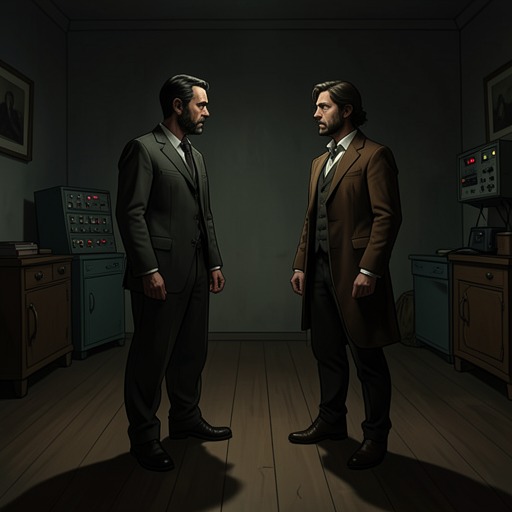
“Someone else’s story” and “the final curtain”
Why Didn't They Ask Evans“Someone else’s story” and “the final curtain” describes Frankie Derwent and Bobby Jones’s theatrical metaphor for their position inside a mystery whose beginnings they have missed and whose ending may be close. The image turns their lack of context into a structural problem: they must act within a plot whose earlier movements are unknown, while trying to understand the clue that brought them into it.
Entering a story midway
Frankie introduces the idea after considering whether an explanation of the photograph might establish an ally and help avert danger to Henry Bassington-ffrench. She says they seem to have entered the middle of “someone else's story.” Bobby agrees that a play is a better comparison than a book: they have walked onto the stage during an act already in progress, have no parts of their own, yet must pretend to belong, without knowing what the first act contained.
The metaphor gives their uncertainty a precise shape. The problem is not merely that they lack a few facts; the decisive earlier history has taken place outside their knowledge. Their present actions therefore unfold inside consequences whose origins they cannot yet see, making the search for what came before essential to understanding the danger around them.
The approaching final curtain
Frankie revises Bobby’s estimate of where they are in the play: she suspects it is the third act, not the second. They need to go back a long way, she insists, and quickly, because the play seems close to its “final curtain.” Bobby adds the grim image of corpses strewn everywhere. Their theatrical language joins two pressures: the case has a hidden past that must be recovered, and the threat of death makes delay dangerous.
They identify the five-word cue that brought them into the mystery as Why didn’t they ask Evans? The question has been a starting point for their involvement, but it remains opaque to them. Frankie observes that, although they have discovered a good deal and encountered more characters, they are no nearer to understanding Evans. The contrast between accumulating information and making no progress toward this figure sustains the sense that they have entered a plot whose central logic is still concealed.
The possibility of an inessential clue
Bobby proposes that Evans may not matter in himself: he may have been only the starting point for the events, rather than their true center. To explain the possibility, he recalls a tale of a prince who builds a magnificent palace or temple around his beloved’s tomb, then orders it removed when the finished structure is marred by one thing—the tomb itself. The analogy reverses the apparent importance of the mystery’s point of origin: a clue can prompt the construction of an elaborate story and still prove inessential to its substance.
Frankie goes further, wondering whether Evans exists at all. The exchange leaves the question unresolved, but it sharpens the expression’s meaning. The characters are not simply missing the opening of a play; they may also be mistaken about which figure, or which clue, belongs at its center. Their metaphors register both the urgency of acting before the final curtain and the difficulty of distinguishing the mystery’s genuine structure from the route by which they entered it.