Dr Jasper Nicholson
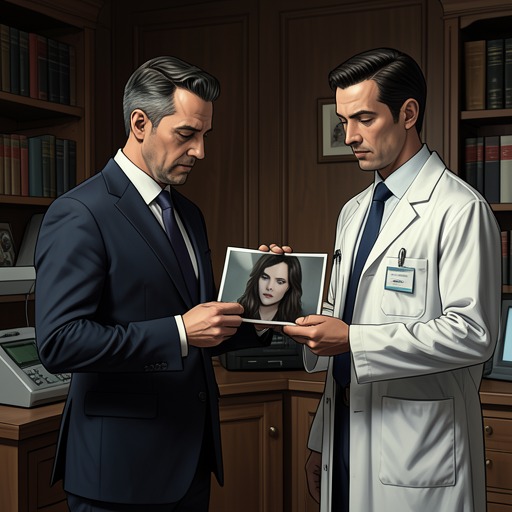
Why Didn't They Ask EvansDr Jasper Nicholson is a Canadian physician who runs a sanatorium for people with nervous disorders and drug dependence. His imposing presence, attention to detail, and association with the treatment of morphia addiction make him a natural object of suspicion; the eventual account, however, separates his medical work from the criminal scheme and reveals that he has been deceived by his wife, Moira Nicholson.
Identity and Introduction
Dr Jasper Nicholson is introduced through the household of Henry Bassington-ffrench and Sylvia Bassington-ffrench, where Roger Bassington-ffrench identifies him as a doctor Henry likes. Roger believes that Henry is taking morphia, judging from his appearance, changes of mood, and unusually small pupils. He considers treatment at Nicholson’s nearby institution as a possible remedy, though he also doubts whether Henry would agree to go. In this early account, Nicholson is presented as a physician whose reputation might offer the family a last resort, not as a suspected criminal.
Sylvia’s description supplies a different, less reassuring impression. She says Nicholson’s institution treats both nervous cases and people who take drugs, and that he has successfully treated patients whose families had lost hope. Yet she admits that she dislikes him, despite finding him attractive and acknowledging his forceful character. Her response is not explained at the time, leaving a gap between his professional reputation and the unease he provokes in her.
At dinner, Frankie Derwent observes a large man whose manner suggests reserves of power. He speaks slowly and says little, but gives his words an air of significance; behind strong glasses, his pale-blue eyes seem reflective. Moira, by contrast, appears slender, pretty, and slightly nervous, talking quickly as if to conceal her unease. These impressions establish a pair whose outward arrangement invites speculation: the self-possessed doctor beside a wife who seems less at ease.
Medicine and the Bassington-ffrench Household
Nicholson’s medical role becomes more consequential when Henry reacts to a discussion of drug treatment. Sylvia praises Nicholson’s successes, but Henry suddenly describes the suffering of withdrawal: a dependent patient cut off from a drug may become severely distressed. He leaves the room shaking. His outburst reveals the intensity of his fear and dependence, but it does not establish that Nicholson has treated him or caused that suffering. The distinction matters: the doctor is associated with a treatment Henry dreads, while Henry’s own condition remains entangled with the private arrangement that Roger has concealed from Sylvia.
Roger had already considered using the possibility of treatment to persuade Henry to accept a cure. He thought Henry might consent during a period of remorse, and that the prospect of Sylvia learning about his drug use could pressure him. He also mentioned that the treatment could be described to her as a cure for nerves. Nicholson’s institution thus enters the family’s affairs through competing forms of concealment: a potential place for treatment, a means of keeping Henry’s dependence from Sylvia, and, in the later criminal plan, a destination to which Henry might be sent under false pretences.
The distinction between treatment and criminal use becomes crucial in Roger’s eventual account. He says that he introduced Henry to morphia after Henry suffered rheumatic pain following a hunting accident, and that Henry became dependent on it in good faith. The plan was then to send Henry to The Grange for treatment, where his death could be made to look like suicide or an overdose. Roger assigns the intended killing to Moira and says he planned to keep himself unconnected. Nicholson’s institution is therefore implicated in the plot as a setting and cover, but the evidence does not make Nicholson its author or accomplice.
Suspicion and Moira’s Account
When Bobby Jones encounters Moira, she identifies herself as Nicholson’s wife and says that her husband wants to murder her. She describes incidents that she interprets as deliberate attempts on her life: a car reversed while she was nearby, and a substance placed in the wrong bottle. She says she has been living on guard against further apparent accidents. Her explanation connects Nicholson to the novel’s recurring pattern of danger disguised as mishap, but at this point Bobby has only her account and no independent confirmation.
Moira further claims that Nicholson wants to marry Sylvia and is arranging for Henry to be brought to The Grange as a patient. She suspects that the morphia Henry receives comes from Nicholson, and imagines that he would use treatment as the route to some further harm. Her allegations draw on real elements of the danger around Henry, including his dependence and the proposed stay at the institution, but misassign responsibility. Later revelations identify Roger and Moira as partners in the scheme and Nicholson as innocent of it. The account does not validate Moira’s stated fear as a reliable description of her husband; instead, it places her claims within the larger pattern of impersonation and concealment.
Frankie also notices Moira’s apparent fear before the truth is known. She tells Roger that Moira always looks frightened and says she believes Moira fears her husband. Roger concedes that he would not want to oppose Nicholson, reinforcing the doctor’s intimidating image without proving that he is dangerous. These reactions show how Nicholson’s appearance and Moira’s performance combine to direct suspicion toward him, while the facts that would clarify their relationship remain withheld.
The Accident and the False Trail
Nicholson’s accuracy first makes him seem a possible threat to Frankie. At dinner he raises a detail of her recent car accident: the doctor who supposedly came to her aid had turned his car, because the message boy had seen no vehicle pass from Staverley and the car’s direction did not match the route it would have taken down the hill. Nicholson reasons that Frankie was unconscious and could not have observed the car’s position herself, then presses her on whether the car had been there earlier. His examination of the evidence is pointed enough to make Frankie uneasy, and she notices a possible emphasis when he says she would always be on the side of law and order.
The scene later gains a different meaning. Roger explains that Nicholson’s questioning about the accident was simply his habit of attending closely to details. The doctor’s observation actually helped Roger recognize that Frankie might not be as uninformed as she appeared. Roger had also overheard her chauffeur address her by name during a telephone call; after noticing these clues, he kept up a deception that encouraged Frankie and Bobby to suspect Nicholson. Nicholson’s precision thus serves two opposing narrative effects: it initially casts him in the role of a calculating investigator, but it also supplies information that exposes the investigators to Roger.
Roger eventually admits that he pretended to be Dr Nicholson partly to see whether he could deceive Frankie and Bobby. He says that they had become convinced the doctor was involved because of his interrogation of Frankie, and that Nicholson’s appearance made him a convenient figure for the disguise. Roger’s performance depends on a distinction the investigation has failed to secure: looking like a scientific criminal and asking pointed questions are not proof of criminal involvement. The false identification turns Nicholson’s conspicuous manner into a tool Roger can exploit.
Marriage, Exoneration, and Narrative Role
The final explanation recasts Nicholson’s marriage as a vulnerability rather than a criminal alliance. Roger says Moira married Nicholson when she was being pursued by American police, thereby moving into a different social world and disappearing from their notice. Nicholson was coming to England to establish a place for nervous patients and was seeking a suitable house to buy cheaply; Moira directed him to The Grange. Roger adds that Nicholson adored her and believed what she told him. In this account, Moira’s connection to her husband gave her respectability and a route into a new setting, while Nicholson himself remained unaware of her criminal work.
This explanation resolves the apparent contradiction between Moira’s accusations and Nicholson’s actual position. She had told Bobby that her husband was planning to kill her and described her vigilance against staged accidents; Roger’s account instead identifies her as his own partner in the crimes. It also clarifies why Nicholson could be close to the plot without being an accomplice: Henry’s dependence and proposed admission to The Grange gave the conspirators a useful opportunity, but Roger says he and Moira planned to exploit that opportunity without Nicholson’s knowledge. His affection for his wife is presented as the reason he believed her, not as evidence that he shared her aims.
Nicholson’s narrative function rests on the difference between medical authority and criminal agency. His sanatorium, his reputation for treating addiction, and his severe manner give other characters reasons to fear or distrust him. Henry’s response to withdrawal and Moira’s allegations intensify that suspicion, while Nicholson’s scrutiny of Frankie appears to make it personal. Yet the explanation overturns the apparent pattern: the doctor’s attention to evidence is a habit, his institution is appropriated as cover, and his marriage leaves him deceived. Nicholson is not the hidden mastermind the clues seem to suggest; he is the credible false suspect around whom the novel’s more deliberate disguises are organized.