Henry Bassington-ffrench’s morphia addiction
Why Didn't They Ask EvansHenry Bassington-ffrench’s morphia addiction is both a private crisis in his family and a vulnerability Roger turns into part of a murder scheme. What first appears to be an illness requiring treatment is eventually revealed as a condition Roger deliberately created and manipulated: he supplied Henry with morphia, promoted the prospect of a cure, and planned to use the treatment setting to disguise Henry’s death.
Onset and Signs
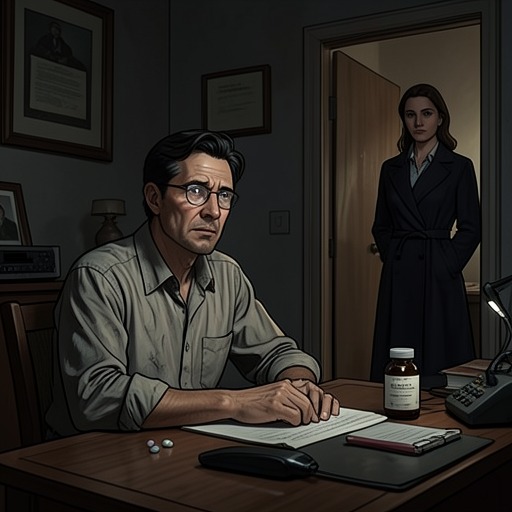
Roger identifies the beginning of Henry’s dependence as roughly six months earlier, after Henry had complained repeatedly of sleeplessness. At first, Roger cannot explain how his brother came to take the drug. His suspicion rests on changes he can observe: Henry’s appearance, pronounced shifts in mood, and pupils that seem unusually small. Frankie has noticed the last of these signs too, lending weight to Roger’s concern without yet establishing how the drug is obtained or who supplies it.
The dependence is also visible in a recurring daily pattern. Roger suspects that Henry becomes especially nervous and irritable at tea time because his supply has run out. After the six o’clock post arrives, Henry goes into his study and later returns to dinner in a markedly different mood, at times displaying an unnatural brilliance in conversation. The contrast suggests that his apparent changes of temperament are linked to access to morphia, while the postal delivery gives Roger a clue about how the supply reaches him.
Family Concern and the Proposed Cure
Roger raises the problem with Frankie because he does not know whether to tell Sylvia. He believes she is unaware of Henry’s dependence and fears that telling her would add another burden to her life. Frankie proposes that Sylvia might be able to influence her husband, but Roger doubts that even a close relative can overcome drug-taking by personal appeal alone. His view is bleak: he thinks Henry would need to agree to treatment.
The proposed treatment is at The Grange, a nearby establishment run by Dr Jasper Nicholson, whom Henry likes. Roger imagines that Henry might accept help during a period of remorse, and that the prospect of Sylvia learning the truth could persuade him to enter treatment. In this account, the addiction is simultaneously a health crisis and a secret that shapes decisions within the marriage. Roger even frames concealment as part of the plan: if Henry recovered, Sylvia need never know.
Sylvia later hears that Henry has broken down and agreed to fight the craving for her and their son, Tommy. Dr Jasper Nicholson has explained the dependence to her as an obsession that can impair a person’s responsibility for his actions. Sylvia says she had not understood what Henry was facing and comes to trust the doctor after he treats her kindly. This confidence contrasts with Roger’s earlier warning about the risks of treatment and leaves Sylvia more willing to accept The Grange as a place of help.
Treatment, Control, and Deception
Henry’s own reaction exposes how frightening the proposed cure seems to him. When the treatment at The Grange is discussed, he becomes visibly distressed and describes the ordeal of abruptly being deprived of a drug to which a person has become accustomed. His outburst unsettles Sylvia, who had understood the institution through reports of patients recovering after other people had lost hope. The scene makes the promised cure less reassuring: treatment may be presented as rescue, but Henry expects it to involve severe mental strain.
Moira Nicholson’s account to Bobby adds a darker possibility. She fears that her husband means to kill her and says that accidents have occurred around her, including a car reversing toward her and a substance placed in the wrong bottle. She suspects that Dr Jasper Nicholson wants to bring Henry to The Grange as a patient, and that something would then happen to him. Bobby notes that Henry takes morphia and that the supply arrives by post. Moira supposes that Dr Jasper Nicholson may be providing it indirectly, then using the treatment establishment to gain control over Henry. These are suspicions, not proof at the point she tells them, and Roger later challenges the weakness of the available evidence against the doctor.
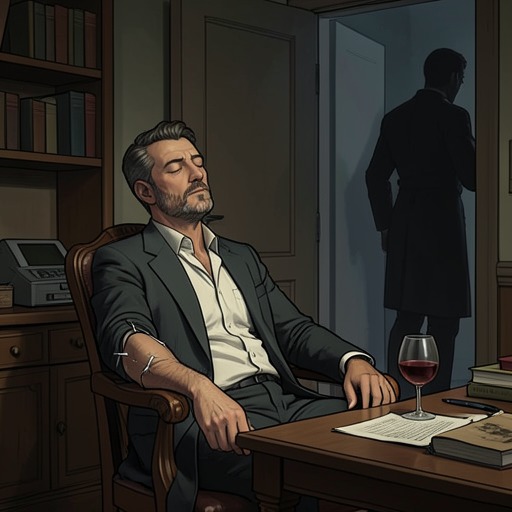
Roger’s eventual confession changes the meaning of the earlier discussion. He says that Henry suffered rheumatic pain after an accident in the hunting field, and that Roger introduced him to morphia. Henry accepted it in good faith and soon became dependent. Roger had intended for him to go to The Grange for treatment, where his death could be made to look like either suicide or an overdose. The addiction was therefore not simply a condition Roger discovered: it was created by him and built into a plan to remove Henry while keeping Roger’s role concealed.
Death and Narrative Significance
That plan does not describe the actual manner of Henry’s death. Roger states that Henry did not commit suicide: Roger killed him after deciding there was no time to waste. He waited until an aeroplane passed overhead, entered the study while Henry was writing, and shot him. He then composed a suicide letter, removed his fingerprints from the revolver, positioned it in Henry’s hand, and arranged the locked-room appearance. The addiction and the proposed treatment had prepared a plausible story of self-destruction, but Roger’s confession reveals murder behind the appearance of suicide.
Henry’s dependence thus performs several roles in the plot. Its visible signs first invite concern from Roger; its secrecy complicates what Sylvia should be told; and the prospect of treatment gives Roger a respectable explanation for bringing Henry under medical supervision. The same condition also makes the staged-suicide explanation credible. The later revelation that Roger introduced the drug forces a re-reading of his earlier concern: he had presented himself as a brother seeking advice while concealing that he was the source of Henry’s dependence and intended to exploit its consequences.