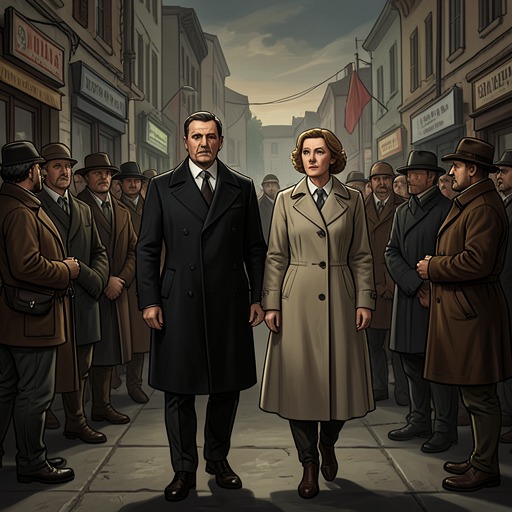
Lord Marchington
Why Didn't They Ask EvansLord Marchington is Frankie Derwent’s father and a source of both comic resistance and practical assistance. His brief appearances reveal a man attached to political opinion, family lineage, and aristocratic connections; those same connections become useful when Frankie investigates the Bassington-ffrenches and arranges a disguise for Bobby Jones.
Identity and Household
Lord Marchington first appears at home reading a political article when Frankie asks whether he knows any Bassington-ffrenches. At first he mistakes the name for a reference to the French and Americans, and diverts into a severe complaint about political conferences wasting the nation’s time and money. His attention follows a familiar track: Frankie has to bring him back to the family name before he properly engages with her question. The exchange establishes both his political preoccupations and the gap between his concerns and his daughter’s immediate purpose.
The household scene also gives his opinions a physical, domestic setting. He has a gouty leg, which hurts when he moves it, and Frankie connects the pain with his free drinking of the family port. His complaints about modern habits and cocktails sit alongside this detail of his own indulgence: the older generation’s disapproval does not mean it is free of its own comforts. The episode presents his manner through conversation and action rather than a formal account of his character.
Family Knowledge and Frankie’s Inquiry
Frankie uses Lord Marchington’s taste for contradiction to draw out what he knows. She asserts that the Bassington-ffrenches are a Yorkshire family, although she does not know which branch might be relevant. He corrects her: there are Hampshire Bassington-ffrenches, a Shropshire branch, and an Irish branch. His knowledge is organized through regional descent and marriage, not simply through a yes-or-no acquaintance with the name.
When Frankie admits she is unsure which branch her supposed friends belong to, Lord Marchington objects that people should ask and establish where they belong. He recalls the older custom of identifying a family branch and tracing a connection through marriage, down to a grandmother who married a second cousin. Frankie answers that there is little time for such genealogical and geographical research in modern life. Their difference gives the investigation a small social contrast: Frankie proceeds with incomplete information and improvisation, while her father imagines identity as something that can be made legible through ancestry and explicit links.
His knowledge also gives Frankie a first lead about the family’s circumstances. Lord Marchington cannot say whether the Bassington-ffrenches as a whole are well off. He has heard that the Shropshire branch has been hard hit by death duties and other burdens, while one of the Hampshire members married an American heiress. Frankie then mentions that one of the family had recently been in the area looking for a house. Lord Marchington finds the idea of wanting a house there strange; Frankie silently recognizes that this is precisely the question worth pursuing. His information is partial, but it supplies branches, financial distinctions, and a local circumstance that help frame her inquiry.
Connections and Practical Assistance
Lord Marchington’s importance to Frankie’s activities becomes more direct when she arranges for Bobby Jones to pose as a junior partner in a solicitors’ firm. She gives Bobby the card of Spragge, Spragge, Jenkinson and Spragge, identifying the firm as her father’s solicitors. Frankie explains that there is no young Spragge: the only Spragge is about a hundred, and she expects to be able to manage him if the impersonation causes trouble. She describes the elderly solicitor as a snob who is especially responsive to lords and dukes. Lord Marchington’s social position thus provides Frankie with access to a professional name and a plausible connection, even though the plan depends on her handling the solicitor herself.
The disguise also draws on the household’s material resources. Frankie hesitates over whether Bobby’s clothes will convince, then proposes raiding her father’s wardrobe rather than risk sending for Badger Beadon. A quarter of an hour later Bobby is wearing Lord Marchington’s morning coat and striped trousers, described as correctly cut and passably fitting. The clothes let Bobby inhabit the outward appearance of a respectable solicitor’s representative; his moustache remains a practical complication, since Frankie notes that a clean-shaven face would look more legal, while Bobby says it cannot readily be removed. Lord Marchington is not shown devising the deception, but his wardrobe and the solicitor’s connection make Frankie’s improvised role possible.
Across these episodes, Lord Marchington is less an independent participant in the investigation than a father whose habits and resources Frankie knows how to use. His insistence on lineage yields useful background; his family’s social standing supplies access; and his clothes give Bobby an immediately recognizable professional appearance. The contrast between his formal, inherited networks and Frankie’s quick improvisation makes his limited presence consequential without suggesting that he knows the full purpose of her scheme.