Arnold of Melchthal
William Tell (P. G. Wodehouse Edition)Arnold of Melchthal is a Swiss spokesman whose willingness to challenge Hermann Gessler gives the opposition to Austrian rule one of its most direct voices. He is introduced as a man supposed to know a great deal about the law, but the encounters that define him make legal knowledge less important than his readiness to speak plainly, endure the consequences, and press the citizens toward action. His left index finger, dipped in hot oil for his protest, becomes both a bodily reminder of the Governor's power and a comic refrain that returns whenever the failed delegation is discussed.
Identity and Selection
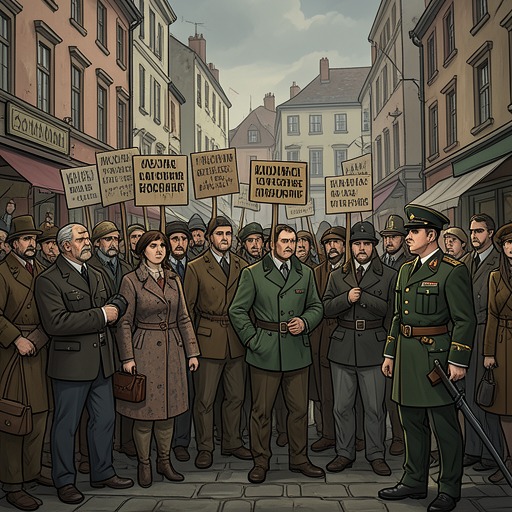
Arnold is one of three citizens appointed to complain to the Governor about taxes. His fellow delegates are Walter Furst, described as red-haired and fierce-looking, and Werner Stauffacher, whose gray hair and uncertainty about how to pronounce his own name receive the narrator's teasing attention. Arnold has light-yellow hair and is said to be supposed to know a great deal about the law. The introductions give the delegation a lightly comic character, but their task is serious: the people of Switzerland have decided that the taxes imposed on them have become intolerable.
The three are shown into the Hall of Audience on a lovely morning in April. The setting places their complaint inside Gessler's formal seat of authority; the citizens must make their case to the very Governor who controls the taxes. At first, Walter is pushed forward because his fierce appearance seems most likely to frighten Gessler. Arnold does not remain a silent member of the party. When the discussion reaches the taxes, he breaks in hastily and begins listing the levies, including taxes on sheep, cows, bread, and tea. The accumulating list conveys the breadth of the grievance more effectively than a single abstract objection could.
The Protest and Its Punishment
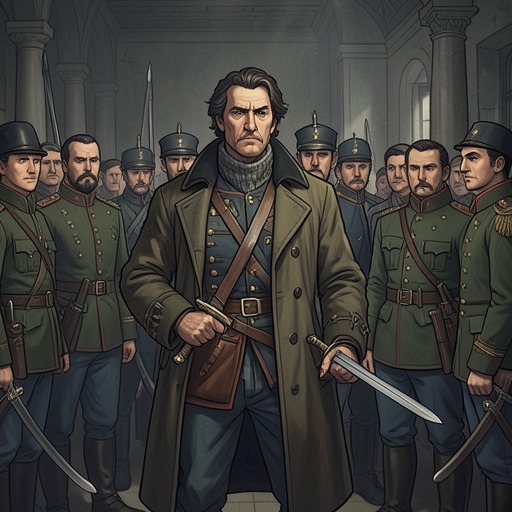
Gessler interrupts the enumeration, saying he knows the taxes and demanding the point. Arnold and the other spokesmen state that there are too many. Arnold then makes the complaint a declaration of resistance: the citizens will not put up with the taxes any longer. His intervention is decisive in tone even though it does not alter the balance of power. Gessler leans forward on his throne and asks him to repeat the remark, turning the protest into an occasion for punishment.
Gessler summons the Lord High Executioner and describes Arnold as a man who dislikes the taxes and refuses to put up with them. The old executioner, dressed in a black robe decorated with death's-heads, is introduced with a manner at odds with his office: he is described as kind-looking and murmurs a mild-sounding response before proceeding. The contrast makes the violence more unsettlingly matter-of-fact. Arnold objects that threatening a man with hot oil is against the law. The executioner replies that Arnold may bring an action against him, then takes his left hand and dips the tip of its first finger into the oil. Arnold cries out and jumps.
The punishment makes the danger of speaking against Gessler concrete: Arnold's protest is answered not with a reasoned defense of the tax system but with pain administered by an official. His appeal to law also sharpens the episode's irony. He is the delegate associated with knowledge of the law, yet that knowledge cannot prevent an act he identifies as unlawful. The executioner's suggestion that he can sue offers no immediate protection; the finger is already in the oil before any remedy could matter.
The Failed Delegation and the Finger's Return
When the delegates recount their interview, Arnold's injury interrupts the account again. Walter describes Gessler as a man with arguments at his fingertips, and at the mention of fingertips Arnold gives a sharp howl. The joke depends on the recent punishment, but it also keeps that punishment present after the men have left the Hall of Audience. Arnold's hurt is not merely a detail of the first confrontation: it shapes the group's later discussion and makes the cost of their failure impossible to forget.
The account of the meeting is that Gessler made the three understand they would have to continue paying the taxes as before. After a long silence, Arnold of Sewa criticizes them for failing and argues that tact was needed when dealing with the Governor. Arnold of Melchthal's finger still hurts, making him a little bad-tempered, and he snaps back that Arnold of Sewa had not succeeded either. The exchange shows him still willing to answer an accusation, but also places his temper in the immediate physical aftermath of the oil. The first delegation has not relieved the taxes, and the citizens' debate over who should speak next turns the failure into a dispute about judgment and tactics.
Despite the renewed criticism, the citizens choose the same three delegates to go to Gessler again. Arnold of Sewa again insists that their lack of tact had irritated the Governor; the others proceed without taking his objection as a reason to replace the original spokesmen. The decision carries Arnold, still marked by the injury, back into the continuing political effort. His recurrence in the delegation is significant: the encounter has hurt him and failed to secure relief, but it has not removed him from the citizens' attempt to resist the Governor.
The Apple and the Call to Act
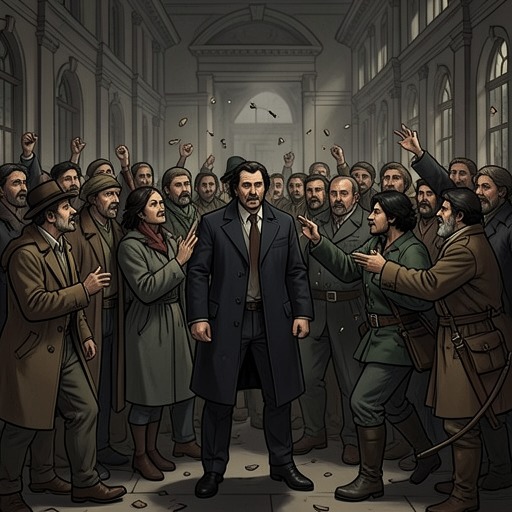
Arnold's most urgent appeal comes later, when the crowd falls back and Walter walks through it carrying the apple after the shooting ordeal. The people watch in silence before whispering among themselves. Arnold turns to Werner Stauffacher and asks whether they will allow such a thing to happen before their eyes. He invokes the oath to rebel and urges the citizens to rise and kill the tyrant. The moment links the public spectacle to the larger resistance: for Arnold, the oath has no force if the people stand by while Gessler acts against them.
Stauffacher answers with the practical danger Arnold's proposal faces: the citizens are unarmed, while the soldiers are armed, and an uprising could leave the rebels dead. Arnold's response is grief and anger at their earlier slowness. He says they should have risen sooner and asks who advised them to delay. Stauffacher had himself advised delay; now he evades naming the adviser, referring instead to the minutes of the last meeting and noting that the motion had carried by a majority of two votes. The exchange places Arnold's demand for action against the group's earlier procedural caution. His urgency is sharpened by the sight of Walter carrying the apple, but the conversation also exposes the practical obstacle that had restrained the citizens.
Character and Narrative Role
Arnold is drawn through a repeated contrast between outspoken resistance and limited power. He can identify the tax burden, refuse to accept it, object to the unlawful threat, and later call for rebellion; none of those declarations immediately changes Gessler's control. The progression from speech to the burned fingertip, then from a painful joke about fingertips to a call for collective action, gives his protest a physical as well as political presence.
His anger is not presented as detached strategy. He speaks hastily in the audience chamber, snaps at Arnold of Sewa while his finger still hurts, and groans over the delay when the crowd watches Walter. Yet the scenes also give his anger a clear object: oppressive taxation and the Governor's power to impose his will. Arnold's role is therefore both comic and consequential. The narrative makes his injury the basis of a recurring joke, while refusing to let the joke erase what it signifies: the cost of open dissent and the unresolved choice between waiting and resisting.