Austrian rule over Switzerland
William Tell (P. G. Wodehouse Edition)Austrian rule over Switzerland frames the story’s conflict as a struggle over who may govern the country and what authority that rule can claim. The era begins under the Emperor of Austria and his governor, Hermann Gessler, and ends with revolt, the collapse of the governor’s fortresses, and Switzerland’s freedom. The account also makes the period a story of memory: an instrument once meant to compel obedience becomes a public memorial of liberation.
Imperial Rule and Its Setting
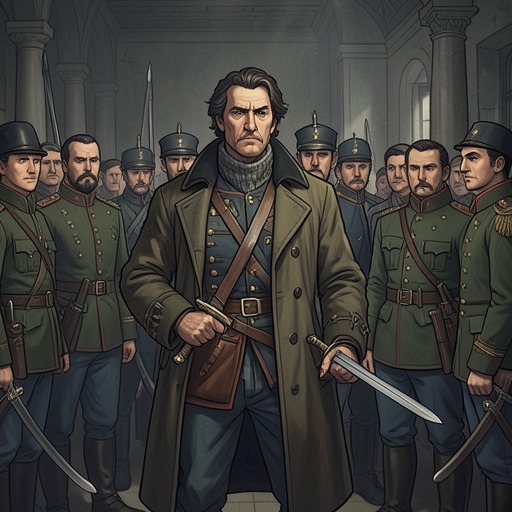
The narrative places the events in a remote, indefinite past, before the first hotel had been built or an English visitor had photographed Mont Blanc and displayed the picture after tea. This comic contrast with modern habits gives the setting the air of a familiar legend rather than a precisely dated history. Within that frame, Switzerland belongs to the Emperor of Austria, who sends his friend Hermann Gessler to govern it.
Gessler’s governorship gives imperial authority a visible local agent. The account describes him as unpopular and makes taxation the chief source of disagreement between governor and people. His power is practical as well as political: as governor, he imposes the taxes he wants, while the Swiss people have little recourse beyond complaint and resistance.
Taxation and Opposition
Gessler’s policy reaches into ordinary livelihoods and daily consumption. A farmer who owns sheep must pay him; selling the sheep and buying cows brings a higher tax. Gessler also taxes bread, biscuits, jam, buns, lemonade, and whatever else he can think of. The narrator presents the Swiss as thrifty and wryly notes that they would rather spend their money on other things, but the accumulating list makes the policy’s reach unmistakable: imperial rule is felt not only in political commands but in the costs attached to food and property.
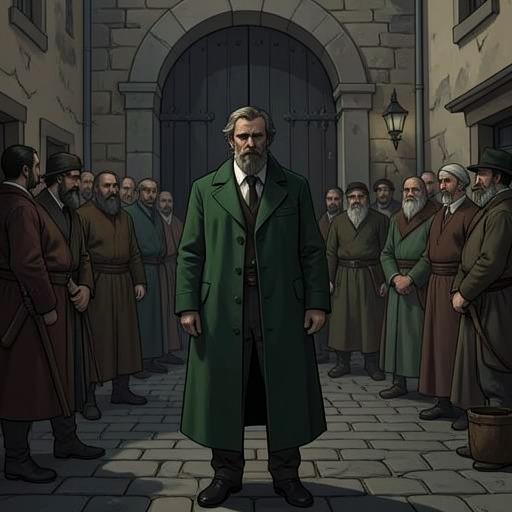
The people eventually appoint Walter Furst, Werner Stauffacher, and Arnold of Melchthal to make their complaint. The delegation visits Gessler on a morning in April and is ushered into the Hall of Audience. Their appeal shows that opposition first takes the form of a formal grievance addressed to the governor himself; the story’s later revolt follows a period in which the governed try to make their objections heard within his authority.
Revolt and the Remaking of Symbols
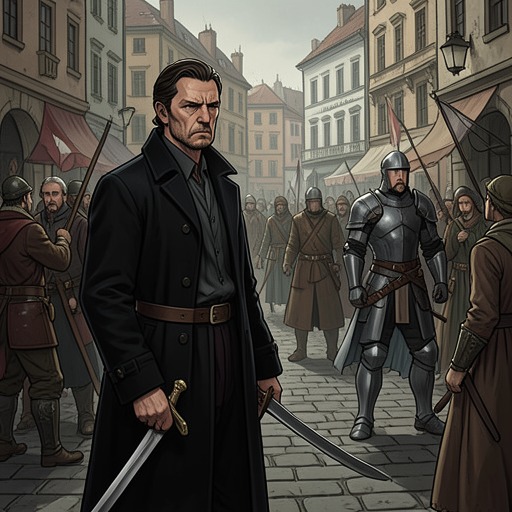
Gessler’s death becomes the signal for a rising that had been brewing for a long time. The people had sworn to drive the enemy from the country, and preparations for revolution had spread across Switzerland, bringing nobles and peasants together. Once news of the governor’s death arrives, meetings take place in every town and the decision is made to begin without delay. That same night, the people take by assault the fortresses Gessler had built during his rule.
The last fortress to fall had only recently been begun. People forced to help build it return to pull down the stones they had labored to put in place; children join them, delighted to break what they choose without being told not to. William Tell watches and remarks that, when these children are gray-haired, they will remember the night as freshly as they remember the following day. The destruction is thus both the undoing of a structure of rule and an event already being imagined as shared memory across generations.
At the Meadow Outside the City Gates, people bring forward the pole Gessler’s soldiers had erected. His hat remains on top, nailed to the wood by William Tell’s arrow—the emblem of an earlier demand for submission. Some call for it to be destroyed, but William Tell argues that it should be preserved as a memorial of newly gained liberty and that the pole should mark the place where the revolution finished. Its meaning has changed: what had been set up to enslave the country is retained to commemorate the end of that oppression.
The End of the Period and Its Legacy
The revolution’s completion does not remove the threat of renewed imperial attack. Arnold of Melchthal asks whether the Emperor of Austria will seek revenge for Gessler’s death and the burning of his fortresses. William Tell answers that an invading force can be met at Switzerland’s few mountain passes and stresses the country’s unity. The account later explains that the Emperor is killed by the lords of Eschenbach and Tegerfelden while riding from Stein to Baden; his bodyguard, separated from him by a stream he has just crossed, cannot come to his aid. His successor is occupied with defending himself against his father’s slayers, leaving the Swiss revolution free to proceed. By the time he can turn his attention to Switzerland, the Swiss are too strong to attack, and they become free.
The closing verse complicates this national account of liberation by observing that some say the tale has been amplified and twisted, while others find it unclear. The narrative therefore preserves the revolution both as a story of collective action and as a legend whose transmission may have altered it. The hat-pole, the children’s remembered night, and the stated freedom of the Swiss people give the period a decisive ending within the story, even as the epilogue leaves the tale’s exact shape open to doubt.