Friesshardt
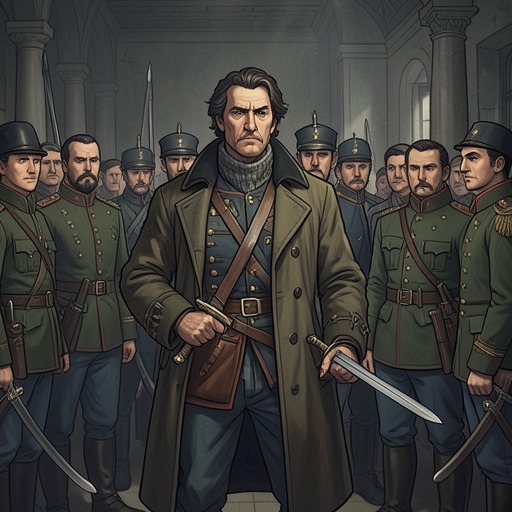
William Tell (P. G. Wodehouse Edition)Friesshardt is a guard in Hermann Gessler’s bodyguard, paired with Leuthold to enforce the order that passersby kneel before a cap displayed on a pole. His role makes the decree’s authority visible at street level: he is not its author, but the soldier expected to turn it into a bodily ritual. The episode presents him as both an enforcer and a comic figure, repeatedly placing the rigid demands of the post against the ingenuity and mockery of the people around him.
Identity and Posting
Gessler stations Friesshardt and Leuthold at the pole in the Meadow Outside the City Gates with instructions to watch throughout the day and ensure that nobody passes without kneeling and removing a hat. The duty is deliberately public. The guards must not merely secure the cap; they are to make each passerby enact submission before it. Friesshardt’s part in the episode therefore begins as surveillance and compulsion, carried out in a place where the population can see both the symbol and the men ordered to defend it.
The townspeople avoid the meadow rather than bow, taking the long way round and leaving the guards with little to do. Friesshardt complains that the meadow, once crowded like a fair, has become a desert. He has also expected the people leaving the council-house at noon to cross the open space. When they do, however, a priest stands before the pole, the sacristan rings a bell, and the group kneels to pray. Their posture resembles the required obeisance, but their stated action is prayer, not homage to the cap. Friesshardt recognizes the distinction as a practical evasion and calls the people artful; his frustration comes from guarding a command whose outward appearance can be imitated without being obeyed.
A Guard Made Ridiculous
The book gives Friesshardt a conspicuous comic voice. Its narrator comments on his poor grammar, and his complaints arrive in repetitive, conversational bursts: he rehearses his failed expectation about noon and returns to the question of why the soldiers are wasting their time. The humor does not erase the coercive nature of his assignment. Rather, it makes the enforcement scene unstable: the guards are armed representatives of Gessler’s authority, yet the people can frustrate that authority simply by choosing another route or finding a religious pretext for kneeling.
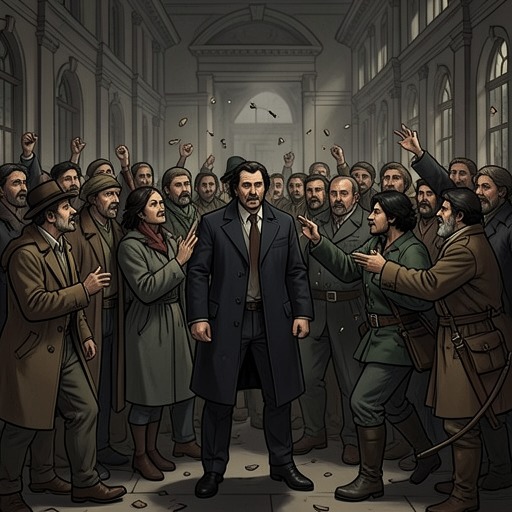
Leuthold suspects that the people are laughing at the guards, and the crowd soon makes its ridicule explicit. Friesshardt and Leuthold stand motionless in their armor and initially ignore the taunts. One heckler calls Friesshardt’s suit a second-hand lobster tin; another says he must be stuffed because he does not answer. The crowd roars with laughter. Friesshardt, who is described as enjoying a joke, nevertheless turns pink. That small reaction distinguishes him from an unfeeling emblem of power: he can take pleasure in humor, but the joke’s target leaves him visibly embarrassed.
The mockery becomes a physical assault. An egg bursts over Leuthold’s shoulder, and the crowd escalates to eggs, cabbages, cats, and other missiles. The two soldiers shout and rave but do not dare abandon their post. Friesshardt’s position traps him between the duty to guard the cap and the danger of remaining within reach of the crowd. When the barrage suddenly stops, the people turn away from the soldiers, leap into the air, wave their hats, and cheer. The abrupt change reveals that the crowd’s attention has shifted to William Tell and Walter approaching the meadow; until then, the guards have been the spectacle.
The Refusal and the Blow
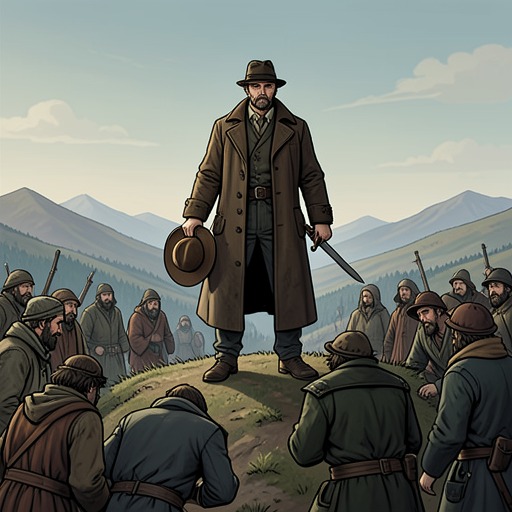
When William Tell and Walter walk past the pole without bowing, the soldiers call after them and insist that they have failed to pay homage. Tell continues with his chin raised; Walter imitates his father. Friesshardt then raises his pike and strikes Tell on the head with all his force. The blow prompts a howl of dismay from the crowd and echoes through the surrounding hills and valleys. In this instant, Friesshardt’s enforcement ceases to be a demand for ceremonial submission and becomes direct physical violence against the man who refuses it.
The disturbance grows beyond the confrontation between the two men. The crowd joins the fighting, and Friesshardt is attacked alongside Leuthold. Tell initially watches with his arms folded: while the quarrel is between himself and Friesshardt, he is willing to fight, but he judges it unfair to help many men attack one, however badly that man has behaved. When he decides the disturbance must end, he draws an arrow and aims at the cap. Friesshardt sees what Tell intends and rushes to stop him. Someone in the crowd hits Friesshardt with a spade, knocking his helmet over his eyes; before he can lift it, Tell’s arrow has passed through the cap and pole. The attack on the soldier thus temporarily disables him, while Tell’s shot destroys the authority-symbol he had been assigned to guard.
Report to Gessler and Narrative Function
After the clash, Friesshardt and Leuthold get up, salute Gessler, and limp toward his horse. Tears run down their cheeks. Asked who called for help, Friesshardt identifies himself and begins a loyal, self-justifying account: he had stood by the pole all day as ordered, told Tell to bow, and struck him on the head to remind him of the requirement. He says that Tell hit him and that the crowd attacked both guards. His version stresses his obedience and the violence done to him, while also admitting that Tell put an arrow through the hat and that Gessler may never be able to wear it again.
Gessler interrupts Friesshardt’s speech to correct his grammar, telling him to say “It was I” rather than “It was me,” then orders him to proceed. The exchange preserves the scene’s comic contrast between the governor’s concern with polished speech and the guard’s rough, stumbling testimony. It does not change the report’s central facts: Friesshardt was ordered to enforce the cap’s authority, Tell refused, and the cap was pierced.
The report also leads directly into the next coercive test. Gessler asks for an apple, and Friesshardt picks up one of the apples lying about after the crowd’s attack; it is bruised from striking his helmet. Gessler says he does not need it for eating and orders William Tell to prepare to shoot it from Walter’s head at a hundred yards, with Tell’s life at stake if he misses on the first shot. The missile that had helped humiliate Friesshardt is thereby turned into the instrument of a far more dangerous demand. Friesshardt does not devise that test, but his report and the scattered fruit connect the failed cap-enforcement episode to the trial that follows. His brief arc is built around this reversal: charged with compelling a public gesture, he ends the scene injured, laughed at, and carrying news of an act of defiance that Gessler answers with a threat against father and son.