Hedwig
William Tell (P. G. Wodehouse Edition)Hedwig is William Tell’s wife, the daughter of Walter Furst, and the mother of Walter and William. In the mountain household she shares with them, she is both a participant in the family’s daily work and the person most clearly alert to the risks gathering around Tell. Her warnings are repeatedly brushed aside, but they give the domestic scenes their tension: while Tell treats danger as part of his nature, Hedwig sees how easily it can reach the family.
Identity and Household
The narrative introduces Hedwig in the family’s chalet high in the mountains, surrounded by snow and edelweiss. She lives there with Tell and their two sons, Walter and William. The portrait of the household places her alongside a husband celebrated for extraordinary skill and daring: Tell is the finest crossbow marksman in Switzerland, accustomed to hunting across ice fields and pursuing Chamois over steep ground. Against this adventurous reputation, Hedwig’s presence establishes the home as a place of ordinary responsibilities and apprehension.
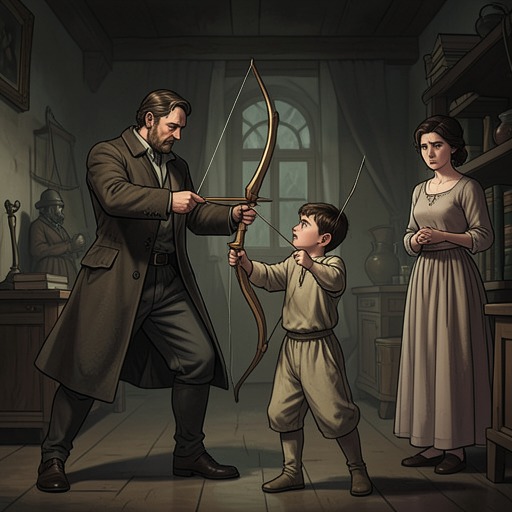
Her practical role appears in the family’s routines. When the boys are playing with a little crossbow, Hedwig is washing up; later, when Tell is sitting at the door mending an axe, she comes bustling out of the house to challenge his approach to their son’s shooting. Her objection is not simply that Walter is young. She argues that a boy should not always want to shoot, and that he ought to stay home and help his mother. The scene makes domestic labor part of her explicit claim: she wants Tell to set a better example, rather than encourage the same pursuits that keep him exposed to danger.
Warnings About Tell
Hedwig’s caution is grounded in Tell’s established conflict with Hermann Gessler. After Tell encounters the Governor in the ravine of Schachenthal, he openly condemns the taxes on bread and sheep and insults him. Gessler is already physically unnerved by Tell’s appearance, and Tell leaves him with a grudge that he is waiting for a chance to repay. When Tell recounts the encounter after supper, Hedwig predicts that Gessler will never forgive him. Tell answers that he will avoid the Governor and assumes Gessler will not seek him out; Hedwig’s reply is a terse insistence that he take care.
Her fears are sharpened by Tell’s chosen occupation. When she later confronts him about his love of adventure, she names the specific hazards she imagines: he could fall from a precipice, be caught in an avalanche, or break through ice while crossing it. Tell answers that he is not made to remain at home and could not be a herdsman; hunting, he says, is his particular aptitude. The disagreement is more than a difference in taste. Tell describes hunting as the line suited to him, while Hedwig sees the physical cost that his self-understanding leaves out. The narrative has already shown him in dangerous terrain and established that his boldness can bring him into direct conflict with the Governor, giving her warnings a concrete basis.
Family Conflict and Political Intrigue
Hedwig’s concern extends to the boys. She objects to Walter’s shooting practice because he is too young, and she would rather see him helping at home. Tell defends early practice as necessary for skill and turns to an anecdote about his own boyhood before Hedwig interrupts. Their exchange shows that the question is not whether Tell can shoot, but what example he is passing on: to him, practice is the beginning of competence; to her, the boy’s constant wish to shoot is itself a problem.
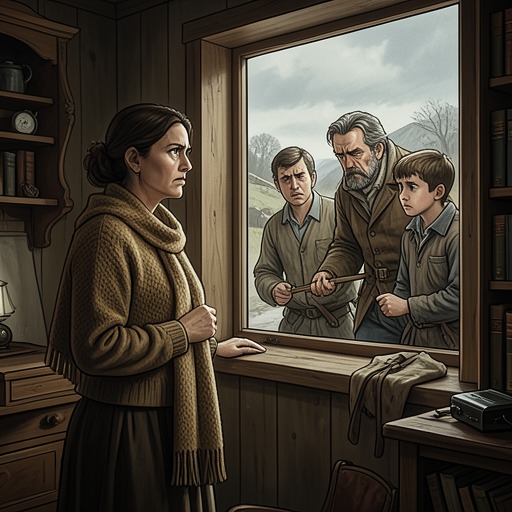
She is also attentive to the political meetings Tell would prefer not to explain. Tell says he is going to town for an appointment with Hedwig’s father and other gentlemen. Hedwig recognizes that Walter Furst has brought Werner Stauffacher and another man to the house, and she remembers that Tell would not let her listen. She suspects a dangerous scheme and identifies it as a plot against the Governor. Tell laughs off her inference, but the scene confirms that she has correctly read the secrecy around the meetings. Her understanding is not presented as participation in the plotting; rather, she is the family member who notices its signs and anticipates its dangers.
The Departure and Narrative Role
Even after recognizing the plot, Hedwig tries to prevent Tell from going. She urges him to send Walter with an excuse, reasoning that the men are sure to place Tell where the danger is greatest. When she adds that Gessler is in town, Tell replies that the Governor will leave that day. Hedwig presses him to wait until Gessler has gone, reminding him that the Governor bears him malice. Tell refuses to delay. He allows Walter to accompany him, while William stays with Hedwig, and she predicts that she will be surprised if nothing bad happens.
The departure leaves her at home with the younger boy while Tell and Walter go toward the very town where her warnings converge: political conspiracy, Gessler’s presence, and Tell’s known antagonism with him. Her predictions do not make her responsible for what follows, nor does the evidence show that she can control Tell’s choice. Instead, her role is to make the risks legible before he accepts them. The contrast between her repeated cautions and his confident dismissal lends the domestic scenes a measure of foreboding, while her recognition of the secret plot shows that she is not merely a voice of household anxiety but an observant reader of the political situation.